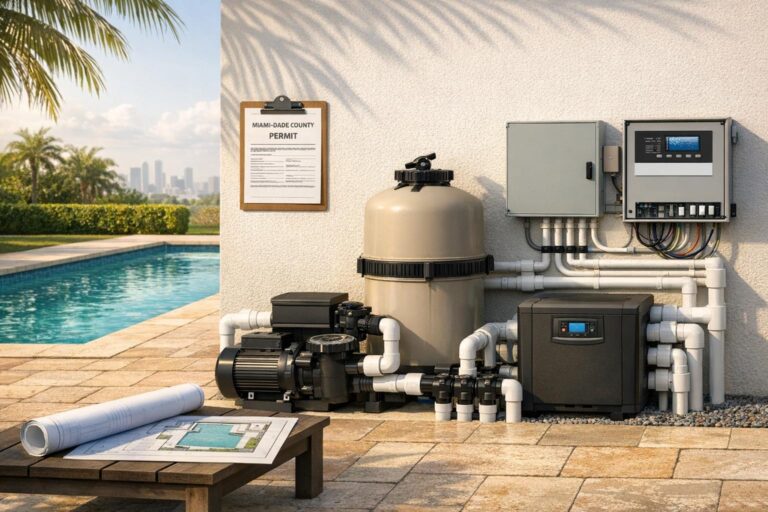
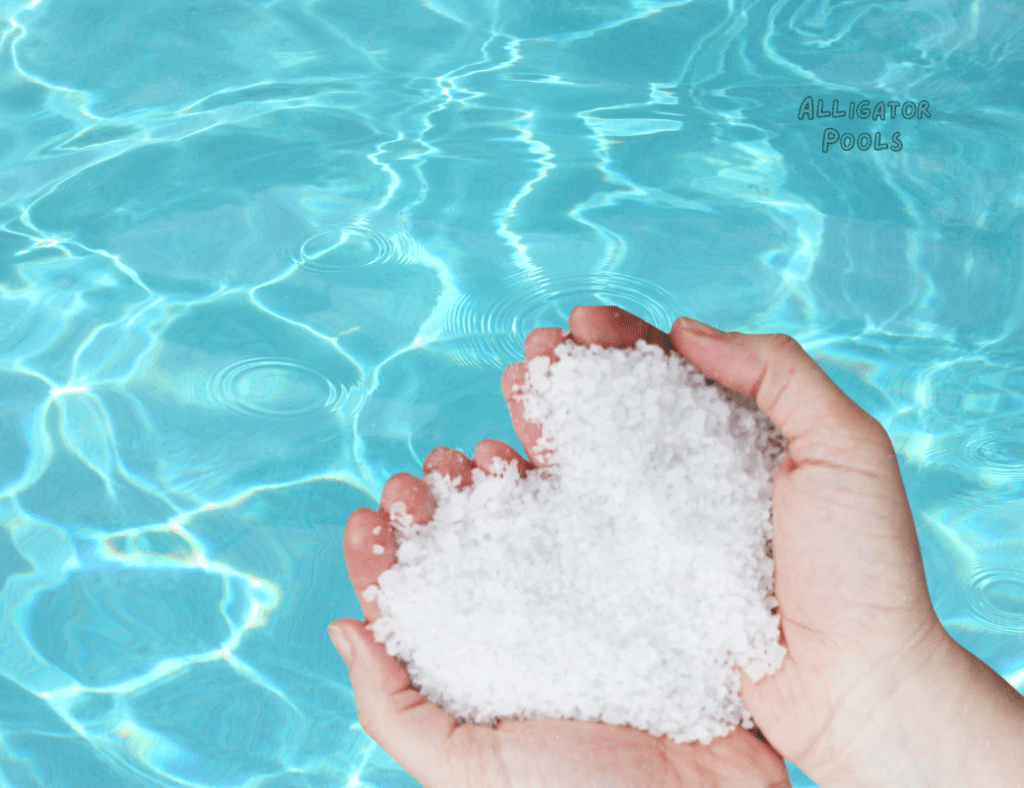
Thinking about a salt system for your Kendall or Miami-Dade pool? This guide explains how saltwater chlorination works, why homeowners choose it, how to size and operate it, and the maintenance required to keep everything running smoothly year-round.
Overview of Salt Systems: Saltwater Chlorinators & Salt Chlorine Generators
Saltwater pools—powered by saltwater chlorinators or salt chlorine generators (SWGs)—have surged in popularity across Kendall and Miami-Dade. The appeal is simple: smoother water feel, fewer harsh odors, consistent sanitation, and easier day-to-day care than manually dosing chlorine.
In this guide, we break down how salt generators sanitize water, where they shine, how to size them correctly for South Florida’s climate, and the routine maintenance that keeps everything running smoothly. If you’re considering a switch, we can help from product selection through long-term pool maintenance.
Understanding Salt Chlorinator Systems in Kendall
A salt chlorinator system—also called a saltwater chlorinator, salt generator, or simply a salt system—is a sanitation method that produces chlorine on site from dissolved salt (NaCl). The water in a salt pool has a mild salinity (far below ocean levels) and passes through an electrolytic cell that converts chloride ions into free chlorine to sanitize the water.
Salinity Targets vs. the Ocean
| Water Type | Typical Salinity (ppm) | Notes |
|---|---|---|
| Ocean water | ~35,000 ppm | Salty taste, stings eyes |
| Salt pool (SWG) | ~3,000–3,500 ppm | Gentle on skin/eyes; many swimmers can’t taste the salt |
| Human tear fluid | ~7,000 ppm | Comfort reference point |
Bottom line: a salt pool is far less salty than the ocean—closer to “silky” than “salty.”
Advantages of Salt Water Pool Systems
Smoother, More Comfortable Water
- Gentler on skin, hair, and eyes
- Less “pool smell” around the deck
- Protects swimwear colors better than high-dose manual chlorination
Consistent, Even Sanitation
- Chlorine is produced steadily while the pump runs
- Fewer harsh “shock and crash” cycles
- Lower risk of algae when dialed in
Lower Handling of Chemicals
- No lugging heavy chlorine jugs weekly
- Simple top-ups of pool salt as needed
- Still test water regularly—automation reduces labor, not water care
Surface & Equipment Friendly
- Stable chlorine delivery reduces surface stress
- With balanced chemistry, scaling and corrosion are manageable
- Pairs well with variable-speed pumps for energy savings
How Do Salt Systems for Pools Work?
Salt systems operate on a straightforward electrochemical principle: dissolve the right amount of salt into the pool, circulate that mild saltwater through an electrolytic cell, and generate free chlorine onsite.
The Electrolysis Cycle (Accurate Chemistry)
- Dissolved salt (NaCl) provides chloride ions (Cl⁻) in the water.
- In the cell:
- Anode (positively charged plate): chloride ions are oxidized to chlorine gas (Cl₂).
- Cathode (negatively charged plate): water is reduced, producing hydrogen gas (H₂) and hydroxide (OH⁻).
- In the pool water: chlorine gas dissolves and forms free chlorine (primarily hypochlorous acid, HOCl, and hypochlorite, OCl⁻) that sanitizes the water.
- Recycling: after disinfecting, chlorine eventually converts back to chloride; the cycle repeats as the cell runs.
Sodium ions (Na⁺) remain in solution; the useful product is free chlorine created from chloride ions at the anode.
How Long Does a Pool Salt System Take to Make Chlorine?
Salt systems only generate chlorine while water is flowing through the cell. Output depends on your pump runtime and the controller’s output %.
Typical South-Florida Run Patterns
- Spring/Fall: ~8–10 hours/day (moderate bather load)
- Summer: ~10–14 hours/day (heat + heavy use = higher demand)
- Winter: ~6–8 hours/day (cooler water = lower demand)
Example Duty Cycle
If you run the pump 10 hours/day at 50% output, the cell actively generates chlorine for ~5 of those hours. Increase either runtime or output % to boost production—and vice versa.
Why Your Pool May Need More (or Less)
- Big swim parties, hot sunny days, or lots of leaves/debris = more chlorine demand
- Shaded pools, cooler temps, minimal bather load = less demand
- Always verify with a reliable test kit; adjust runtime/output accordingly
Components of a Salt Chlorine Generator
The Cell
Contains coated metal plates (often ruthenium/iridium-coated titanium) where electrolysis happens. It wears over years of use and will eventually require replacement. Keeping the cell clean maximizes lifespan.
The Control Module (Power Center)
The “brain” that powers the cell, sets the output %, reads sensors (flow, salt), and may integrate with pool automation. Many modern systems support remote monitoring and simple controls.
Flow & Salt Sensors
These confirm safe operation (adequate flow) and proper range (salt ppm). Low or high salt conditions reduce performance and can trigger alerts.
Sizing & Selecting the Right System
In Kendall’s heat, it’s smart to oversize slightly. A unit rated for at least 1.5× your pool volume gives headroom for summer peaks.
What We Consider When Recommending a System
- Pool volume: gallons/liters
- Sun exposure & water temp: hotter, sunnier pools need more output
- Bather load: families, parties, pets = more chlorine demand
- Surface & equipment: plaster/pebble, heaters, water features
- Electrical & pad layout: clean install and service access
- Automation: need for app/remote integration
Initial Salt Addition
Most systems target ~3,000–3,500 ppm. To estimate the salt needed from zero, use:
pounds of salt ≈ (target ppm × pool gallons) ÷ 12,000
Already have some salt? Test first and only add what’s needed to hit the manufacturer’s window.
Maintaining Your Pool’s Salt System in Kendall
Salt pools are easier, not “set-and-forget.” Routine water care still matters.
Weekly/Regular Tasks
- Test and balance: FC (free chlorine), pH, TA, CYA, and salt ppm
- Empty skimmer/pump baskets and maintain strong flow
- Brush walls/steps; keep surfaces clean to reduce demand
- Verify output % is keeping FC in range (commonly 2–5 ppm for many residential pools; follow manufacturer/local guidance)
Cell Inspection & Cleaning
- Open and visually check for scale (white crust on plates)
- Clean per manufacturer instructions—usually a dilute acid bath only when necessary (over-cleaning shortens life)
- If scale forms often, revisit pH/TA/calcium balance and flow
Seasonal Adjustments (Miami-Dade)
- Summer: increase runtime or output % to match heat, sun, and swim load
- Winter: reduce output; cold water slows chlorine demand and production
If you’d rather delegate the upkeep, we offer tailored pool services for salt systems—testing, tuning, and preventative care.
Common Issues & Troubleshooting
“Low Salt” or “High Salt” Alerts
- Confirm with an independent salt test (don’t rely only on the panel)
- Adjust in small increments; retest before adding more
“No Flow” or Weak Flow
- Clean baskets/filter, verify valves and water level
- Check that the flow switch and cell orientation follow the manual
Low/No Chlorine Reading
- Verify pump runtime/output %; increase temporarily and retest
- Test/adjust CYA (stabilizer)—too low and sunlight burns off chlorine
- Heavy bather load or organics may require a temporary liquid-chlorine boost
Scaling & Rapid pH Rise
- Maintain pH ~7.4–7.8 and TA in the recommended range
- Consider lowering TA slightly and using borates (if compatible) to stabilize pH
End-of-Life Cell
- Cells have a finite output life (often 8,000–10,000 operating hours)
- When output won’t hold despite correct chemistry and runtime, plan a replacement
Costs, Lifespan & Ownership
Upfront & Ongoing
- Equipment: generator + cell + installation
- Salt: inexpensive; mainly a one-time startup plus occasional top-ups
- Electricity: modest—units draw little; runtime is tied to your pump
- Cell replacement: expect eventual replacement after years of service
Where Savings Come From
- Fewer trips purchasing chlorine products
- Steadier water quality → fewer rescue chemicals
- Time saved by automation
Safety Notes & Common Myths
- Myth: salt pools are chlorine-free. Reality: salt systems make chlorine from salt—same sanitizer, smoother delivery.
- Myth: salt ruins everything metal. Reality: at ~3,000–3,500 ppm, with correct water balance and bonding/grounding, modern pools do well.
- Note: follow manufacturer clearances/orientation and local electrical codes for a safe, reliable install.
When a Salt System Isn’t Ideal
- Very small spas with extremely high temps and splash-out
- Installations where local codes or specific surfaces/metals are not compatible
- Situations where the owner cannot maintain basic chemistry (any system needs this)
Not sure? We’ll assess your site and advise honestly.
Final Thoughts: Saltwater Systems for Kendall & Miami-Dade Pools
Salt systems deliver soft-feeling water, stable sanitation, and simpler routines—ideal for South Florida when sized and maintained correctly. If you’re weighing the switch, our team can spec, install, and fine-tune the right solution for your pool—and keep it humming with scheduled pool maintenance services or comprehensive pool services.
Salt System FAQs
Are saltwater pools really gentler?
Yes. With lower salinity than the ocean and steady chlorine production, most swimmers report softer water feel and fewer eye/skin complaints.
Do I still need to test and balance?
Absolutely. Salt systems automate chlorine generation, not total water care. You still monitor pH, TA, CYA, calcium, and salt ppm.
What salinity should I target?
Follow your manufacturer window—commonly ~3,000–3,500 ppm. Always test before adding salt; add in small increments.
How long does a cell last?
Many cells last several years (often 8,000–10,000 run hours). Lifespan depends on runtime, output settings, and water balance.
Will I still ever “shock” the pool?
Occasionally, yes—after heavy use or storms you may supplement with liquid chlorine to quickly raise FC, then let the SWG maintain.
Do salt systems raise pH?
They can trend pH upward. Regular acid additions and dialing in TA/borates (if compatible) help stabilize pH.
Is a salt pool better for surfaces and equipment?
When chemistry is kept in range and bonding is correct, salt pools perform very well and avoid the hard swings of manual dosing.