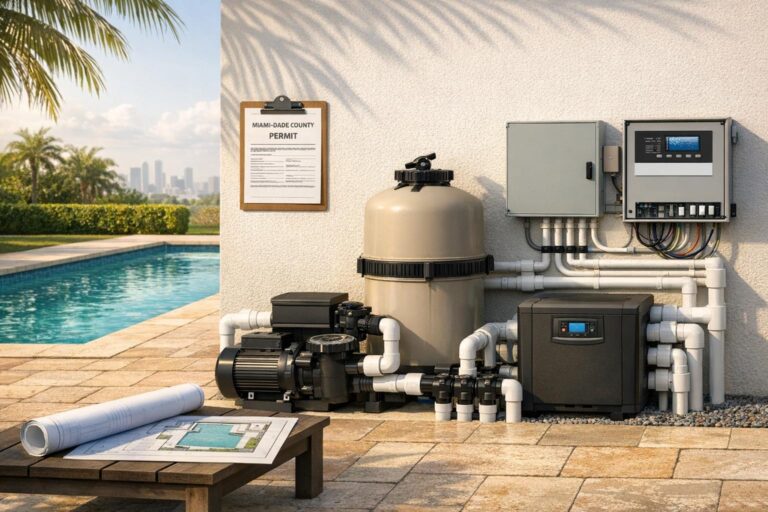

In Miami-Dade County, knowing the difference between a licensed pool contractor and a pool cleaner is essential to avoid legal and financial risks. Pool cleaners handle routine maintenance like cleaning and balancing water chemistry but cannot perform repairs, install equipment, or make structural changes. Licensed pool contractors, however, are qualified to manage construction, repairs, equipment installation, and structural work, all of which require permits and compliance with Florida Building Code regulations. Hiring unlicensed workers for contractor-level tasks can lead to fines, liability for damages, and voided warranties.
Key Differences:
- Pool Cleaners: Focus on cleaning, water testing, and chemical adjustments.
- Licensed Contractors: Handle structural repairs, resurfacing and remodeling, equipment installation, and electrical work.
If your pool needs repairs, equipment upgrades, or structural fixes, always hire a licensed contractor to ensure safety, compliance, and long-lasting results.
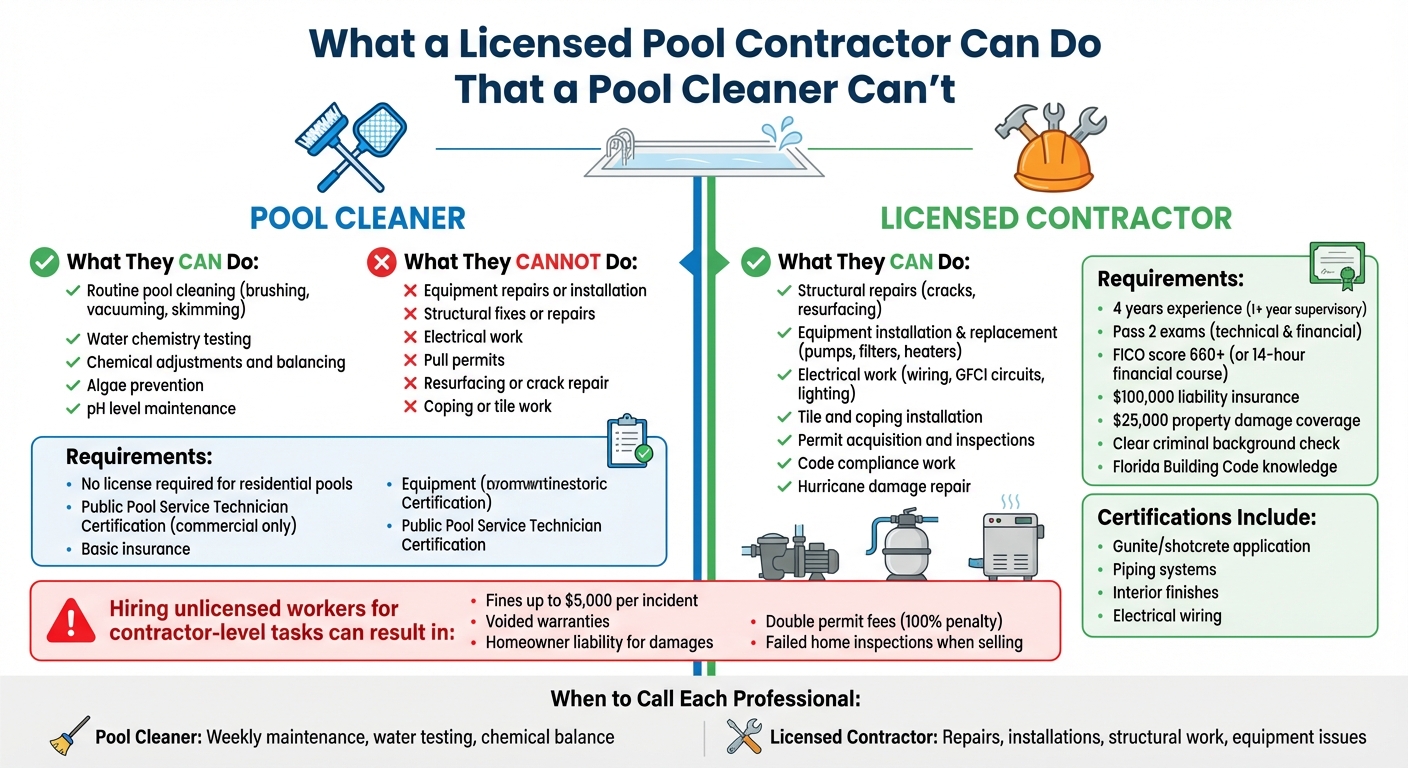
Pool Cleaner vs Licensed Contractor: Key Differences and Responsibilities
Licensing and Professional Qualifications
Florida Licensing Requirements for Pool Contractors
In Florida, the Construction Industry Licensing Board (CILB), operating under the Department of Business and Professional Regulation (DBPR), enforces strict rules for pool contractors. To qualify for a license, contractors must meet several criteria: four years of experience (including at least one year in a supervisory role), successful completion of two exams covering technical and financial topics, a minimum FICO score of 660 (or a 14-hour financial course for lower scores), liability insurance of at least $100,000, property damage coverage of $25,000, and a clear criminal background check. These requirements set licensed contractors apart from pool cleaners, who do not face such stringent regulations.
"A licensed person has the required education, experience, insurance and qualifications to obtain a license. They must pass a competency examination before practicing." – Florida Swimming Pool Association [1]
For pool cleaners, the rules are far less demanding. Those working on residential pools are not required to hold a license. However, commercial pool technicians must obtain a Public Pool Service Technician Certification from the Florida Department of Health. Even so, this certification does not permit them to handle structural repairs or install equipment.
Training and Skill Differences
Licensed pool contractors undergo extensive training to meet high technical standards. Their education spans multiple disciplines, including layout design, piping, excavation, electrical wiring, and equipment installation. They are also expected to stay current with the Florida Building Code, which is updated every three years (currently the 8th Edition 2023), and adhere to ANSI/PHTA standards for pool design and construction.
Additionally, contractors often earn certifications in specialized areas like gunite/shotcrete application, piping systems, decking, and interior finishes. This training ensures they are qualified to handle complex tasks, such as managing electrical wiring on the load side of the dedicated disconnect [1].
sbb-itb-a36f8f1
Structural Repairs and Pool Renovations
Resurfacing, Crack Repair, and Coping Work
In Florida, structural pool repairs – like resurfacing, crack repairs, and tile or coping installation – are strictly the domain of licensed contractors [1]. While pool cleaners can handle routine maintenance such as brushing and balancing chemicals, they are not permitted to touch the structural aspects of a pool.
Licensed contractors carry specialty certifications for tasks like tile and coping installation, interior finishes (such as plastering), and structural work involving materials like gunite or shotcrete. These licenses ensure that repairs are done safely and in compliance with local regulations [6]. Hiring an unlicensed worker not only risks subpar results but could also leave you liable for legal or financial consequences [1].
Certain warning signs indicate the need for professional intervention: cracks wider than 1/8 inch, hollow sounds suggesting delamination, rough surfaces, or unexplained water loss [7]. In Miami-Dade, traditional white plaster typically lasts about five years due to heavy use and warm water, while modern finishes like Diamond Brite can hold up for 7 to 10 years [4]. For those seeking long-term durability, high-end glass tile installations, when done properly, can last 20 to 30 years or more [4].
These repair and renovation needs are directly influenced by Miami-Dade’s unique weather, which demands specialized methods and materials.
Handling Miami-Dade County Weather and Environmental Factors

Miami-Dade’s challenging climate plays a significant role in pool wear and tear, necessitating repair techniques tailored to the region. Intense UV rays, high humidity, salt-laden air, and frequent storms all accelerate the aging process of pool materials. Licensed contractors use materials and methods specifically designed to withstand these conditions – something routine maintenance alone cannot address.
Timing is also critical for resurfacing projects in South Florida. John Chavez, Founder of Sublime Pools & Spa, explains:
"In South Florida, October through February provides perfect weather for curing new surfaces" [7].
During these cooler months, contractors can avoid the rapid curing that often leads to cracks. They also apply specialized bond coats and primers designed for Miami’s warm, humid conditions to ensure proper adhesion [4]. After storms, protective waterline tiles may be added to guard against staining [4]. These technical considerations highlight why many pool owners wait until problems arise before addressing repairs, making the expertise of a licensed contractor indispensable [7].
Equipment Installation and Replacement Services
Equipment Services That Require a Licensed Contractor
In Florida, the law mandates that only a licensed swimming pool and spa contractor can handle the repair, installation, or replacement of pool and spa equipment [1]. This includes essential components like pumps, filters, heaters, and lighting systems. For larger installations – such as pumps exceeding 1.5 HP or heaters over 250,000 BTU – a Certified Pool Contractor (CPC) is required [8]. For reference, single vs. variable-speed pumps typically cost between $800 and variable-speed pumps typically cost between $800 and $1,600,600, while saltwater systems range from $1,500 to $2,800. Electrical work, such as installing GFCI circuits, can cost anywhere from $1,800 to $3,200 [8].
Licensed contractors are also responsible for electrical connections. They handle wiring on the load side of the dedicated disconnect, which includes pumps, lighting, and equipotential bonding. The Florida Swimming Pool Association explains:
"A swimming pool and spa contractor is allowed to install, repair and replace swimming pool and spa equipment and wiring, including equipotential bonding, on the load side of the dedicated electrical disconnect" – Florida Swimming Pool Association [1].
For gas-powered heaters, additional credentials are required, such as a Category V LP Gas Installer license [1]. Other tasks, like LED lighting upgrades, skimmer replacements, and installing Safety Vacuum Release Systems (SVRS), also demand the expertise of a licensed contractor [3][8]. In fact, in 2022, the Florida Department of Business & Professional Regulation issued 37 citations to general contractors for unauthorized pool plumbing work. These violations carried fines of up to $5,000 per incident [8].
These regulations are in place not just for safety but also to optimize equipment performance and durability.
Benefits of Professional Equipment Installation
The strict licensing requirements bring added benefits when you opt for professional installation. Licensed contractors carry public liability and property damage insurance – typically ranging from $100,000 to $300,000 – protecting homeowners from liability for injuries or property damage on-site [1][10]. They also ensure compliance with Florida Building Code standards, such as proper PVC piping depth and hydraulic flow, which help prevent equipment strain [8]. Additionally, licensed professionals secure the necessary electrical and plumbing permits, oversee inspections, and leave work exposed until it passes official approval [3][9].
Another critical advantage is maintaining manufacturer warranties. Improper installation by unlicensed individuals can void these warranties, leaving you unprotected. The Florida Swimming Pool Association cautions:
"Non-licensed contractors may not be insured, leaving you liable for any injuries or damages" – Florida Swimming Pool Association [1].
Professional installation also improves energy efficiency. Contractors ensure pumps run at optimal flow rates, heaters maintain correct combustion ratios, and electrical connections meet safety standards. These details can directly affect energy bills and extend the lifespan of your equipment. Miami-Dade County strongly advises against unqualified work:
"Never allow pool maintenance workers to perform electrical work. It is dangerous, illegal and can be fatal" – Miami-Dade County [3].
With the demanding pool environments in Miami-Dade County, professional expertise is not just a luxury – it’s a necessity to ensure safe, efficient, and long-lasting equipment operation.
Building Codes and Safety Compliance
Permits and Inspection Requirements
Licensed contractors in Miami-Dade County play a key role in navigating the permit and inspection processes required for pool projects. Whether it’s a pool renovation or installing new equipment, permits are a must – and only licensed contractors or owner-builders can secure them for construction, structural repairs, or replacements of mechanical, electrical, or plumbing (MEP) systems [9]. This process involves submitting approved design plans that comply with the Florida Building Code (8th Edition) and Miami-Dade County regulations.
Additionally, pool projects often require permits for specific trades like electrical and plumbing work [3]. Contractors handle these permits and coordinate mandatory inspections, whether conducted onsite or virtually, ensuring all work remains accessible until it passes final approval [11]. In fact, Miami-Dade County has introduced virtual inspections for certain tasks, like pool piping or electrical rough-ins, using platforms such as WhatsApp to streamline the process. Contractors must also keep approved plans and permit cards onsite for inspector review. Once the work is completed and approved, they provide homeowners with a Certificate of Completion or equivalent documentation to confirm compliance with all relevant codes. It’s important to note that building permits in Miami-Dade County expire if work doesn’t begin or is halted for more than 180 days [9].
Managing permits effectively not only ensures compliance with regulations but also reduces potential legal and financial risks for homeowners.
Reducing Homeowner Liability Through Compliance
Sticking to code-approved work doesn’t just enhance safety – it also protects homeowners from potential legal and financial headaches. In Miami-Dade County, undertaking work without the proper permits can lead to a "double fee" penalty, requiring homeowners to pay an extra 100% of the standard permit fees [5]. If inspections are skipped and work is concealed, homeowners may face additional expenses to uncover systems like plumbing and electrical for proper review.
Hiring unlicensed contractors is another risky move. These individuals often lack adequate insurance, leaving homeowners liable for accidents or damages [1]. Unpermitted work can also create significant hurdles when selling your home. For instance, fines for hiring unlicensed workers can reach up to $5,000, and failing to install an approved safety barrier may result in a $500 ticket. Licensed contractors ensure compliance with the Florida Residential Swimming Pool Safety Act, which mandates safety measures like barriers or alarms to pass final inspections [1]. These precautions not only safeguard homeowners but also reflect the professional expertise discussed throughout this article.
When to Hire a Contractor vs. a Pool Cleaner
Knowing whether to call a licensed contractor or stick with your regular pool cleaner can help you avoid unnecessary expenses, save time, and even sidestep legal complications. Here’s a breakdown of which tasks require a contractor’s expertise and which ones fall under a pool cleaner’s responsibilities. The main distinction lies in the complexity of the job: routine cleaning and water chemistry are handled by pool cleaners, while repairs, installations, or structural work need a licensed contractor.
Projects That Need a Licensed Contractor
In Florida, any work beyond cleaning and water treatment requires a licensed contractor. This includes structural repairs like fixing cracks in the pool shell, replacing worn-out coping, or addressing storm-related damage. For example, resurfacing your pool is a contractor’s job – traditional plaster typically lasts about five years in Miami’s climate, while modern aggregate finishes can extend that lifespan to 7–10 years [4].
When it comes to equipment issues, contractors are essential. Whether it’s a malfunctioning pump, a faulty filter, or a broken heater, only a licensed professional is authorized to handle repairs or installations. Electrical work also falls under their scope – this could include upgrading underwater lighting to meet Miami-Dade’s low-voltage standards or wiring new equipment. After a hurricane, contractors are often needed to repair damage from flooding or debris, such as punctured surfaces or offline equipment. These projects usually require permits and inspections, and Florida law mandates that only licensed contractors carry out this type of work [1].
Routine Tasks for Pool Cleaners
Pool cleaners focus on regular maintenance to keep your water clear and safe. Their responsibilities include brushing, vacuuming, skimming, testing water chemistry, and making chemical adjustments to prevent algae and maintain proper pH levels.
However, their scope is limited. Pool cleaners cannot handle equipment repairs, structural fixes, or electrical work. While they can identify potential problems – like noticing cracks or unusual equipment noises – they aren’t authorized to perform repairs, pull permits, or use specialized tools. In Miami-Dade, registered pool cleaners are required to hold the necessary certifications and insurance.
If you’re unsure who to call, ask yourself: Does the task go beyond cleaning and water treatment? If the answer is yes, reach out to a licensed contractor with a "CPC" or "RP" license number [2]. For routine upkeep, a certified pool cleaner is the right choice.
Conclusion
The distinction between pool cleaners and licensed contractors is straightforward: pool cleaners focus on routine upkeep, while licensed contractors handle repairs, installations, and structural tasks.
Choosing an unqualified individual for contractor-level work can lead to serious risks, including liability issues and code violations. Licensed contractors, on the other hand, carry proper insurance and must pass rigorous exams to prove their expertise. For instance, in Florida, contractors are required to have at least 4 years of experience, with a minimum of 1 year in a supervisory role [1]. Hiring someone unlicensed for these tasks makes you legally and financially responsible for any injuries, damages, or permit-related problems that might arise.
In Miami-Dade County, where hurricane damage, aging pool surfaces, and failing equipment are common, hiring a licensed contractor is non-negotiable. Tasks like crack repairs, resurfacing, or pump replacements demand permits, inspections, and adherence to strict building codes. At Alligator Pools, we bring over 40 years of experience to every project, offering services such as Diamond Brite resurfacing, structural crack repair, and equipment upgrades – all designed to extend the life of your pool in South Florida’s challenging climate [4].
Knowing when to call the right professional makes all the difference. Trust your pool cleaner for weekly maintenance, but when it’s time for repairs or renovations, rely on a licensed contractor who understands local regulations and delivers safe, durable results.
FAQs
How can I verify a pool contractor’s Florida license?
To check if a pool contractor in Florida is properly licensed, use the Florida Department of Business & Professional Regulation (DBPR) License Search portal. You can search by the contractor’s name, license number, city, or license type to confirm their credentials and status. The Florida Swimming Pool Association also advises using this tool to make sure the contractor is licensed, qualified, and maintains a good standing. Verifying this information before hiring is a smart step to safeguard your investment.
What pool work needs a permit in Miami-Dade County?
In Miami-Dade County, you’ll need a permit for most pool-related projects, such as construction, resurfacing, or structural repairs. These permits are essential to ensure the work complies with local codes and usually require submitting plans and certifications. However, minor maintenance or repairs that don’t affect the pool’s structure or safety features might not need a permit. To stay on the right side of safety and legal requirements, it’s always a good idea to confirm whether your specific project requires one.
Will unlicensed repairs void my equipment warranty?
Yes, having repairs done by someone without a proper license can void your equipment warranty. Licensed contractors are the only ones authorized to perform specific repairs and modifications that meet regulatory standards. If an unlicensed individual handles the work, it might not adhere to these standards, which could lead to a violation of your warranty terms.