
Did you know your pool pump could be driving up your energy bills and reducing your pool’s water quality? Many Miami homeowners unknowingly make programming mistakes that lead to higher costs, equipment damage, and cloudy water. Here’s a quick rundown of the top issues and how to fix them:
- Running the pump at the wrong times: Operating during peak hours raises electricity costs. Shift to off-peak hours, like late at night, to save money and improve water treatment.
- Using the wrong speed or runtime: Single-speed pumps waste energy if overused, while underuse leads to algae or cloudy water. Variable-speed pumps, running at lower speeds for longer periods, are more efficient.
- Neglecting other equipment needs: Heaters, salt systems, and skimmers depend on proper pump scheduling. Coordinate runtimes and speeds to keep everything working smoothly.
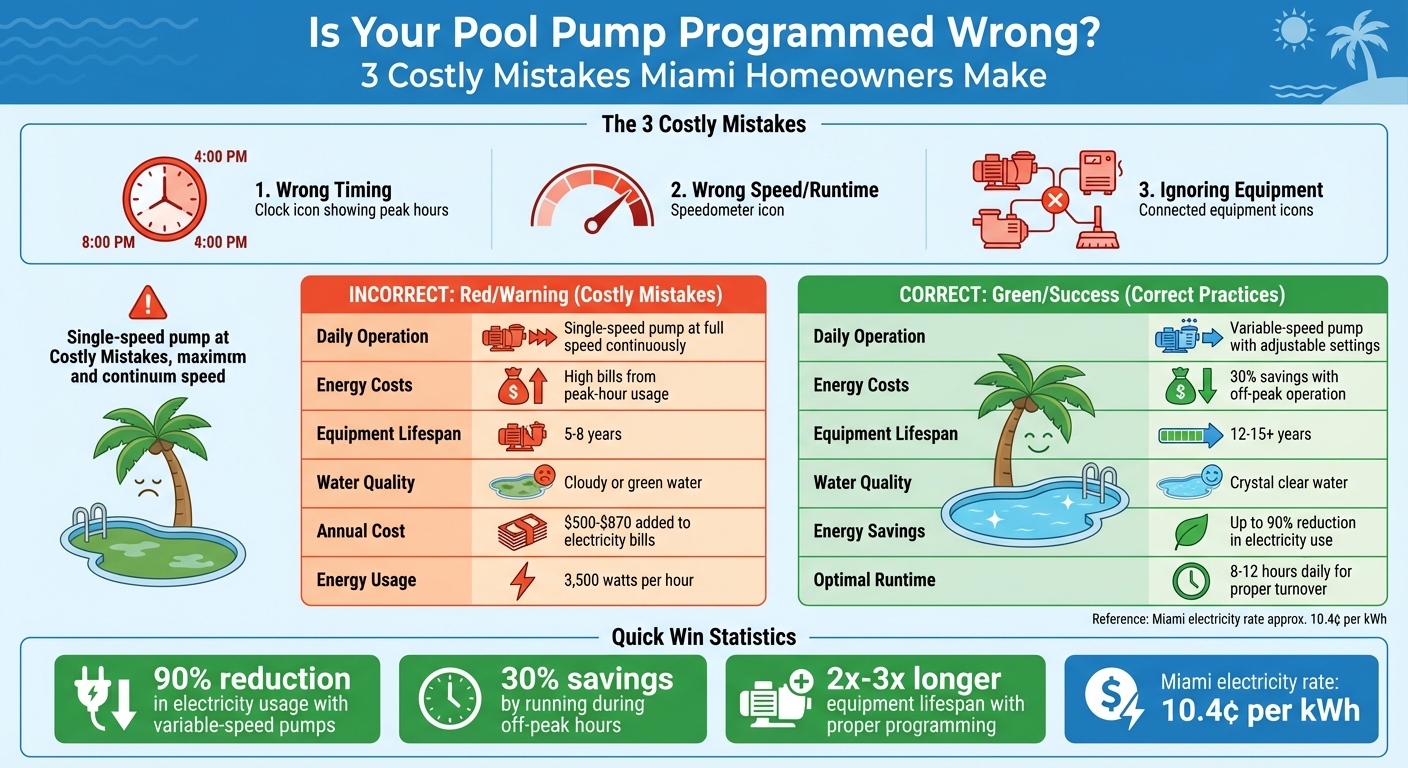
Incorrect vs Correct Pool Pump Programming: Cost and Performance Comparison
How To Program A Variable Speed Pump Schedule
1. Running the Pump at the Wrong Times
Getting the timing right for your pool pump can make a huge difference in your energy costs. In Miami, where electricity averages 10.4 cents per kWh, running your pump during peak hours – often from midday to early evening – can rack up hefty bills. Pool pumps are one of the biggest energy users in a home, potentially adding $500 to $870 to your annual electricity expenses[3].
To save money, shift your pump’s runtime to off-peak hours, such as late at night or early in the morning, when electricity is cheaper[2]. In fact, Florida law requires new residential pool filtration pumps to have a time switch to encourage operation during these lower-cost periods[4]. If your utility company offers Time-of-Use pricing, aligning your pump schedule with these cheaper timeframes can lead to noticeable savings.
Running the pump overnight doesn’t just cut costs – it’s also more effective for maintaining your pool. At night, the oxidation-reduction potential (ORP) is higher, allowing chlorine to work more efficiently without being hindered by cyanuric acid[2]. Adding pool chemicals, like shock, in the evening before the pump runs overnight helps them disperse evenly and prevents the sun from breaking them down too quickly.
Here’s an example schedule to optimize performance: run your pump for 6 hours overnight and 4 hours in the late afternoon or early evening to avoid peak electricity rates while ensuring proper circulation[1]. If you have a variable-speed pump, consider running it at low speeds for about 9 hours within a 12-hour cycle[2]. Using a programmable timer or smart controller can automate this process, eliminating the need for daily manual adjustments. To keep your pool water circulating properly in Florida’s heat, aim for a total daily runtime of 8 to 12 hours[2].
2. Using the Wrong Pump Speed or Run Time
In Miami, many homeowners either push their pool pumps too hard or don’t use them enough, which leads to wasted energy and poor water quality. Running a single-speed pump at full power all day can consume up to 3,500 watts per hour[7]. On the other hand, running it for too little time can cause filtration issues, leaving you with cloudy water or algae problems. To avoid these issues, it’s essential to determine your pool’s turnover needs and set the right runtime.
To maintain proper water circulation, your pool should achieve at least one full water turnover every 24 hours[1]. Here’s how to calculate the ideal runtime: First, figure out your pool’s volume in gallons by multiplying its length, width, and average depth, then multiply that result by 7.5 if your pool is rectangular[1]. Next, divide the total gallons by your pump’s flow rate (in gallons per hour). For example, if you have a 20,000-gallon pool and a pump with a flow rate of 2,400 GPH, you’ll need about 8.3 hours of runtime daily[6]. This ensures proper circulation, which is especially important in Miami’s hot and humid climate.
While setting the right runtime is crucial, optimizing pump speed can take efficiency to the next level. Variable-speed pumps let you adjust settings for different needs. For instance, you can run the pump on high speed for 3–4 hours for cleaning tasks and then switch to low speed for 8–9 hours for everyday filtration[6]. At lower speeds – typically around 1,200–1,500 RPM for general filtering – you’ll use significantly less electricity[7]. When you need more power, like when operating a pool cleaner, you can temporarily increase the speed to 2,200–2,500 RPM, then lower it again[7]. This approach can cut electricity use by up to 90% compared to single-speed pumps[7].
"Too much, and you’re wasting energy and wearing out your equipment." – Professional Aquatic Services [1]
Looking ahead, new U.S. Department of Energy regulations will take effect on September 29, 2025, requiring any new or replacement pool pump over 1 HP to be a DOE-approved variable-speed model[5]. While these pumps typically cost between $2,000 and $3,000 installed, they last much longer – 12 to 15+ years compared to 5 to 8 years for single-speed pumps[5]. Running at lower speeds also reduces wear and tear on motor bearings and other components, helping to protect your investment and keep your energy bills under control.
sbb-itb-a36f8f1
3. Ignoring How Other Equipment Affects Pump Scheduling
Your pool pump doesn’t work in isolation – it’s the heart of a system that includes heaters, salt cells, skimmers, and more. To keep everything running smoothly, it’s essential to coordinate your pump’s schedule with the requirements of this equipment. For instance, salt cells typically need a flow rate of around 20 GPM, while heaters often require 30–60 GPM to function properly[8]. Running your pump at very low speeds all day might save energy, but it can also stop your heater, electric heat pump, salt chlorinator, and skimmer from doing their jobs effectively[8].
To strike the right balance, try setting an adjustable schedule. For cleaning tasks, aim for pump speeds of 2,200–2,500 RPM. During the night, you can switch to a lower speed, around 1,200–1,500 RPM, for energy-efficient circulation. This way, you avoid the energy drain of running a fixed-speed pump at high power all the time[7][8].
Chemical distribution is another area where pump scheduling plays a key role. After adding shock or other chemicals, it’s important to run the pump for several hours to ensure even distribution throughout the pool[2][7]. Timing also matters – shocking your pool at night can prevent UV rays from breaking down chlorine, which happens quickly in Miami’s intense sunlight (up to 90% of unstabilized chlorine can degrade in just two hours)[2].
To fine-tune your pump’s performance, consider using a flow meter to monitor flow rates. Many homeowners run into issues with pumps that are either overworking or underperforming. If you’re unsure about your pump’s sizing or schedule, consult a local pool professional who can help you create a plan tailored to your pool’s needs and equipment setup[8].
Comparison Table
Incorrect pump programming can lead to higher costs, poor water quality, and reduced equipment lifespan. Here’s a breakdown of how incorrect and correct programming stack up:
| Factor | Incorrect Programming | Correct Programming |
|---|---|---|
| Daily Operation | Single-speed pump running at full speed continuously | Variable-speed pump with adjustable settings for efficiency |
| Energy Costs | High electricity bills from constant high-speed use | Up to 30% savings by operating during off-peak hours [9] |
| Equipment Lifespan | 5–8 years on average for single-speed pumps [5] | 12–15+ years for variable-speed pumps [5] |
| Water Clarity | Cloudy or green water due to debris and algae [1] | Clear water with proper turnover and chemical distribution [1] |
| Equipment Wear | Excessive strain on motor bearings, filters, and heaters [1][5] | Lower speeds reduce stress on components, extending their life [5] |
This table highlights why fine-tuning your pump settings is essential.
While variable-speed pumps may cost more initially, they offer long-term benefits like lower energy bills and a longer lifespan. Running the pump at lower speeds not only improves filtration but also reduces wear and tear. Customize your pump’s operation to fit your pool’s needs instead of defaulting to full power all the time.
Conclusion
Fixing these common pump programming mistakes can help you lower electricity costs, extend the life of your equipment, and keep your pool water crystal-clear. Simple adjustments – like running your pump during off-peak hours, setting speeds to match your pool’s actual needs, and syncing it with other equipment like heaters or salt systems – can make a noticeable difference. In fact, variable-speed pumps can reduce electricity usage by up to 90%[7].
Proper programming doesn’t just save money – it protects your equipment too. It can extend a pump’s lifespan from 5–8 years to over 12–15 years[5]. Plus, with less strain on filters, heaters, and other components, you’ll deal with fewer repairs and replacements. Consistent filtration also keeps algae at bay and ensures balanced water chemistry, preventing cloudy or unappealing water.
In South Florida, where the heat, heavy pool use, and frequent storms take a toll, precise pump programming is essential. Aim for one full water turnover per day while avoiding unnecessary runtime[1][7].
Now’s the perfect time to review your pool’s setup. Reach out to Alligator Pools for expert assistance in optimizing your pump or upgrading your system. Our certified technicians know Miami-Dade County’s unique climate and water conditions. They’ll evaluate your pool’s size, equipment, and usage patterns to create a tailored programming schedule that maximizes efficiency and savings.
Contact Alligator Pools today for a free estimate on pump optimization, equipment upgrades, or regular maintenance. With over 40 years of experience serving Miami-Dade County, we’re here to help you save money and enjoy a perfectly balanced, energy-efficient pool.
FAQs
What’s the best way to program my pool pump for energy savings and efficiency?
To get the most out of your pool pump, start by factoring in your pool’s size, water volume, how much sun it gets, and how often it’s used. Generally, running the pump for 8–12 hours a day helps maintain good water circulation and keeps the chemical balance in check. If you have a variable-speed pump, you can fine-tune the motor speed to match your needs – use lower speeds (around 1,200–1,800 RPM) for everyday operation, and higher speeds (around 2,500–3,500 RPM) for tasks like deep cleaning or after heavy pool use.
If your electricity provider offers off-peak rates, consider programming the pump to operate during those times to cut down on energy costs. Keep an eye on water clarity, filter pressure, and chemical levels to determine if adjustments are needed. Fine-tune the runtime or speed based on these observations. It’s also a good idea to jot down your settings – this makes it much easier to tweak things as the seasons change and ensures your system stays efficient.
Why should I choose a variable-speed pool pump instead of a single-speed pump?
Variable-speed pool pumps are an excellent option for homeowners looking to cut down on electricity use. By switching to one, you could save up to $1,000 in energy costs over three years. These pumps also operate in a way that minimizes wear and tear, meaning they last longer and require less maintenance. On top of that, they align with Florida’s pool energy efficiency standards, ensuring your pool stays compliant with local rules while running smoothly.
How do pool heaters and salt systems impact pump scheduling?
Pool heaters and saltwater chlorination systems rely on steady water flow to function properly. If your pump doesn’t run long enough, the water circulation might not be sufficient. This can prevent the heater from evenly warming the pool or the salt system from fully sanitizing it. The result? Debris can accumulate, your equipment may experience unnecessary strain, and energy consumption could increase. However, running the pump nonstop isn’t the answer either – it’s not energy-efficient and can lead to waste.
In South Florida’s warm climate, setting a thoughtful pump schedule – usually 8 to 12 hours a day – can ensure proper water turnover while supporting your pool’s heater and salt system. Modern variable-speed pumps make this process even more efficient. They let you program lower speeds for nighttime circulation and higher speeds during the day for cleaning and swimming. This strategy not only helps protect your equipment and reduce wear but also cuts energy costs and aligns with Florida’s pool energy regulations.