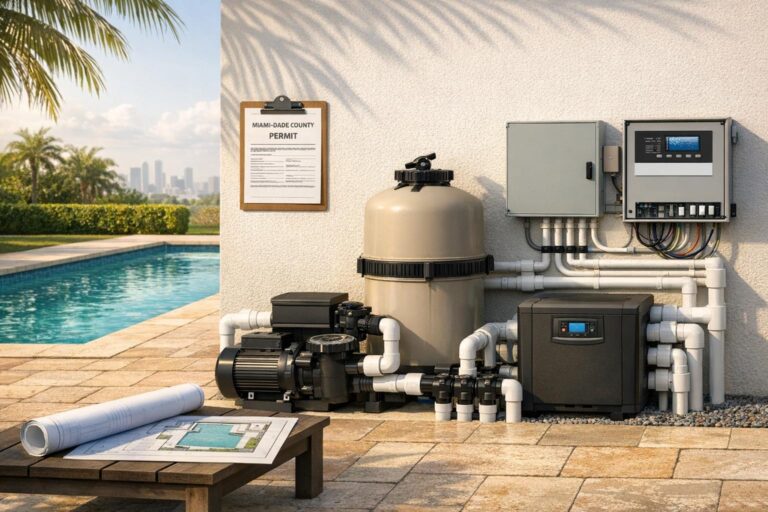

Looking to save money on your pool’s energy costs? Upgrading to an energy-efficient pool pump can reduce electricity consumption by up to 80% and save you $450–$1,000 annually. Variable-speed pumps, backed by ENERGY STAR, are the best choice for Miami pool owners, offering lower energy bills, quieter operation, and improved water quality.
Here’s what you need to know:
- Single-Speed Pumps: Affordable upfront ($150–$300) but energy-intensive and costly to run.
- Dual-Speed Pumps: Moderate energy savings with two speed settings; costs $300–$600.
- Variable-Speed Pumps: Most efficient option, using 200–300 watts; priced at $600–$1,200+ but pays for itself in 1–2 years.
Why it matters for Miami homeowners:
- Pools often run 6–12 hours daily due to year-round use.
- Florida’s high electricity rates make energy savings crucial.
- Rebates of $200–$300 are available in Miami-Dade County.
Switching to a variable-speed pump not only cuts costs but also reduces wear on your pool system, extends equipment life, and ensures better filtration. Professional installation and maintenance, like those provided by Alligator Pools, ensure optimal performance and long-term savings.
Ready to upgrade? Keep reading for details on pump types, installation tips, and maintenance best practices.
Types of Pool Pumps and Their Features
Single-Speed, Dual-Speed, and Variable-Speed Pumps
Understanding the different types of pool pumps can help you manage energy costs, improve water circulation, and extend the life of your equipment.
Single-speed pumps operate at a fixed speed – usually around 3,450 RPM – whenever they’re turned on. These pumps are the simplest and most affordable, with prices ranging from $150 to $300. However, they’re not energy-efficient since they always run at full power, regardless of the task. A typical 1.5 HP single-speed pump consumes between 1,500 and 2,200 watts. Running it for 8 hours a day can use 360–530 kWh per month, costing $70–$120 in electricity (based on $0.15–$0.20 per kWh). Over Miami’s long swimming season, this can become a hefty expense.
Dual-speed pumps provide a more energy-conscious option by offering two settings: a low speed for everyday filtration and a high speed for more demanding tasks like vacuuming or running water features. At low speed, these pumps use about 550 watts compared to 2,200 watts on high. By primarily running on low speed, energy consumption drops to around 4–6 kWh daily (120–180 kWh monthly), significantly lowering costs. While dual-speed pumps are more expensive upfront – ranging from $300 to $600 – the energy savings can quickly make up for the initial investment.
Variable-speed pumps (VSPs) are the most energy-efficient and advanced choice. Equipped with digital controls, they adjust motor speed to match your pool’s specific needs. These pumps can operate at 1,000–1,500 RPM, using only 200–300 watts. This translates to just 1.6–2.4 kWh per day (48–72 kWh per month) for 8 hours of operation. At Miami’s electricity rates, monthly costs can drop to $10–$15, cutting energy use by 80–90% compared to single-speed models. Although variable-speed pumps are the most expensive – priced between $600 and $1,200 or more – the energy savings often pay for the higher cost within a few years.
| Pump Type | Upfront Cost | Typical Wattage | Monthly Energy Use (8 hrs/day) | Monthly Cost ($0.15–$0.20/kWh) | Annual Savings vs. Single-Speed |
|---|---|---|---|---|---|
| Single-Speed | $150–$300 | 1,500–2,200 watts | 360–530 kWh | $70–$120 | Baseline |
| Dual-Speed | $300–$600 | 550 watts (low) | 120–180 kWh | $25–$40 | $540–$960 |
| Variable-Speed | $600–$1,200+ | 200–300 watts | 48–72 kWh | $10–$15 | $800–$1,400 |
Variable-speed pumps also reduce wear and tear on your pool system compared to single-speed models. Next, let’s dive into the motor technologies that power these pumps and how they influence efficiency.
Motor Technologies in Pool Pumps
The type of motor in a pool pump plays a big role in its performance and efficiency. Single-speed and many dual-speed pumps rely on induction motors. While dependable and relatively affordable, these motors operate at only 30–70% efficiency, with much of the energy wasted as heat.
In contrast, variable-speed pumps use permanent magnet motors (also called ECM or PMSM motors), which are far more efficient. These motors achieve 80–90% efficiency and generate less heat, extending their lifespan. They’re also designed to maintain high efficiency at different speeds, making them ideal for variable-speed applications where the pump adjusts its output throughout the day.
Selecting the Right Pump for Your Pool
In Miami, where pools are used year-round, choosing the right pump is essential for balancing performance and cost. For smaller pools with minimal features, a dual-speed pump can deliver solid energy savings at a reasonable cost. For larger pools or those with multiple features, a variable-speed pump offers the best combination of efficiency and performance.
Since many Miami pools run 6–12 hours daily, the ability to operate at lower speeds not only improves water quality but also reduces wear on the system. Plus, local utility rebates – typically $200–$300 per unit in Miami-Dade County – can help offset the higher upfront cost of a variable-speed pump.
To ensure your pump is the right size for your pool’s volume and features, consulting a licensed professional is a smart move. Alligator Pools specializes in equipment installation and can guide you through selecting and installing the perfect pump for Miami’s unique climate conditions.
Installation and Setup of Energy-Efficient Pool Pumps
Installation Requirements and Considerations
Setting up an energy-efficient pool pump involves addressing specific electrical and plumbing needs to ensure optimal performance.
For starters, a dedicated 240-volt circuit with proper grounding is essential. Variable-speed pumps also require a GFCI breaker and surge protection to safeguard their advanced electronic components. Unlike single-speed pumps, which simply switch on or off, variable-speed models rely on permanent magnet motors and sophisticated electronic controls. These systems perform best with a clean, stable electrical supply[9][1].
The pump’s control panel, which manages motor speed and RPM adjustments, needs to be installed in a location shielded from water spray and excessive moisture. This panel is usually mounted on a nearby wall or integrated directly into the pump housing[9].
On the plumbing side, energy-efficient pumps are generally compatible with existing setups. However, their variable flow rates require attention to intake and discharge line sizing to avoid unnecessary pressure drops. Proper ventilation is also key. While variable-speed pumps generate less heat than single-speed models, they still need sufficient airflow to function efficiently[3]. Additionally, ensure the pump is accessible for maintenance, particularly for cleaning the strainer basket.
In Miami, compliance with Florida pool codes and local electrical ordinances is a must. Once the pump is installed correctly, the next step is programming it to meet your pool’s unique filtration needs.
Programming and Adjusting Pump Settings
Proper programming is critical to maximizing the energy savings of your variable-speed pump. These pumps allow users to set multiple speed schedules tailored to their pool’s specific requirements[1].
One major advantage is the dramatic energy savings at lower speeds. For instance, reducing the pump’s speed by half can cut energy use to just one-eighth. A 1.5-horsepower variable-speed pump running at 1,500-2,000 RPM might consume only 250 watts, compared to 2,200 watts at full speed[4].
To create an effective schedule, focus on matching pump speed to actual filtration needs rather than running it at full capacity all the time[10]. A typical schedule for residential pools might include:
- Low-speed operation (6-8 hours) during nighttime off-peak hours for basic filtration.
- Medium speed in the morning for moderate cleaning.
- High speed only when necessary, such as for vacuuming or backwashing.
Many modern pumps come with built-in controllers offering up to eight programmable speed settings and timers[1]. Some even feature smart technology, enabling remote adjustments via mobile apps. This functionality is particularly useful for adapting to seasonal changes or unexpected pool conditions[1].
In Miami’s subtropical climate, seasonal adjustments are especially important. During summer months (June-September), when temperatures climb and algae growth accelerates, pools may need 8-12 hours of daily filtration at medium speeds (2,000-2,500 RPM) to maintain water clarity and chemical balance. Conversely, in winter (December-February), cooler temperatures reduce algae growth, allowing filtration times to drop to 4-6 hours daily at lower speeds. The rainy season (May-October) might require temporary increases in filtration speed to address water clarity issues caused by heavy rainfall.
For those seeking optimal energy efficiency, some advanced pumps feature adaptive flow technology, which automatically adjusts water flow based on system demands. This eliminates the need for constant manual adjustments while ensuring energy savings[1].
Professional Installation with Alligator Pools

For a seamless installation and compliance with local regulations, professional assistance is highly recommended. Alligator Pools specializes in energy-efficient pool pump installations across Miami-Dade County, serving areas like Coral Gables, Kendall, Doral, and South Miami.
Why choose licensed professionals? Alligator Pools holds a Florida pool and spa service contractor license (CPC1459915), ensuring all installations meet safety and compliance standards. Their technicians are Certified Pool Operators (CPO) trained in the latest equipment care and installation practices[8].
Professional installation avoids common issues that can undermine performance and safety. For example:
- Improper electrical connections can create hazards or reduce efficiency.
- Incorrect plumbing alignment may lead to leaks or pressure issues that damage components.
Alligator Pools ensures that all electrical connections meet safety standards and that the plumbing is configured to optimize the pump’s performance. After installation, they conduct thorough testing to verify smooth operation. This includes starting the pump at low speed and gradually increasing it to ensure proper water flow. They also measure electrical consumption with a clamp meter to confirm the pump is operating within expected wattage levels. If the readings are off, it could indicate issues with the electronic controller[4].
Additionally, Alligator Pools can program automation features to suit your pool’s usage patterns and Miami’s seasonal variations. They can also help you take advantage of Florida utility rebates, which often provide $200-$300 for switching to variable-speed pumps[5]. With these rebates and the energy savings from an ENERGY STAR certified pump, the investment typically pays off in under two years[10][6].
With over 40 years of experience, Alligator Pools offers transparent pricing, reliable timelines, and tailored solutions. Their expertise ensures your energy-efficient pump delivers on both performance and savings.
Maintenance and Longevity of Energy-Efficient Pool Pumps
Regular Maintenance Tasks
Keeping your energy-efficient pool pump in top shape requires consistent care. Thanks to their advanced design, variable-speed and multi-speed pumps need less maintenance than traditional single-speed models, as they operate with less strain [10].
Start with the basics: clean the pump’s strainer basket regularly. During peak usage, this should be done weekly; during cooler months, monthly is sufficient. Turn off the pump, release the pressure, remove the basket, rinse it thoroughly, and reinstall it. A clogged basket forces the pump to work harder, reducing efficiency and potentially shortening its lifespan.
Pay attention to the pump lid O-ring, especially in Miami’s humid, salty environment. These rubber seals can dry out or crack faster in such conditions. Inspect the O-ring monthly for wear and tear to prevent bigger problems down the line.
Check the pump for leaks around the housing, plumbing connections, and valves every month. Coastal air can accelerate corrosion, making early detection essential. Additionally, ensure all electrical connections and junction boxes stay dry and free of corrosion, as moisture can damage the sensitive electronics in variable-speed pumps.
Maintaining proper water chemistry is critical for extending your pump’s life. Keep the pool’s pH between 7.2 and 7.8, alkalinity at 80–120 ppm, and chlorine levels at 1–3 ppm. Imbalanced water can cause scale buildup on the impeller and inside the pump, forcing the motor to overwork. High chlorine levels or incorrect stabilizer levels can also degrade seals and O-rings over time.
Seasonal maintenance is equally important. Check and clean the impeller (if accessible) according to the manufacturer’s instructions. For variable-speed pumps with permanent magnet motors, install the unit in a shaded, ventilated area or use a weatherproof enclosure to shield it from rain and salt spray.
Troubleshooting Common Problems
Routine maintenance not only keeps your pump efficient but also helps you catch potential issues early. Variable-speed pumps operate much quieter than traditional models – up to four times quieter – so unusual noises like grinding, screeching, or humming are easier to notice [11]. These sounds might indicate bearing failure or debris in the impeller. If you hear them, turn off the pump immediately, check the strainer basket, and ensure the pool water level is adequate. If the noise continues, consult a professional.
Priming issues are another common concern. If the pump struggles to prime or frequently loses prime, check the water level, valve settings, and pump lid for secure sealing. Bubbles in the pump basket or returning water could signal air entering the system, so inspect plumbing connections for cracks.
Variable-speed pumps may also display error codes like "Priming", "Overload", or "Communication" when something is wrong. Refer to the pump’s manual for guidance, but if error codes persist after a reset or you notice leaks around the housing or seals, turn off the pump and contact a licensed pool technician. Repeated circuit breaker trips might indicate moisture in electrical connections, which requires professional attention.
Extending Your Pump’s Lifespan
Proper care and timely troubleshooting can significantly extend the life of your pool pump. A well-maintained variable-speed pump can last 10–15 years, compared to 5–10 years for dual-speed and single-speed models. This durability pairs well with the energy savings achieved through efficient pump settings. However, in a challenging coastal environment like Miami, achieving these lifespans requires diligent maintenance.
One key factor is optimized programming. Running the pump at the lowest RPM necessary for effective filtration reduces both mechanical stress and heat buildup. Lowering the pump speed by half can cut energy use to just one-eighth, which directly reduces wear on components [10]. Save high-speed operation for tasks like vacuuming or backwashing.
Protect the pump from the elements. Prolonged exposure to sun and rain can wear down the motor housing and electronic parts. If the pump is in an open area, consider adding a cover or enclosure for extra protection.
Energy-efficient pumps also improve filtration by circulating water at slower rates, which reduces strain on filters, plumbing, and other system components [10]. This gentler operation helps prevent leaks and minimizes repairs, benefiting the entire pool system.
Annual professional inspections are essential for catching wear and tear early. Companies like Alligator Pools offer comprehensive pump maintenance as part of their full-service pool care across Miami-Dade County. Their Certified Pool Operator (CPO) technicians inspect pumps, motors, seals, and electrical connections; clean internal components like the impeller; verify programming; and ensure the entire circulation system is running smoothly.
"From routine pool maintenance to complex repairs or resurfacing, our trained professionals ensure your pool receives unmatched attention." – Alligator Pools [8]
Integrating pump maintenance with regular pool cleaning, water testing, and equipment checks ensures your energy-efficient pump remains reliable for years. Some pool owners have reported saving up to 75% on their energy bills when conservation measures are properly implemented [6]. For urgent issues, Alligator Pools offers quick responses via phone (305-255-7946), email (sales@alligatorpools.com), or text, serving areas like Coral Gables, Kendall, Doral, South Miami, and throughout Miami-Dade County.
sbb-itb-a36f8f1
Cost Savings and Long-Term Benefits
Calculating Your Energy Savings
Want to figure out how much you could save with an energy-efficient pump? Start by checking the pump’s wattage on its nameplate, noting how many hours it runs each day (in Miami, pools typically need 6–10 hours of operation), and reviewing your electricity rate per kilowatt-hour (kWh) from a recent Florida Power & Light (FPL) bill. FPL rates generally fall between $0.13–$0.16 per kWh, but they can go as high as $0.25.
Let’s break it down: a standard 1.5 HP single-speed pump draws around 2,200 watts. Running it for 8 hours daily uses about 17.6 kWh per day – or roughly 528 kWh per month. At $0.25 per kWh, that’s around $132 in monthly operating costs. Now compare that to a variable-speed pump, which typically uses only 250–300 watts at lower speeds. At 250 watts running for 8 hours daily, the usage drops to about 2 kWh per day, or 60 kWh per month. That’s just $15 per month at the same electricity rate. This often results in energy savings of 65–90%[2].
Return on Investment for Miami Homeowners
Once you’ve calculated your current pump’s energy costs and compared them to an energy-efficient alternative, you can estimate the payback period. Add up the cost of the pump and installation – usually between $1,200 and $2,000 in South Florida – and divide that by your projected annual savings.
For example, if the upgrade costs $1,800 and cuts your annual electricity bill by $900, the payback period is about two years. Miami’s long swimming season, where pools are used almost year-round, makes these savings even more impactful. Many homeowners have reported monthly pump costs dropping from $100–$140 to just $20–$40 after upgrading. That’s an annual savings of $800–$1,000, making the investment pay off quickly. This combination of reduced costs and rapid returns highlights why energy-efficient pumps are a smart choice for Miami homeowners[7].
Maximizing Savings with Alligator Pools
To make the most of these savings, professional installation and maintenance are crucial. Even the most efficient pump won’t deliver its full potential if it’s not properly sized, programmed, or maintained. Running a variable-speed pump at unnecessarily high speeds, relying on factory-default settings, or skipping routine maintenance like cleaning filters can all chip away at your savings.
This is where Alligator Pools comes in. Serving Miami-Dade County since 1985, this licensed Florida pool contractor ensures your pump is perfectly matched to your pool’s layout and features. Their installation services include programming the ideal run times and speeds, integrating the pump with existing automation systems, and achieving proper hydraulic balance – all of which help maximize efficiency.
Beyond installation, Alligator Pools provides ongoing maintenance to keep your pump running at peak performance. Regular cleaning of skimmer and pump baskets, filter maintenance, and inspections of seals and electrical connections are just a few of the services they offer. These efforts not only sustain energy savings but also bring additional perks like quieter operation and crystal-clear water, making the investment even more rewarding.
Max Efficiency SCHEDULE For Variable Speed Pool Pump
Conclusion
Switching to an energy-efficient pool pump is one of the smartest choices homeowners in Miami can make. As we’ve covered in this guide, modern pumps not only cut energy costs but also improve water quality and extend the life of your pool system. With Miami’s long swimming season and high energy rates, the initial investment often pays for itself within 1–2 years[10]. After that, the savings go straight back into your wallet.
But it’s not just about saving money. These pumps also boost overall pool performance. Running at slower speeds for longer periods helps improve water clarity and filtration, reduces wear and tear on equipment like filters and heaters, and creates more stable water chemistry – something especially important in Miami’s algae-prone conditions[3]. Plus, variable-speed pumps are quieter and cooler, making your backyard more enjoyable and extending the life of your pool equipment[3].
Of course, even the most advanced pump won’t deliver maximum benefits if it’s the wrong size, poorly installed, or improperly maintained. That’s where professional expertise is key. Alligator Pools, a trusted name in Miami-Dade County since 1985, brings over 40 years of experience to every installation. As a licensed Florida pool contractor (CPC1459915) with Certified Pool Operator (CPO) certified technicians, they ensure your pump is perfectly matched to your pool’s size, plumbing, and unique features.
Alligator Pools doesn’t stop at installation – they offer comprehensive maintenance plans to keep your system running efficiently. These plans include cleaning skimmer and pump baskets, maintaining filters, checking for leaks, and adjusting pump schedules with the seasons. Regular care like this not only preserves your energy savings but also helps prevent costly repairs down the line.
From choosing the right equipment to ensuring long-term performance, professional expertise makes all the difference. Ready to lower your energy bills and improve your pool’s performance? Contact Alligator Pools at 305-255-7946 or email them at sales@alligatorpools.com. Their team will evaluate your current system, recommend the best ENERGY STAR–certified pump for your needs, and handle the installation process from start to finish. With clear pricing, a 3-year workmanship guarantee, and service across Coral Gables, Kendall, Pinecrest, and all of Miami-Dade County, Alligator Pools ensures energy efficiency comes with peace of mind.
FAQs
What are the benefits of upgrading to a variable-speed pool pump for Miami homeowners?
Switching to a variable-speed pool pump can bring Miami homeowners some major perks. For starters, these pumps use far less energy than single-speed models, which can translate to noticeable savings on your electricity bill. Many pool owners report cutting their energy costs by as much as 70% over time.
But the benefits don’t stop there. Variable-speed pumps run much quieter, making your pool area more peaceful. They also improve water circulation, which means a cleaner pool and less wear and tear on your other equipment. Plus, they tend to last longer, making them a smart choice for anyone looking to maintain a reliable and efficient pool setup in Miami’s warm, sunny climate.
How do I choose the best energy-efficient pool pump for my pool and usage habits?
Choosing the right energy-efficient pool pump hinges on factors like your pool’s size, type, and how you use it. To start, pay attention to the pump’s flow rate and horsepower. Larger pools usually need pumps with more horsepower, while smaller pools can run efficiently on lower-powered options. One standout option for energy savings is variable-speed pumps. These allow you to adjust the speed to match your pool’s needs, helping to cut down on energy use over time.
For a tailored recommendation, consider consulting a pool professional. If you’re in Miami, Alligator Pools can assist with selecting, installing, and maintaining the ideal pump for your pool. They’ll ensure it performs efficiently while keeping energy costs in check.
How can I maintain my energy-efficient pool pump to keep it running efficiently and extend its lifespan?
To keep your energy-efficient pool pump running smoothly and extend its lifespan, regular upkeep is essential. Start by clearing out the pump basket and skimmer frequently. This helps prevent debris from building up, which could put unnecessary strain on the motor. Also, take a moment to inspect the seals and O-rings now and then – if you notice wear or damage, replace them promptly to avoid leaks.
Don’t forget about the pool filter. Keeping it clean ensures proper water flow and reduces stress on the pump. Another tip? Make sure the pump runs for the right amount of time each day – typically 6 to 8 hours, depending on your pool’s size and how often it’s used. For added peace of mind, schedule regular check-ups with a professional. They can spot potential problems early and help keep your pump in top shape.