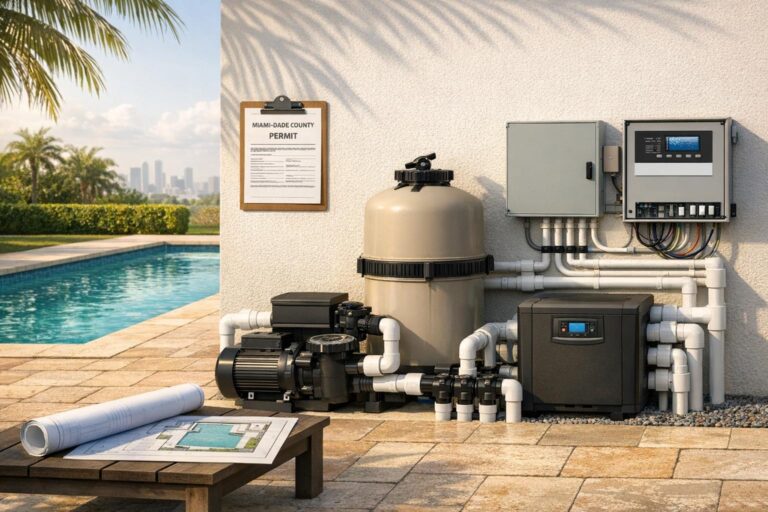

Running your pool pump during a Florida thunderstorm is risky and not recommended. Lightning can cause power surges that damage expensive equipment like pumps and heaters, with repair costs ranging from $2,000 to $8,000. Beyond financial loss, running the pump during a storm can create safety hazards, as pool water conducts electricity and increases the risk of injury or death.
Key Takeaways:
- Turn off your pool pump when you hear thunder to protect it from power surges.
- Disconnect the pump at the circuit breaker and avoid handling electrical equipment if you’re wet.
- Cover the pump motor with waterproof material to shield it from rain and flooding.
- Never swim during a storm – lightning can strike up to 25 miles away from the storm’s center.
- After the storm, inspect equipment for damage, ensure it’s dry, and balance pool chemistry before restarting.
Safety first: Protect your pool and equipment by shutting everything down before a storm arrives. Follow these steps to save money and avoid unnecessary risks.
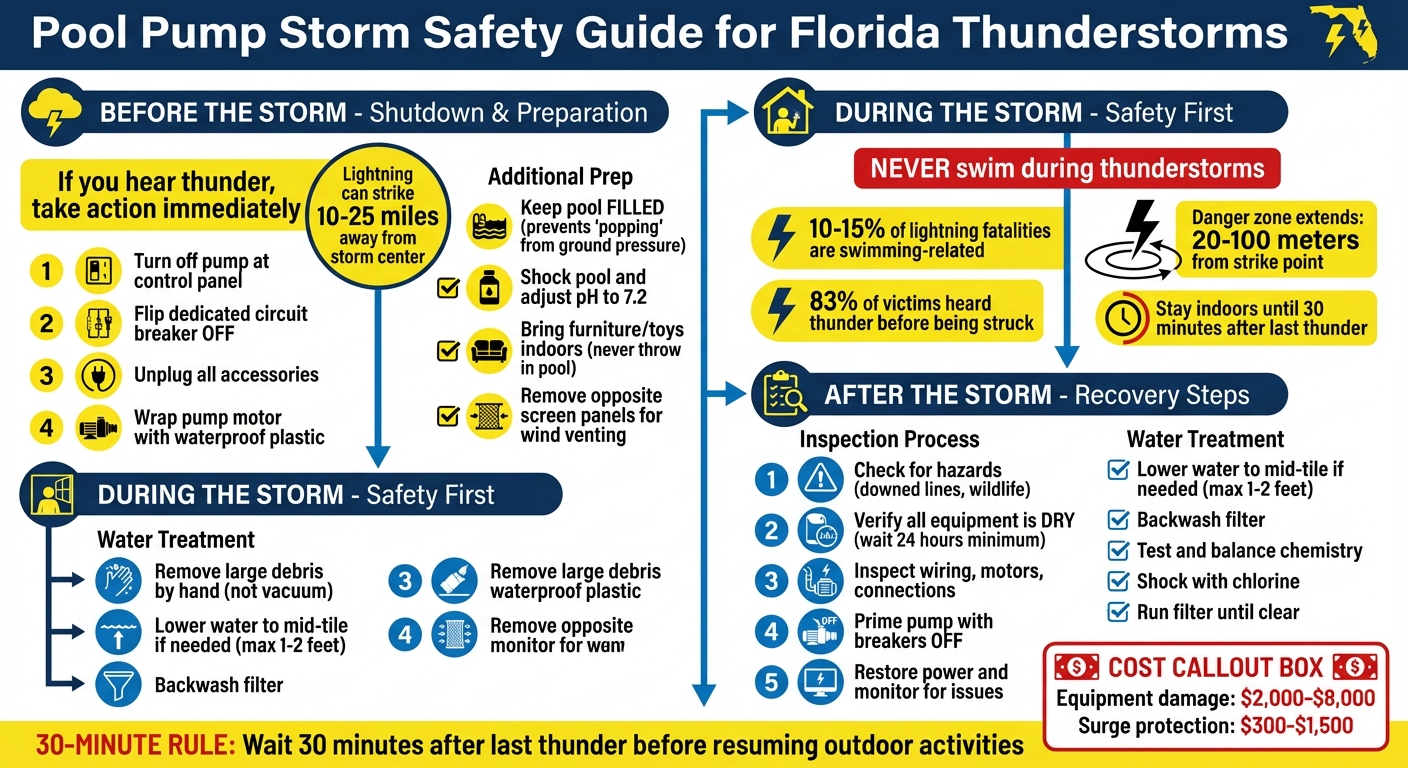
Pool Pump Storm Safety: Before, During, and After Thunderstorm Checklist
Risks of Running Your Pool Pump During Thunderstorms
Lightning Strikes and Power Surges
Lightning packs a massive punch of energy that can wreak havoc on your pool’s electrical system. Pumps, heaters, LED lights, and automation controls are all vulnerable to damage when lightning strikes nearby. Even without a direct hit, electricity can travel across wet surfaces or through nearby objects, finding its way into your pool’s system[1].
Repairing or replacing damaged pool equipment isn’t cheap—following a pool maintenance guide can help prevent some issues – it can cost anywhere from $2,000 to $8,000. Adding surge protection might help, but it comes with its own price tag, ranging from $300 to $1,500[1].
"Lightning strikes can destroy pool systems worth thousands of dollars." – Coach Slava[1]
But it’s not just about the financial hit. These power surges can also pose serious risks to personal safety.
Personal Safety Dangers
The same properties that make your pool equipment vulnerable also put people at significant risk. Pool water, with its chlorine, dissolved minerals, and salts, is an excellent conductor of electricity[1]. When the pump is running, it creates an active circuit connecting the water to the power grid. If lightning strikes nearby, it can electrify the water and surrounding surfaces, posing a deadly threat. The danger zone can extend anywhere from 20 to 100 meters from the strike point[1]. Metal components like ladders, railings, and pool lights only amplify the risk.
Swimming-related incidents account for 10% to 15% of all lightning fatalities in the United States[1]. Shockingly, about 83% of lightning victims heard thunder before being struck, yet they stayed in or near the water[1]. To make matters worse, lightning can strike from storms located as far as 10 to 25 miles away, sometimes even under clear skies[1][6].
"Your body, being a better conductor than water, becomes the primary target for the electrical charge." – Slava Fattakhov, Professional Swimming Coach[1]
sbb-itb-a36f8f1
When to Turn Off Your Pool Pump
How to Assess Storm Conditions
Knowing when to shut down your pool equipment starts with paying attention to weather cues, especially thunder. The National Weather Service emphasizes:
"Remember, if you can hear thunder, you are close enough to the storm to be struck by lightning. If possible, go to safe shelter immediately! Lightning can strike several miles from the parent thunderstorm." – National Weather Service [8]
Hearing thunder is your clearest signal – don’t wait for rain to take action. Lightning can strike even under clear skies, several miles from the storm’s core [8]. Keep an eye on dark, building clouds, which often signal an approaching storm [5]. Additionally, physical sensations like tingling or hair standing on end may indicate lightning is nearby [8]. Official weather alerts, especially hurricane warnings, should prompt immediate action to secure your pool equipment [4][7]. In places like Florida, where summer storms can appear suddenly, staying alert throughout the day is key.
Once storm conditions are confirmed, act quickly to shut down your pool equipment safely.
Safe Equipment Shutdown Procedures
To protect your pool pump and reduce electrical hazards, turn it off well before the storm hits. Start by shutting down the pump at its control panel, flipping the dedicated circuit breaker, and unplugging all accessories. Always avoid handling switches if you’re wet or near metal surfaces [4][3][7]. Disconnecting the pump from the electrical grid this way helps shield it from power surges.
"Turn off all swimming pool pumps and filters, and wrap them in waterproof materials." – Florida Power & Light (FPL) [4]
If you have additional pool accessories plugged in, unplug them only after you’ve turned off the breaker [4][7]. Avoid leaning on concrete surfaces during this process, as they can conduct lightning [5]. These precautions not only safeguard your equipment but also reduce the risk of personal injury.
After the storm, follow the "30-Minute Rule": wait at least 30 minutes after the last sound of thunder before resuming outdoor activities or restarting your pool equipment [5][9]. This ensures any lingering lightning risk has passed.
Storm Preparation for Your Pool and Equipment
Securing Pool Equipment
Once you’ve powered down your pump, it’s crucial to protect your equipment from potential wind and water damage. Wrap pump motors tightly with waterproof plastic and secure them with tape or rope to keep them safe [11].
"It is important that all electric power be turned off at the circuit breakers before a storm hits. Any exposed electrical equipment such as motors for the pumps should be tightly covered with plastic wrap." – Florida Swimming Pool Association [11]
If there’s a chance of flooding, take an extra step: disconnect the pump motor and move it to a high, dry indoor spot [11]. Also, bring patio furniture, toys, and pool accessories indoors. While it might seem like a quick fix, never toss furniture into the pool – this can cause damage. Instead, securely store loose items inside to prevent them from becoming hazards [10]. For screen enclosures, remove panels on opposite sides to create wind vents and minimize structural stress [11].
Adjusting Water Levels and Chemistry
Protecting your pool equipment is just one part of storm prep. Keeping the water levels and chemistry in check is just as important.
Avoid draining your pool. The water inside acts as a stabilizing force, especially in areas with a high water table, like Florida. It prevents the pool from "popping" out of the ground when the water table rises during heavy rains [3][10]. To put it into perspective, a full pool weighing around 250,000 pounds can lose up to 80% of its weight if drained [14].
"The weight of the water keeps the pool from being lifted off its foundation and ‘popping’ out of the ground because of pressure from Florida’s high water table." – Florida Swimming Pool Association [3]
Before the storm hits, shock your pool to combat bacteria and algae that may come from debris and rainwater [14]. Adjust the pH to 7.2, then add chlorine and algaecide right away. Run the filter for several hours to ensure everything circulates properly.
Weather and Your Pool Lightning and Thunder
After the Storm: Pool Recovery Steps
After a storm, once your pool has been shut down and protected, it’s crucial to assess both the equipment and water quality before getting back to regular operations. These steps help prevent equipment damage and ensure safety.
Equipment Inspection and Restart
Before turning anything back on, check the area around your pool for hazards like downed power lines or displaced wildlife such as snakes or even alligators. Storms, especially in Florida, can push wildlife into unexpected places [2,14]. Stay alert.
Take a close look at all electrical components, including the pump, motor, wiring, and ground connections. Make sure everything is completely dry and undamaged [3,15].
"Be sure that everything is dry before dealing with electrical start-up. Check your circuit breakers to be sure they are off before attempting to reconnect electrical equipment such as pump motors." – Florida Swimming Pool Association [3]
Even if the motor doesn’t appear wet, give it at least 24 hours to dry out before restarting [13]. If any parts of your equipment were submerged, have them inspected by a professional [3,17]. Once you’re confident everything is safe, double-check that the circuit breakers are off. Then, prime the pump, restore power, and carefully monitor for leaks or unusual noises during several full cycles [3,15,16].
After confirming your equipment is functioning properly, you can move on to cleaning and balancing the water.
Debris Removal and Water Treatment
Once your equipment is up and running, start by removing large debris using a pool rake or net. Avoid using your pool’s vacuum or pump for this job, as clogs can easily occur.
"Do not use your regular pool vacuum equipment or pool pumps as they are likely to clog the plumbing." – Florida Swimming Pool Association [11]
If the pool water level is too high, lower it to the mid-tile line, but be cautious not to drain more than 1–2 feet at a time. Draining too much can create upward pressure from the saturated ground, which might damage the pool’s structure [2,3,18].
Once the debris is cleared and the water level is correct, backwash the filter to remove any silt [12]. Next, test the water and adjust the pH, alkalinity, and hardness levels. After balancing the chemistry, shock the pool with chlorine to eliminate bacteria and prevent algae growth [3,17]. Keep the filtration system running until the water clears, and clean the filter as needed throughout the process [18,23].
Conclusion
When thunderstorms roll in, make sure to turn off your pool pump. Lightning strikes can lead to power surges that may damage pump motors and electronic controllers. Plus, operating electrical equipment near water during a storm is a serious safety hazard [8].
To protect your investment, it’s crucial to follow proper shutdown procedures. The Florida Swimming Pool Association emphasizes this point:
"Pools are a major investment, doing something incorrectly can cause extremely expensive additional repairs" [3].
Before the storm hits, take precautions like waterproofing exposed motors and keeping your pool filled to prevent structural damage caused by hydrostatic pressure [2][10].
Safety should always come first. Stay indoors during the storm and only inspect your pool once the area is confirmed safe [2][10]. Afterward, allow all electrical components to dry for at least 24 hours, remove debris by hand, and shock the water to eliminate bacteria and prevent algae growth [13][10]. These steps will help keep your pool in great condition and safe for your family.
FAQs
What steps should I take if my pool pump was running during a thunderstorm?
If your pool pump was operating during a thunderstorm, the first thing you should do is shut it off at the circuit breaker to eliminate any ongoing electrical hazards. After the storm clears, unplug the pump and take a close look at the motor and wiring for any signs of visible damage. If everything seems fine, you can go ahead and restart the pump. But if you spot anything unusual or concerning, avoid using it and reach out to a professional. This ensures your safety and helps prevent additional damage to the equipment.
How can I check if my pool equipment was damaged after a storm?
After a storm, the first step is to visually inspect your pool equipment. Look for any noticeable damage, such as rust, corrosion, or water intrusion in pump housings, motor enclosures, or filter canisters. Pay attention to the wiring – discoloration, melted insulation, loose connections, or a burnt smell are all red flags. Check hoses, fittings, and the pump’s impeller for signs of cracks or bulging, and make sure the skimmer and return lines are free of debris.
Once you’re sure everything is dry, it’s time to test the equipment. Reset the circuit breakers and turn on the pump. Keep an ear out for unusual sounds like grinding or humming, and watch the pressure gauge for sudden spikes or drops – these could signal blockages or leaks. If the pump doesn’t start, runs inconsistently, or has weak water flow, it might be dealing with electrical or mechanical issues.
If you spot problems like wet wiring, visible cracks, strange noises, or a motor that refuses to run, don’t try to push the equipment further. Using damaged equipment can worsen the problem or even pose safety risks. Instead, call a professional pool technician or electrician to evaluate and repair the system before you get everything back up and running.
Is it safe to swim in a pool immediately after a thunderstorm?
No, swimming immediately after a thunderstorm isn’t safe. It’s recommended to wait at least 30 minutes after hearing the last rumble of thunder before returning to the pool. This waiting period reduces the risk of lightning, which can remain a hazard even when the storm appears to have moved on.
This precaution is particularly important in areas like Florida, where storms can develop and shift rapidly. Staying mindful of these risks ensures a safer experience for everyone enjoying the pool during unpredictable weather conditions.