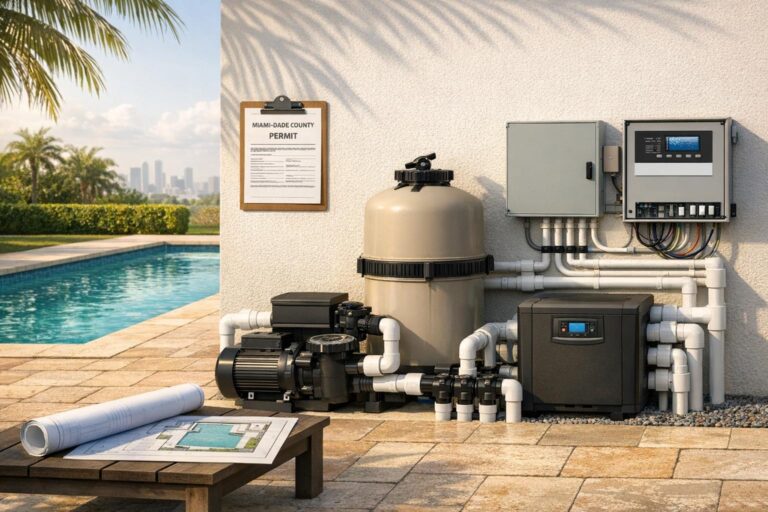

If you own a pool in Miami, you’ve probably noticed how quickly a rainstorm can turn your crystal-clear water into a cloudy mess. Here’s the problem: heavy rain dilutes essential chemicals like chlorine, disrupts pH levels, and introduces debris and pollutants that fuel algae growth. Without quick action, your pool’s water quality can deteriorate, leading to bacteria buildup, equipment strain, and costly repairs.
Key Takeaways:
- Rainwater Dilution: Lowers chlorine, alkalinity, and calcium hardness, leaving water unbalanced.
- Contaminants: Pollutants, leaves, and runoff introduce nitrates and phosphates, helping algae thrive.
- Equipment Strain: Overflowing water and debris can overload your pump and filter.
To fix the damage, clean debris, test chemical levels, and shock your pool to restore balance. Proactive steps like pre-storm maintenance and proper drainage can help minimize these issues during South Florida’s rainy season.
How To Drain and Clean Your POOL After HEAVY RAIN
sbb-itb-a36f8f1
How Rainstorms Disrupt Pool Chemistry
Miami’s heavy rainstorms can throw your pool’s chemistry out of balance in no time. With large amounts of rainwater pouring in, combined with pollutants and debris, your pool’s water clarity and chemical stability can take a serious hit.
Chemical Dilution and Water Imbalance
Rainwater is missing key elements like chlorine, cyanuric acid, and calcium. When several inches of rain fall, these essential chemicals get diluted, reducing chlorine levels and disrupting the overall balance. To make matters worse, Florida’s rainwater is naturally acidic, which can speed up the imbalance, leading to corrosive water that may damage plaster surfaces and metal fixtures. Alicia Stephens, Education and Training Manager at Biolab, highlights the immediate risks:
"Heavy rain can dilute your sanitizer level quickly, just because you’re adding so much fresh water. When you don’t have enough sanitizer, bacteria and algae can grow." [2]
This dilution creates the perfect environment for other problems, especially when external contaminants come into play.
Pollutants and Debris from Rain
Rainwater isn’t as clean as it seems. According to Terry Arko from HASA, rain carries pollutants like nitrogen dioxide, sulfur dioxide, dust, and smoke that stick to water droplets [2]. When the storm hits, your pool collects more than just rain – it gathers leaves, twigs, pollen, and even runoff from nearby areas. This runoff often contains nitrates and phosphates from soil and fertilizers, which algae thrive on [2][4]. With sanitizer levels already weakened, bacteria and algae can quickly take over. The combination of chemical dilution and physical debris also puts extra pressure on your pool’s filtration system.
Equipment Strain After Heavy Rain
The aftermath of a storm doesn’t just affect water quality – it also puts your pool equipment to the test. When water levels rise above the mid-tile line, the skimmer can no longer function properly because it becomes submerged [4][5]. At the same time, leaves and debris clog the skimmer and pump baskets, restricting water flow and overloading the pump. Your filter then struggles to handle the surge of fine sediment and organic matter. If the pressure gauge reads 8 to 10 PSI higher than normal, it’s a clear sign that the system is overwhelmed and losing efficiency [8]. Add in the potential for power outages during storms, and it’s easy to see how these challenges can lead to significant strain on your pool’s equipment. All these factors underline the importance of immediate testing and chemical adjustments after heavy rain.
How to Identify Storm Damage to Pool Water
After a Miami rainstorm, acting quickly to spot signs of pool imbalance can save you from bigger headaches down the line. Catching chemical issues early makes it much easier to restore your pool to safe swimming conditions.
What to Look For
Start by checking for cloudy water – this often means pollutants or diluted chemicals have disrupted your pool’s balance. A green tint in the water could point to algae growth or tannins from leaves and pollen washed in by the storm [4]. Don’t stop there – inspect the walls and steps. If they feel slippery, it might be an early sign of algae, even if the water still looks clear [5]. Also, floating debris like leaves, twigs, or dirt signals that phosphates and nitrates, which fuel algae growth, may have entered your pool. Once you’ve done a visual check, confirm your findings with a water test.
Testing Your Pool Water
After your visual inspection, it’s time to test the water for a clearer picture. Take a sample from about 18 inches below the surface – this ensures you’re testing the mixed pool water, not just the rainwater sitting on top [9]. For testing, you’ve got several options:
- Test strips are quick and easy to use.
- Liquid test kits (like Taylor‘s) are more detailed, offering precise color comparisons.
- Digital testers provide convenience but come with a higher price tag.
When testing, focus on these key chemical levels: free chlorine (1.0–3.0 ppm), pH (7.2–7.6), total alkalinity (80–120 ppm), calcium hardness (200–400 ppm), and cyanuric acid (30–50 ppm). In South Florida, it’s a good idea to test your pool at least twice a week – and always right after a big storm.
| Chemical Parameter | Target Range | What Rain Does |
|---|---|---|
| Free Chlorine | 1.0–3.0 ppm | Drops due to dilution and debris |
| pH Level | 7.2–7.6 | Often decreases (becomes more acidic) |
| Total Alkalinity | 80–120 ppm | Drops 5–10 ppm during heavy rain |
| Calcium Hardness | 200–400 ppm | Decreases (rainwater is typically soft) |
| Cyanuric Acid | 30–50 ppm | Gets diluted |
When to Take Immediate Action
Certain conditions call for urgent attention. If chlorine levels fall to zero or below 1.0 ppm, or if the pH dips under 7.0, you should shock your pool right away to prevent algae and bacteria from taking over. Similarly, if the water becomes fully cloudy, develops green patches quickly, or if water levels rise above the skimmer midpoint, it’s time to act. As Lo-Chlor highlights, leaving organic material in the pool for too long makes rebalancing much harder [10].
Next, we’ll dive into the exact steps to restore your pool’s chemistry after a storm.
Steps to Restore Pool Chemistry After a Storm
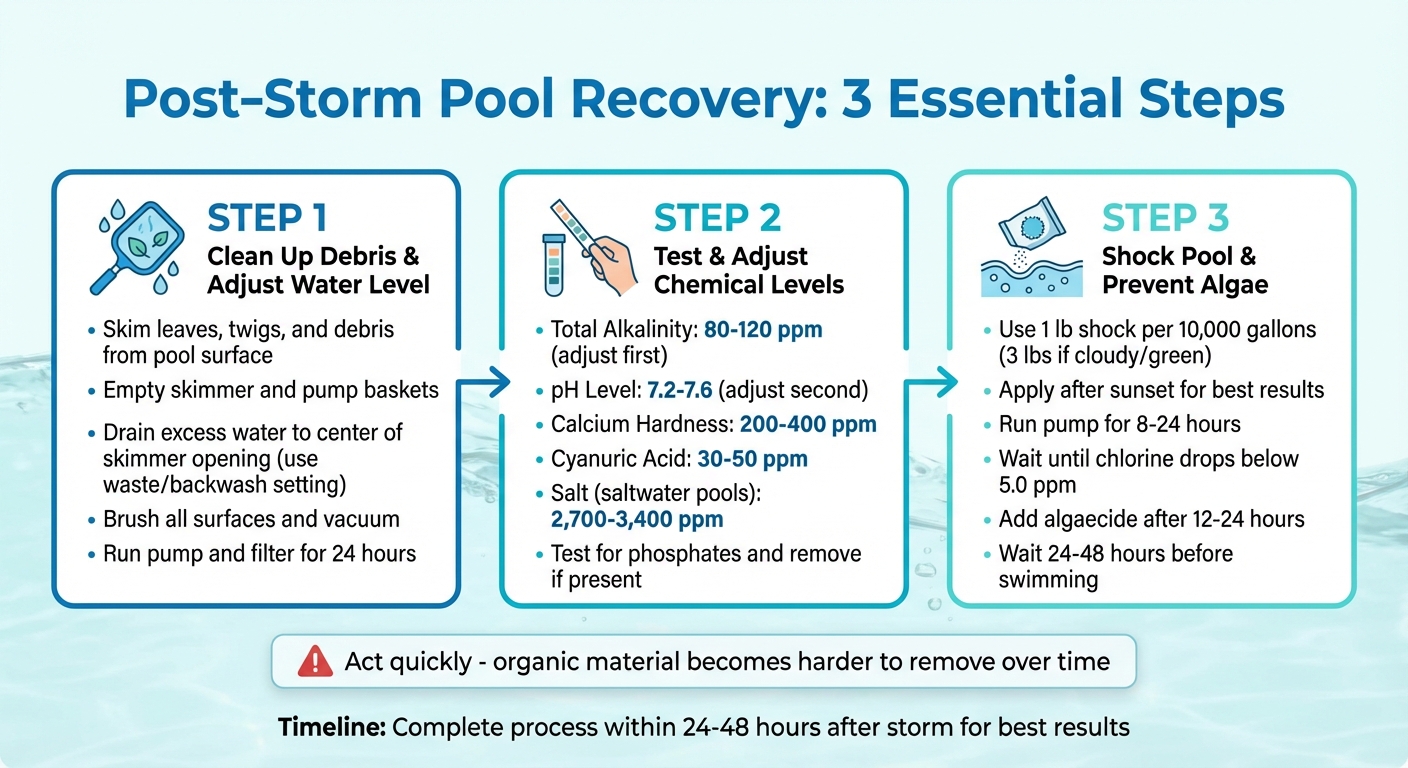
Post-Storm Pool Recovery: 3-Step Process to Restore Water Chemistry
After a storm, your pool’s chemistry can be thrown off balance due to diluted chemicals and debris. Here’s how to get things back on track: start by cleaning up debris and adjusting the water level, move on to testing and balancing chemicals, and finish by shocking the pool to prevent algae growth.
Clean Up Debris and Adjust Water Level
Begin by skimming leaves, twigs, and other debris from the pool. Don’t forget to empty the skimmer and pump baskets to keep water circulating properly. If heavy rainfall – like that often seen in Miami – has caused the water level to rise above the skimmer’s ideal range, use your pump’s "waste" or "backwash" setting to drain the excess water until it reaches the center of the skimmer opening.
Thoroughly brush all pool surfaces and vacuum to remove dirt and algae spores. If there’s silt in the pool, set the filter to "waste" while vacuuming to avoid recirculating debris. Run the pump and filter for a full 24 hours to clear out fine particles and help distribute chemicals evenly.
Once the pool is free of debris and water levels are back to normal, it’s time to test and adjust the chemical balance.
Test and Adjust Chemical Levels
After cleaning, check your pool’s water chemistry. Start by testing and adjusting in this order: total alkalinity (target range: 80–120 ppm), pH (ideal range: 7.2–7.6), and then chlorine levels. Chlorine works best when pH is properly balanced. To raise alkalinity, use sodium bicarbonate (baking soda). Adjust pH with a pH increaser like soda ash or a pH reducer such as muriatic acid.
If you have a saltwater pool, make sure the salt concentration is between 2,700 and 3,400 ppm to ensure the salt cell can generate chlorine effectively. Check calcium hardness (aim for 200–400 ppm) and cyanuric acid (30–50 ppm), as heavy rain often dilutes these levels. Lastly, test for phosphates – since they feed algae – and, if necessary, use a phosphate remover before moving on to the next step.
Once your pool’s chemical levels are balanced, it’s time to shock the pool.
Shock the Pool and Prevent Algae
Shocking the pool immediately after a storm helps eliminate bacteria and algae before they take hold. Generally, you’ll need 1 pound of shock for every 10,000 gallons of water. However, if the water is especially cloudy or green, a triple dose – 3 pounds per 10,000 gallons – might be required [11]. Always apply shock treatment after sunset, as UV rays can weaken chlorine’s effectiveness. For pools with vinyl liners, dissolve granular chlorine in a bucket of water first to avoid bleaching the liner.
As Lo-Chlor advises:
"The longer this mix of organic material is in your pool, the more difficulty you will have getting your pool water clean and balanced, again."
Run the pump for 8–24 hours to circulate the chemicals thoroughly. Once chlorine levels drop below 5.0 ppm – usually within 12–24 hours – you can add an algaecide to keep algae at bay. For safety, wait 24 to 48 hours after the storm before allowing anyone to swim.
How to Protect Your Pool During Rainy Season
South Florida’s rainy season doesn’t have to turn into a constant battle with your pool’s chemistry. By taking a few proactive steps, you can minimize storm damage and keep your pool in great shape.
Regular Maintenance Schedule
Stay on top of your pool’s water chemistry by testing it twice a week and running your filter for at least 8 hours a day during the wet season [6][12]. Make it a habit to check and empty your skimmer and pump baskets frequently – debris can clog water flow and put unnecessary strain on your equipment [3][12].
Before a storm hits, boost your chlorine levels to prepare for the influx of contaminants rain often brings. Alicia Stephens, Education and Training Manager at Biolab, emphasizes the importance of this step:
"Always, always, always shock the pool before a storm if you’re able to. That will build your chemistry up to where it’s a little more forgiving of whatever’s going to get washed into the pool during the storm" [2].
Also, keep your cyanuric acid levels between 30–50 ppm. This stabilizer acts like sunscreen for your chlorine, helping it last longer under Miami’s intense sun once the rain clears [6][4].
While proper chemical maintenance is essential, physical measures can provide additional protection for your pool during storms.
Physical Barriers and Drainage
A sturdy pool cover is one of the best ways to protect your pool from storm damage. Covering your pool before rain starts can block debris, reduce chemical dilution, and prevent the water level from rising too high above the skimmer [1][5][12]. Don’t forget to remove floats, toys, and any loose furniture from the pool area to avoid wind damage.
For heavier storms, Terry Arko, a Chemistry Expert at HASA, suggests taking extra precautions:
"If a very heavy and lengthy storm is expected, it may be prudent to protect the pool and the equipment from flooding with strategic placement of sandbags" [2].
Positioning sandbags around key equipment like the pump, filter, and chemical storage can shield them from flooding during South Florida’s intense downpours. Additionally, ensure your deck’s drainage system directs water away from the pool to reduce runoff.
Pool Resurfacing and Long-Term Care
Beyond immediate storm preparations, long-term care of your pool’s surfaces can make a big difference in its durability.
Pool resurfacing helps it withstand repeated exposure to stormwater. Rain can dilute your water and lower pH levels, which can accelerate the wear and tear on poorly maintained surfaces. Keeping calcium hardness levels between 200–400 ppm not only helps protect your pool’s finish but also extends its lifespan under frequent storm conditions [6]. Regular chemical balancing isn’t just about keeping the water clear – it’s also a critical step in safeguarding your pool against the corrosive effects of acidic rainwater [4].
Conclusion
Miami rainstorms can wreak havoc on your pool’s water chemistry. They dilute chlorine, drop alkalinity by 5 to 10 ppm, and dump organic debris into the water – creating a perfect storm for algae growth if left unchecked[4][7]. Without quick action, what starts as slightly cloudy water can spiral into a full-blown algae bloom.
To combat these sudden changes, quick and consistent maintenance is key. Regularly testing your water, pre-treating with shock before storms, and ensuring proper chemical levels can help stabilize your pool during heavy rains[2]. Running your filter continuously for 24 hours and promptly removing debris not only restores balance but also prevents unnecessary strain on your equipment[1][7].
Staying on top of these steps not only keeps your water sparkling but also protects your pool’s longevity. Maintaining a pH level between 7.2 and 7.6 prevents damage like metal corrosion and surface etching, while keeping calcium hardness between 200–400 ppm helps your pool withstand South Florida’s challenging conditions[6].
As Alicia Stephens from Biolab explains:
"If you have the right chemicals in there, it never gets bad in the first place, because it’s just cleaning everything up as it comes in"[2].
For Miami homeowners looking for a stress-free pool experience during the rainy season, professional pool care services can be a game-changer. With over 40 years of expertise in Miami-Dade County, Alligator Pools offers weekly maintenance, equipment repairs, and resurfacing services to ensure your pool stays safe and swim-ready – even after the most intense storms.
FAQs
How can I stop rainwater from throwing off my pool’s chemical balance?
To keep your pool’s water chemistry in check during rainstorms, a tight-fitting pool cover is your best defense. It helps reduce water dilution and keeps debris out. If covering the pool isn’t possible, make sure the water level stays at the skimmer line so excess rainwater can drain properly. Once the storm passes, use a reliable test kit to check your pool’s water balance and adjust the chemicals as necessary. This ensures the water stays safe and ready for swimming.
What should I do to fix my pool’s chemistry after heavy rain in Miami?
After a heavy rainstorm, the first step is to clear out debris like leaves, twigs, or dirt from your pool. This prevents additional contamination and keeps your water cleaner. Then, check the water level – it should align with the skimmer opening. If the level is too high, drain the excess water to ensure proper circulation.
Next, test the water chemistry, paying close attention to pH, alkalinity, and chlorine levels. Make adjustments as needed, and if the chlorine levels are too low, consider shocking the pool to bring them back to a safe range. Finally, run your pool’s filter continuously for at least 24 hours. This helps circulate the water and balance the chemicals effectively, getting your pool back in swimming condition.
Why does rainwater cause algae to grow in my pool?
Rainwater can throw off your pool’s chemical balance by lowering chlorine levels and bringing in organic debris, dust, and nutrients like phosphates and nitrates. These nutrients serve as a buffet for algae, and when sanitizer levels drop, it creates the ideal conditions for algae to grow. After a heavy rainstorm, it’s not unusual to see algae blooms if the water isn’t treated properly.
To avoid this, check your pool’s water chemistry after it rains and make any necessary adjustments. Adding the right amount of chlorine and quickly clearing out debris can go a long way in keeping your pool clean and algae-free.