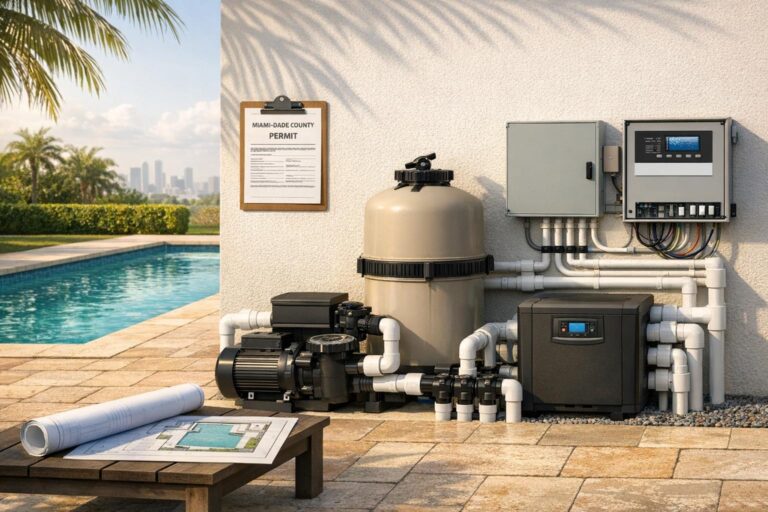

Pools in Miami face accelerated equipment wear due to the region’s heat, humidity, and salty air. Here’s what typically fails first and why:
- Pool Pumps: Lifespan drops to 2–5 years (vs. 8–12 years nationally). Heat, humidity, and debris lead to motor burnout, seal leaks, and impeller damage.
- Filters: Cartridge filters last 2–3 years, and sand filters 5–6 years due to debris, algae, and scale buildup.
- Heaters: Gas heaters fail within 5–10 years, often due to scale buildup and corrosion from salty air. Electric heaters last longer but still face humidity-related issues.
- Salt Chlorinators: Cells wear out in 3–7 years due to scaling and constant use.
- Lighting: UV rays and water intrusion cause early failure, especially for non-LED systems.
Quick Tips to Extend Lifespan:
- Test water chemistry weekly to prevent scale and corrosion.
- Regularly clean filters, salt cells, and pump baskets.
- Apply lubricant to O-rings annually and rinse equipment to remove salt.
- Upgrade to single vs. variable-speed pumps and LED lighting for better durability and efficiency.
Miami’s climate demands consistent maintenance and smart upgrades to keep pool equipment running longer.
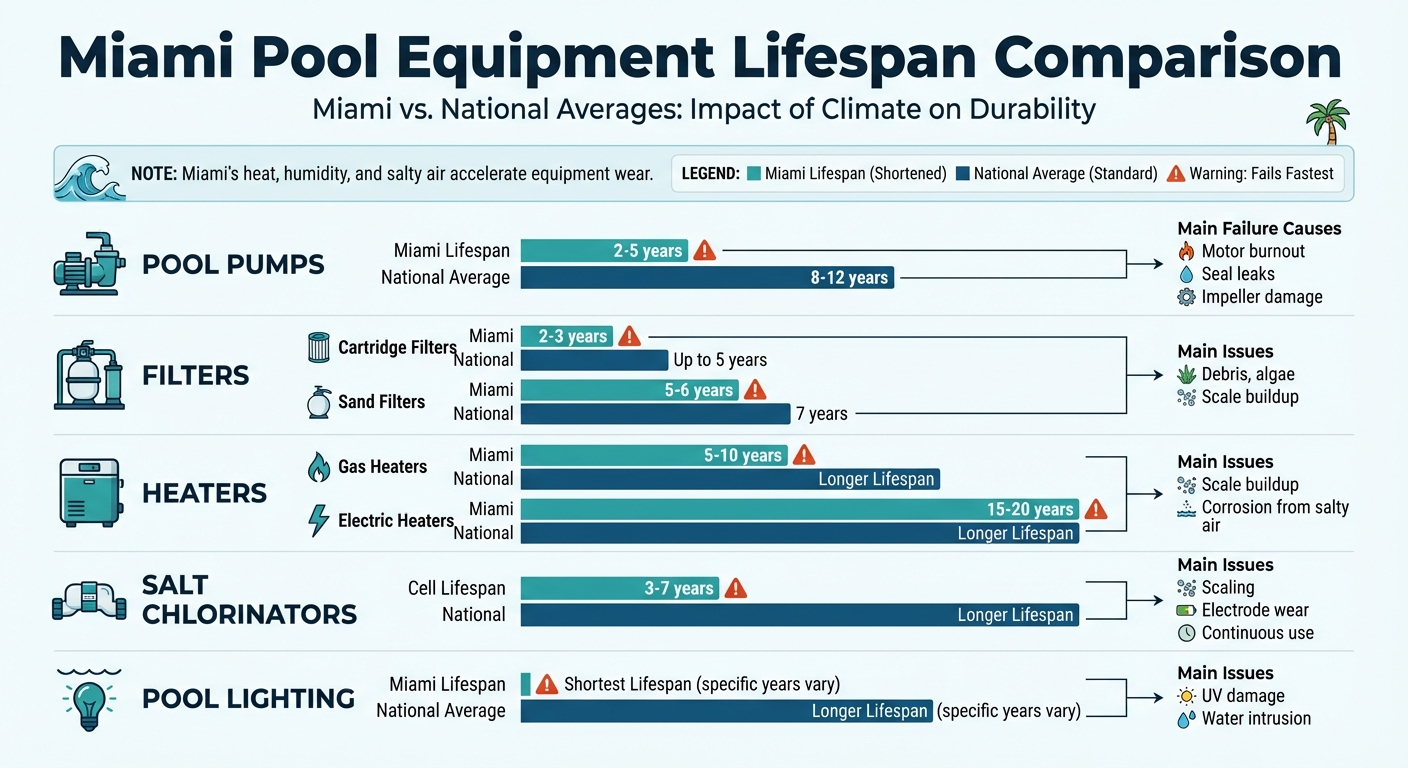
Miami Pool Equipment Lifespan Comparison Chart
How Landscaping Debris Damages Your Pool Equipment (And How to Protect It)
Pool Pumps: Most Likely to Fail First
Pool pumps in Miami face a tough battle against the elements. While pumps typically last 8–12 years in other parts of the country, Miami’s year-round pool season, combined with high heat and humidity, significantly shortens their lifespan. Components like motors, seals, and bearings wear out faster, leading to pump failure. And when a pump fails, the water stops circulating, chemicals can’t distribute properly, and your pool can quickly become unsafe [4][5][6].
Let’s break down what causes pool pumps to fail, the warning signs to watch for, and the environmental factors in Miami that speed up wear and tear.
What Causes Pool Pumps to Fail
Motor burnout is the leading cause of pump failure in Miami. The constant heat puts relentless thermal stress on pump motors, causing them to overheat and fail sooner than expected. While a motor might last about 8 years under ideal conditions, worn bearings can cause grinding or screeching noises long before that [5][6][7].
Seal leaks are another common issue. Miami’s heat and humidity can quickly dry out and crack O-rings and gaskets, which often need replacing every 1–3 years [6]. In coastal areas like Miami Beach or Coral Gables, salt air accelerates corrosion on the motor shaft and seal plate, leading to leaks that can allow water to damage the motor’s electrical components [5][6].
Impeller damage happens when debris clogs the pump or when cavitation (air bubbles in the system) causes uneven wear. Impellers might last 5–7 years under normal conditions, but Miami’s heavy rains and tropical storms often wash debris like leaves and twigs into pool systems, reducing their lifespan [4][6]. While pump housings are rust-resistant and can last 8–10 years, extreme temperature swings can cause cracks, with replacements costing around $250–$300 [6].
Warning Signs Your Pump Is Failing
Unusual noises are often the first sign of trouble. Grinding or screeching sounds point to worn bearings, while a humming noise without water movement often indicates a failed capacitor [7]. Capacitors typically last for about 5,000 starts, and when they fail, they may swell up or give off a burnt smell [7].
Other warning signs include air bubbles in the return lines or a pump basket that won’t fill with water, which could mean failing seals or suction leaks [5][7]. Weak water flow, cloudy water despite proper chemical use, and low filter pressure readings are also red flags [4][8]. If your pump overheats or shuts off unexpectedly, it’s likely nearing critical failure [5]. Additionally, a sharp increase in your electricity bill – normal pump operation costs between $30–$150 per month – could indicate that the motor is working harder than it should [8].
Miami Conditions That Shorten Pump Life
"South Florida pool ownership comes with its own unique set of challenges – high humidity, heavy rainfall, and relentless sun all contribute to accelerated wear on pool equipment." – M&M Pool & Spa Services [4]
Miami’s year-round pool season means pumps are always running, which speeds up wear on every component [4][5]. Poor ventilation around the pump area can make things worse, as trapped heat during the summer puts extra strain on the motor [5].
Debris is another major factor. During Miami’s rainy season, keeping skimmer and pump baskets clear is essential to avoid clogs that force the motor to work harder and overheat [4]. Applying pool lubricant to O-rings annually can help prevent them from drying out and cracking in the intense heat [6]. If your pump is more than 8 years old and showing signs of wear, upgrading to a variable-speed model can improve durability and lower your energy costs [5].
Filters: Prone to Clogging and Damage
Miami’s climate significantly reduces the lifespan of pool filters. While manufacturers suggest cartridge filters can last up to 5 years and sand filters around 7 years, the reality in Florida is quite different. Cartridge filters often wear out within 2–3 years, and sand filters typically last about 5–6 years instead [13]. Frequent storms bring debris and sand, overloading filters, while the warm temperatures encourage algae growth that quickly clogs the filter media [10].
Adding to the challenge, Miami’s hard water – measuring 200–400 ppm – causes scale buildup, which clogs filters and puts extra strain on pumps [9][10]. High humidity fosters mold growth on cartridge filters, and salt chlorination systems can cause chemical imbalances that corrode metal components and damage internal seals [9]. These environmental factors lead to recurring issues that compromise filter performance.
Typical Filter Problems
Some common filter issues include torn cartridge media and broken laterals in sand filters, which allow dirt and debris to bypass the filter and flow back into the pool through the return jets [11].
Multiport valve leaks are also frequent, often caused by cracked O-rings that dry out under Miami’s intense heat. Water pooling around the filter housing or clamp could indicate a failing belly band O-ring, a cracked tank, or a warped clamp due to high-pressure stress. Hard water scale buildup can permanently clog filter media, causing the pressure gauge to spike to cleaning levels within just days. When this happens, the filter may need deep chemical cleaning or even replacement [11][12].
High filter pressure – anything reaching 40 PSI or more – can be dangerous. On clamshell-style filters, extreme pressure can cause clamp bands to fail, potentially leading to the lid blowing off [11]. Repair costs in Miami typically range from $50 to $200, so catching issues early can save you money [9]. Knowing the warning signs of filter failure is essential.
How to Tell Your Filter Is Failing
One of the first indicators of a struggling filter is a fluctuating pressure gauge. If the gauge shows an increase of 8–10 PSI above the clean start-up pressure, the filter is dirty and needs immediate cleaning or backwashing [11][12]. In South Florida, cartridge filters often require cleaning every 2–6 weeks, depending on the amount of debris. If your gauge reads zero while the pump is running, try flicking the dial gently to see if the mechanism is stuck [11][12].
Cloudy water, even with proper chemical levels, is another sign of failing filter media [11][12]. If particles are returning to the pool through the jets, inspect your cartridges or laterals for damage. A noticeable drop in water flow from the pool jets often precedes a high-pressure reading on the filter gauge [11].
| Symptom | Likely Cause | Recommended Action |
|---|---|---|
| High Pressure (8-10+ PSI) | Dirty media or scale buildup | Backwash or clean cartridges [11][12] |
| Low/Zero Pressure | Clogged pump basket or failed gauge | Clean baskets; replace gauge [11] |
| Dirt Returning to Pool | Torn media or broken parts | Inspect cartridges/laterals [11] |
| Leaking Clamp | Worn O-ring or warped tank | Lubricate or replace O-ring [11][12] |
| Rapid Pressure Rise | Oil/mineral saturation | Use chemical filter cleaner [11] |
Heaters: Scale Buildup and Ignition Problems
Miami’s challenging climate – marked by hard water, salty air, and high humidity – takes a heavy toll on pool heaters. Gas heaters typically last 5–10 years, while electric models can endure 15–20 years, though gas units are more prone to damage due to their corrosion-sensitive components [3].
Scale buildup is a frequent issue for pool heaters in Miami-Dade County. When the water’s pH exceeds 7.6, calcium deposits form on the heat exchanger [14][15]. Miami’s high temperatures speed up evaporation, concentrating these deposits and reducing the heat exchanger’s efficiency [3]. Over time, this layer forces the heater to work harder, consuming more energy and ultimately leading to failure [3].
Ignition problems are another common headache for gas heaters exposed to Miami’s salty air and humidity. Burners can corrode or get clogged with debris, preventing proper ignition [16]. The pilot orifice – a tiny opening that controls the flame – often gets blocked by rust, dust, or even insects [3]. High humidity further complicates matters by corroding wiring and disrupting electronic ignition systems, while acidic water accelerates internal damage [9].
Common Pool Heater Failures
The heat exchanger is particularly vulnerable when scale buildup becomes excessive. This critical component transfers heat from the burner to the pool water. If the scale layer grows too thick, the exchanger can overheat, triggering safety sensors that shut down the system [1][3]. If your heater starts "short cycling" (frequent on-off cycling), it’s a sign that scale is severely interfering with its operation [3].
Burner corrosion is another frequent issue in Miami’s coastal areas, where the salt-laden air aggressively attacks metal components. Corroded burners can fail to ignite properly [16]. Thermostat failures are also common, especially after 3–7 years, as moisture seeps into the control panel. This can cause the heater to click without igniting or to run continuously without reaching the desired temperature [16].
Gaskets and O-rings often dry out and crack within 1–3 years due to Miami’s intense heat, leading to leaks around the heater housing [3]. Similarly, bypass valves, which regulate water flow through the heater, tend to fail after 7–12 years due to chemical damage from poorly balanced water [3].
Early Warning Signs of Heater Issues
Certain signs can help you catch heater problems early. For example, strange noises like banging or whistling often indicate scale buildup restricting water flow through the heat exchanger [3][16]. Rattling or screeching sounds, on the other hand, might mean debris is trapped in the system or that components are loose [16].
Uneven heating – when the pool takes longer to warm up or doesn’t reach the set temperature – could point to a failing heating element or an issue with the thermostat calibration [16]. Many digital heaters display error codes to warn of problems like restricted flow from scale buildup or pressure switch failures [3][16]. These codes can help prevent more serious damage.
Visible rust on the cabinet or burner tray is a clear sign of deeper corrosion [3]. If you hear clicking without ignition, it could mean the electronic ignition system is struggling due to a clogged burner, a faulty ignition board, or moisture affecting the electrical components [16].
| Sign | Potential Issue |
|---|---|
| Strange Noises | Debris in the system or scale buildup in the heat exchanger [3][16] |
| Clicking (No Ignition) | Faulty electronic ignition or clogged burner [16] |
| Uneven Heating | Failing heating element or thermostat calibration issue [16] |
| Error Codes | Pressure switch or sensor failure [16] |
| Visible Rust | Salt air corrosion or chemical imbalance [3] |
Addressing these warning signs early can help keep your pool heater running efficiently. Miami’s relentless heat and humidity make regular maintenance essential.
To combat these issues, test your water chemistry weekly. Miami’s intense sunlight can degrade pool chemicals faster than usual [1]. Aim to maintain a pH level between 7.4 and 7.6, calcium hardness between 200 and 400 ppm, and total alkalinity between 80 and 120 ppm to minimize scale and corrosion risks [9][3]. Regularly clean burners and clear the pilot orifice to mitigate salt air corrosion [3][16]. Keep in mind that most heater warranties exclude damage caused by scale buildup or corrosion, as manufacturers consider these preventable with proper water chemistry management [3].
sbb-itb-a36f8f1
Salt Chlorinators and Lighting: Shortest Equipment Lifespans
Salt chlorinators and pool lighting often face the brunt of Miami’s challenging climate. While pumps, filters, and heaters can last 8–12 years, the lifespan of salt chlorinators and lighting is significantly shorter. Salt chlorinator cells typically last only 3–7 years [17], and pool lighting may fail even sooner due to the area’s intense sun, salt-filled air, and constant pool usage. These factors speed up wear and tear on these already delicate components.
Salt Chlorinator Problems: Scaling and Electrode Wear
Salt chlorinators in Miami deal with unique challenges. The titanium electrode plates inside the chlorinator cell, which convert salt into chlorine through electrolysis, are consumable and wear out over time [17][18]. Unlike colder regions where pools are closed during winter, Miami’s year-round pool usage forces these systems to run continuously, adding to the strain [18].
Hard water contributes to mineral scaling, where calcium builds up on the titanium plates, reducing their efficiency in producing chlorine [17][18]. This scaling often appears as a white, powdery residue on the plates [17]. Additionally, Miami’s salty air speeds up corrosion of metal parts and electrical connections [5][18], while the high humidity can cause electrical shorts in control panels [18][19].
Professional cleaning for salt cells costs between $50 and $150, while replacement cells typically run between $399 and $649, depending on the pool’s size and the model [17][18]. To maintain your chlorinator, clean the cell one to three times a year if your water is properly balanced [17]. Check for scaling every three months, and when cleaning, use a weak muriatic acid solution – avoid over-soaking or using metal scrapers, as these can damage the electrode coating permanently [17]. Regularly monitor your LSI (Langelier Saturation Index) and rinse the exterior with fresh water to remove salt deposits [17][18].
Pool Lighting: UV and Water Damage
Pool lighting systems in Miami often fail prematurely due to the harsh environment. Intense UV rays degrade plastic housings and internal components, leading to fading and cracking [1]. Over time, moisture can seep into sealed light fixtures through worn-out O-rings or cracked seals. Miami’s heavy rainfall and high humidity only make this problem worse, causing corrosion and electrical failures [4][9].
If your pool lights start flickering or stop working, it’s likely due to water intrusion into the electrical components. Regularly inspect O-rings, seals, and housings for any signs of cracking to catch issues early [4]. Upgrading to LED pool lights can be a smart move – they’re more energy-efficient and better suited to Miami’s warm climate [20]. Using weather-resistant covers and ensuring proper ventilation around lighting equipment can also help combat humidity-related electrical problems [9]. Consistent inspections and timely upgrades can go a long way in extending the life of your pool lighting system.
How to Extend Pool Equipment Lifespan in Miami
Miami’s subtropical climate can be tough on pool equipment, speeding up wear and tear. However, with consistent maintenance and smart upgrades, you can keep your pumps, filters, heaters, and other components running longer. This not only saves on repair costs but also helps you avoid replacing equipment prematurely.
Regular Maintenance Tasks for Miami Pools
To keep your pool equipment in good shape, weekly tasks are essential. Skim the pool, clean out baskets, and test pH and chlorine levels. Miami’s intense UV rays can break down chlorine up to 40% faster than in northern regions[21]. During summer, testing chemical levels twice a week can help prevent algae growth and chemical imbalances.
On a monthly basis, take extra steps like deep cleaning your filters and inspecting O-rings. Lubricating these O-rings prevents air leaks that could cause pumps to overheat or lose prime. Check for leaks around the pump and filter housings, and rinse off equipment regularly to remove salt spray, which can be corrosive. During the summer months, running your filtration system for 10–12 hours a day is recommended to handle higher bather loads and faster chemical breakdown. Maintaining a pH level between 7.2 and 7.6 helps prevent scale buildup that could clog equipment. Also, during hurricane season, secure your equipment to avoid flooding and expensive repairs.
If regular maintenance isn’t enough, upgrading your equipment can provide added protection and efficiency.
Equipment Upgrades That Last Longer
When your equipment is nearing the 7–10 year mark or needs frequent repairs, it might be time to consider replacements. Variable-speed pumps are an excellent choice for Miami’s climate. They operate quietly, reduce heat stress on motors, and can cut operating costs by 60% to 80% compared to older single-speed models[21]. Their customizable flow rates are especially helpful for pools with water features or salt systems.
Cartridge filters are another smart upgrade, as they effectively trap fine particles like wind-blown sand – common in coastal areas like Miami Beach. For lighting, switching to LED options not only increases energy efficiency but also ensures durability under Miami’s strong UV exposure. Adding shade structures, such as pergolas or weather-resistant covers, over your equipment pads can protect sensitive components from direct sunlight.
If you’re thinking about a saltwater chlorination system, choose models made with corrosion-resistant materials and schedule regular inspections to monitor metal components. Proper ventilation around pump motors is also crucial in Miami’s humid environment to avoid electrical issues and corrosion.
For more personalized upgrade recommendations, professional services can guide you.
Alligator Pools Equipment Services
In addition to regular maintenance and equipment upgrades, Alligator Pools provides expert services designed to address Miami’s specific challenges. Serving Miami-Dade County since 1985, they specialize in protecting and maintaining pool equipment in South Florida’s demanding climate. Their technicians handle pool motor repairs and replacements, perform leak detection to prevent suction issues that could lead to pump burnout, and install equipment pads to shield machinery from sun exposure, flooding, and rust.
Alligator Pools also helps homeowners transition to variable-speed pumps, set up pool automation systems for consistent water chemistry and optimized pump schedules, and prepare pools for hurricane season with customized advice. With certified technicians, clear pricing, and a 3-year workmanship guarantee, Alligator Pools supports pool owners in areas like Coral Gables, Kendall, Pinecrest, and beyond, helping to prevent equipment failures and lower long-term maintenance costs.
Conclusion: Maintaining Your Pool Equipment Investment
Pool equipment in Miami-Dade faces faster wear and tear due to the region’s unique climate. For example, pool pumps typically last 8–12 years, while salt chlorinators may only last 3–7 years[2][22]. These shorter lifespans highlight the importance of staying on top of maintenance.
One of the best ways to protect your pool equipment is by keeping water chemistry in check. Aim for a pH level between 7.2 and 7.6 and alkalinity between 80–120 ppm. This balance helps prevent scaling and corrosion, which can damage heaters and pump seals[10][9]. Miami’s strong UV rays break down chlorine up to 40% faster than in northern regions[21], so testing your pool water at least twice a week during the summer is a must.
Regular professional inspections are another critical step. A small repair costing $150–$700 can save you from spending $500–$1,500 on a full replacement[9][22]. Technicians can identify early signs of trouble, like worn bearings, small leaks, or electrical issues, long before they lead to a complete equipment failure.
Taking a few simple precautions can also extend the life of your equipment. For instance, adding shade structures over equipment pads can protect plastic parts from UV damage. Running your pump for 10–12 hours daily during the summer helps distribute chemicals evenly, while cleaning filters as soon as pressure rises reduces strain on the motor[10].
In Miami’s challenging climate, consistent upkeep is non-negotiable. By combining regular maintenance, proper water chemistry, and professional support, you can help your pool equipment reach or even exceed its expected lifespan – all while keeping your operating costs in check.
FAQs
How can I keep my pool pump running longer in Miami’s climate?
To keep your pool pump running smoothly in Miami’s hot and humid climate, regular upkeep is a must. Every day, skim debris from the pool, keep the water level where it should be, and stay alert for odd noises or leaks. Each week, clean out the pump basket, check the impeller for blockages, lubricate seals, and balance the water chemistry to avoid scaling, which can overwork the motor. Once a month, inspect the pump housing for any rust or corrosion caused by the salty air, clean or backwash the filter, and think about using anti-corrosion coatings or UV-resistant covers. As hurricane season approaches, secure the pump with a waterproof cover and double-check that all components are tightly secured.
To give your pump extra protection, reduce heat stress by placing it in a well-ventilated spot and ensuring it’s connected to a dedicated electrical circuit. If you’re considering an upgrade, a variable-speed pump could be a great choice – it runs cooler and uses less energy compared to single-speed models. Watch for warning signs of overheating, like a motor that feels too hot, grinding noises, or frequent circuit breaker trips. Tackling these issues early can save you from expensive repairs and help your pump last longer in Miami’s tough conditions.
How can I tell if my pool filter needs to be replaced sooner than expected?
If your pool filter seems to be wearing out faster than expected, there are a few telltale signs to keep an eye on. One of the most common is cloudy or dirty water that doesn’t improve, even after running the filter for the recommended amount of time. Persistent algae growth, despite maintaining proper water chemistry, is another red flag that your filter might not be effectively capturing debris. A strong, unpleasant odor coming from the pool could also indicate that contaminants aren’t being properly removed.
A sharp increase in the pressure gauge reading is another sign something’s wrong. If the pressure remains high after backwashing or cleaning, it could mean the filter media is clogged, damaged, or worn out. Other clues include reduced water flow at the return jets, frequent air bubbles in the system, or the filter cycling on and off more than usual. These issues often suggest that your filter may be nearing the end of its lifespan and might need to be replaced.
Catching these problems early can save you from bigger equipment headaches and help keep your Miami pool water clean, clear, and ready for swimming.
Why do salt chlorinators and pool lights wear out faster in Miami’s climate?
Salt chlorinators and pool lights in Miami often don’t last as long as they might in other places, thanks to the area’s challenging weather conditions. The combination of high humidity, salty air, and intense sunlight speeds up corrosion and UV damage, which are the primary reasons these items fail. For salt chlorinators, the salty, moisture-heavy air eats away at metal contacts, circuit boards, and the titanium or stainless-steel cells. This often means they only last about 3–7 years. Pool lights face similar issues, with moisture creeping in to corrode wiring and seals, while UV rays crack plastic housings and wear down silicone gaskets.
Miami’s constant heat adds another layer of stress, causing seals and electrical components to wear out faster due to higher operating temperatures. On top of that, frequent storms and occasional flooding introduce even more water exposure, increasing the likelihood of damage. Together, these conditions make salt chlorinators and pool lights among the first pieces of pool equipment to need replacing in Miami’s tough climate.