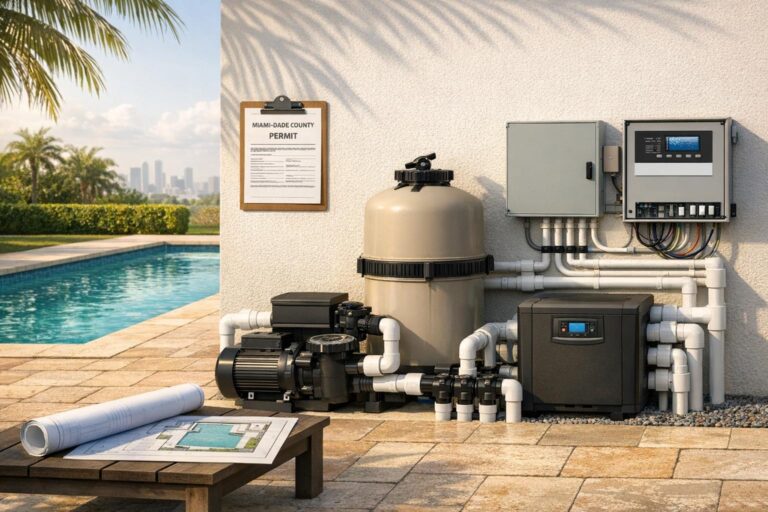

Is your pool pump losing prime? Miami’s heat might be the culprit. High temperatures, water evaporation, and shifting soil create the perfect storm for pool pump issues. When your pump loses prime, it stops circulating water, leading to inefficiency, potential damage, and costly repairs.
Here’s what you need to know:
- Common Causes: Low water levels, cracked O-rings, suction-side plumbing leaks, valve misalignment, skimmer cracks, and heat-damaged seals.
- Quick Fixes: Refill pool water, replace O-rings, tighten connections, open valves, or patch minor cracks with epoxy.
- Prevention Tips: Check water levels 3x weekly, lubricate O-rings monthly, and inspect seals annually.
- When to Call a Pro: Persistent air leaks, underground pipe issues, or motor damage should be handled by a technician.
Act fast – ignoring these problems can lead to expensive repairs, like motor replacements costing $800–$1,500+. Regular maintenance and quick action can save you time and money.
How To Troubleshoot a Pool Pump That Is Not Fully Priming
What Does "Losing Prime" Mean?
A primed pump is completely filled with water, not air. This allows the pump to create the suction needed to pull water from your pool, push it through the filter, and return it through the jets. Think of it like drinking through a straw – if air gets in, the flow stops.
Losing prime happens when air enters the suction side of the pump, breaking the water flow. When this occurs, the pump can’t generate enough suction to move water effectively, causing it to stop working as it should [1][5]. Signs of this include air bubbles swirling in the pump basket, gurgling noises, and weak or no water flow coming from the return jets [3]. Some pumps may take 15 seconds or longer to regain prime and resume normal operation [3].
Running a pump without water, or "dry", can lead to serious damage. Overheating, seal failure, and component damage are common issues. For instance, mechanical seals can melt and start leaking, while internal parts may warp or deform [6].
"Pumps that ‘run dry’ (without incoming water) for long periods can blow out the shaft seal and begin leaking. In some cases, it will melt pump baskets and even deform the pump volute." – In The Swim [6]
If your pump starts sounding rough or unusually noisy, it could be experiencing cavitation. This occurs when vapor bubbles form and collapse inside the pump, potentially damaging internal components [5]. Loud screeching or grinding noises often point to motor failure, which is another consequence of running the pump dry [2]. Identifying prime loss early can save you from costly repairs and ensure your pool system stays in good shape.
Knowing what losing prime means is the first step to diagnosing and resolving the issue, especially in Miami’s intense heat.
Why Miami’s Climate Causes More Prime Loss
Miami’s unique climate presents serious challenges for pool pumps. During the summer, equipment pads can reach blistering temperatures of 120–140°F, and this intense heat takes a toll on seals, O-rings, and plastic components [7]. High temperatures cause elastomers and seals to dry out, crack, and lose flexibility. As a result, your pump has to work harder, leading to overheating and quicker breakdowns compared to pumps in cooler areas [7]. The heat doesn’t just harm your equipment – it also accelerates water loss.
Evaporation is another major culprit behind prime loss in Miami. Pools without covers can lose as much as ½ inch of water daily due to evaporation, which can quickly drop the water level below the skimmer [9]. When this happens, the pump starts pulling in air instead of water, causing it to lose prime almost instantly.
"If left unchecked, low water levels can cause your pump to suck in air, which may damage the motor in a single speed pump, and disrupt water circulation." – On-Time Pool Service [8]
Miami’s shifting ground conditions also put strain on pool systems. The sandy soil in the area expands and contracts with changes in temperature and rainfall, especially during the spring and summer months [10]. This constant movement stresses underground pipes and connections, loosening joints or even causing cracks. For instance, skimmer leaks – commonly found where plastic meets concrete – make up about 60% of all pool leak service calls [11].
The combination of scorching temperatures, rapid evaporation, and shifting soil leads to a noticeable increase in prime-loss service calls during Miami’s 6–8 months of 85°F+ weather [7]. Being aware of these climate-driven challenges can help you better troubleshoot and maintain your pool pump.
6 Main Causes of Prime Loss and How to Fix Them
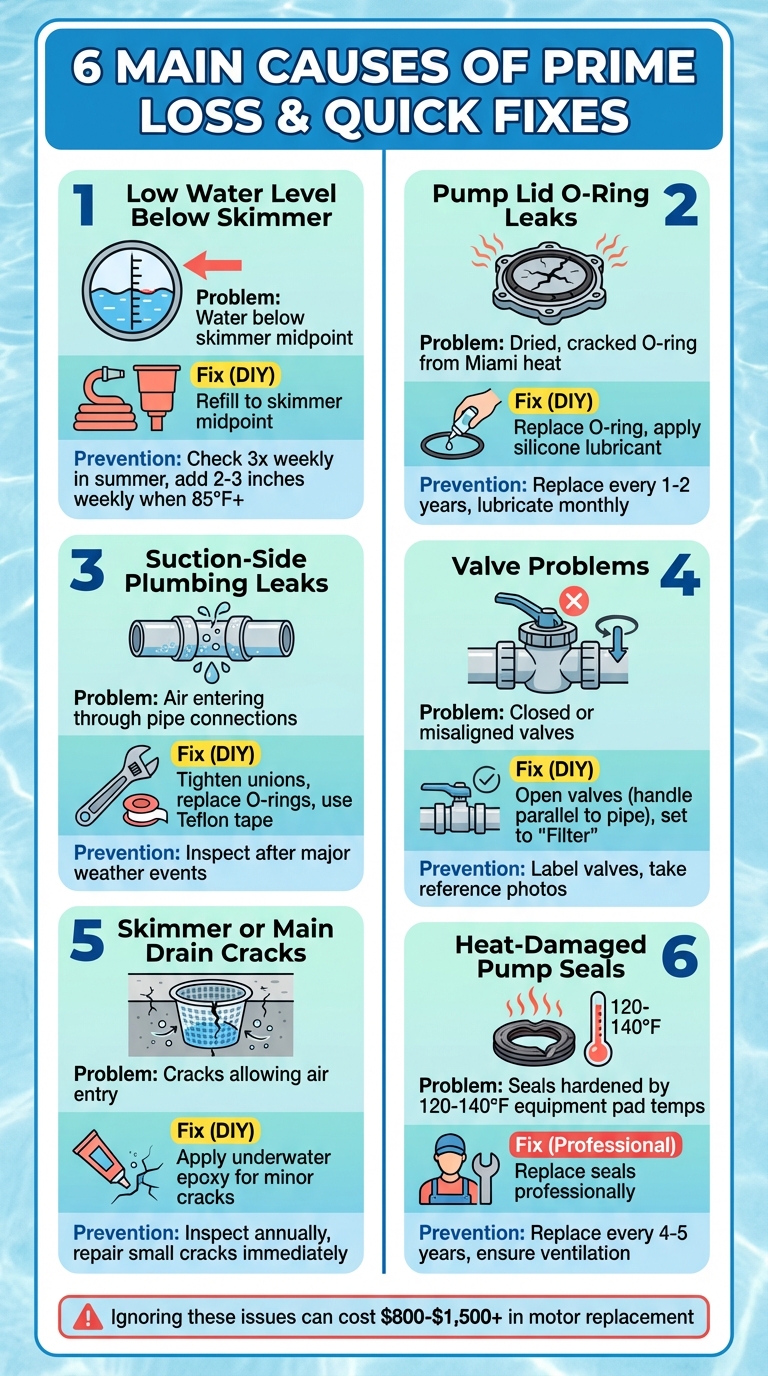
6 Causes of Pool Pump Prime Loss and Quick Fixes for Miami Pools
Let’s dive into the six most common reasons behind prime loss in pool pumps. Each issue comes with straightforward ways to identify and resolve it, so you can get your pump back in action quickly.
1. Low Water Level Below Skimmer
What’s happening:
When the water level drops below the skimmer’s midpoint, the pump pulls in air instead of water. This is the leading cause of prime loss in Miami pools.
How to diagnose it:
Check the water level at the skimmer. If it’s below the midpoint, you’ll likely hear a gurgling noise as air enters the system.
The fix:
Turn off the pump and use a garden hose to refill the pool until the water reaches the skimmer’s midpoint. Restart the pump – it should prime within a minute.
Prevention tips for Miami:
- Check water levels three times a week during the summer.
- Plan to add 2–3 inches of water weekly when temperatures exceed 85°F.
- Mark the ideal water level on your pool tile with a grease pencil or tape for quick reference.
- Consider installing an automatic pool filler to maintain levels consistently.
2. Pump Lid O-Ring Leaks
What’s happening:
Miami’s heat can dry out and crack the rubber O-ring that seals the pump lid, letting air sneak into the pump basket.
How to diagnose it:
If your pump has a clear lid, look for steady streams of bubbles while it’s running. After turning off the pump, inspect the O-ring for cracks, flat spots, or stiffness. A good O-ring should feel soft and flexible.
The fix:
Remove the old O-ring and clean its groove with a damp cloth. Replace it with a new O-ring suited to your pump model, and apply a silicone-based lubricant (avoid petroleum jelly). Press it evenly into place, secure the lid, and hand-tighten it – don’t overtighten.
Prevention tips for Miami:
- Replace the pump lid O-ring every 1–2 years, even if it looks fine.
- Keep a spare O-ring handy and apply fresh silicone lubricant monthly to maintain elasticity.
3. Suction-Side Plumbing Leaks
What’s happening:
Leaks in pipes, fittings, or connections before the pump allow air to enter the system, disrupting prime.
How to diagnose it:
Run the pump and spray soapy water on visible unions, valve connections, and pipe fittings between the skimmer and pump. If bubbles form, you’ve found a leak. Focus on threaded connections and union O-rings.
The fix for minor leaks:
Turn off the pump and tighten loose unions by hand. Replace O-rings in leaking unions, and for threaded connections, wrap threads with Teflon tape before reassembling. Run the pump again to ensure no air bubbles remain.
When to call a professional:
If you can’t locate above-ground leaks but air persists in the system, the problem may be underground. A professional can perform leak detection.
Miami note:
Temperature changes and heavy rains can shift soil, stressing pipe joints. Inspect connections after major weather events.
4. Valve Problems
What’s happening:
Closed or misaligned valves can restrict water flow, forcing the pump to draw in air. This often occurs after pool cleaning or filter maintenance.
How to diagnose it:
Check all valves between the pool and pump. Ball valve handles should align parallel to the pipe when open. The multiport valve should be set to "Filter", not "Closed", "Waste", or "Recirculate."
The fix:
Open any closed valves by aligning their handles parallel to the pipe. For balanced suction, keep the skimmer fully open and the main drain partially open.
Prevention tips:
- Label your valves to indicate their functions.
- Take a photo of the correct valve positions for quick reference when troubleshooting.
Miami note:
Heat can warp plastic valve components over time. Inspect valve handles and seals during quarterly maintenance.
5. Skimmer or Main Drain Cracks
What’s happening:
Cracks in the skimmer throat or main drain allow air to enter the suction line. Miami’s changing temperatures and soil conditions can wear down concrete, leading to cracks.
How to diagnose it:
Turn off the pump and inspect the skimmer throat with a flashlight for cracks or gaps. For a more thorough check, plug the skimmer pipe, fill the skimmer to the top, and mark the water level. If the water drops significantly after 24 hours (while pool water stays steady) or you notice wet spots on the deck, there’s likely a leak.
The fix for minor cracks:
Drain the water below the crack and let the area dry completely. Apply underwater epoxy putty as directed, pressing it firmly into the crack. Allow it to cure for 24 hours before refilling.
When to call a professional:
For large cracks, separated joints, or structural damage, professional repair or replacement of the skimmer or drain is necessary.
Prevention tips:
- Inspect the skimmer and main drain annually, especially before summer.
- Avoid hanging heavy equipment on the skimmer.
- Repair small cracks immediately to prevent them from worsening.
6. Heat-Damaged Pump Seals
What’s happening:
Extreme heat in Miami can harden and crack pump seals, causing water leaks and prime loss.
How to diagnose it:
Look for water dripping from beneath the pump, calcium deposits near the seals, or repeated prime loss after long use.
The fix:
If you’re experienced with pump maintenance, replace the seals yourself. Otherwise, contact a professional. Running a pump with damaged seals can lead to expensive repairs.
Prevention tips:
- Avoid running the pump dry.
- Ensure proper ventilation around the equipment pad.
- Plan to replace seals every 4–5 years or as soon as wear is noticeable.
Once you’ve addressed the cause of your prime loss, you’ll be ready to properly prime your pump and restore full water flow.
How to Prime Your Pump Correctly
Once you’ve addressed the potential causes of prime loss, it’s time to properly prime your pump to restore its full functionality. Follow these steps carefully to ensure everything is set up correctly.
Start by turning off the power at the circuit breaker. Remove the pump lid and fill the pump basket completely with water. Let the water flow for at least two minutes [13]. While doing this, inspect the O-ring to ensure it’s clean, and apply a thin layer of silicone lubricant. Secure the lid by hand to create a tight seal.
Next, open the skimmer and return valves, and set your multiport valve to "Filter." If your filter has an air relief valve on top, leave it open initially. Once water starts flowing steadily, you can close the valve. Turn on the pump and monitor the basket; water should begin filling it within 30 to 60 seconds. When a steady stream of water appears from the air relief valve, close it [13].
If the pump doesn’t prime within a minute, turn it off, refill the basket, and double-check all connections. Air can sometimes get trapped in the suction lines, particularly if the pump has been off for a while. To remove air pockets, you can gently direct a hose stream into the skimmer while the pump is running [12].
For pumps that still won’t prime after these steps, refer to the troubleshooting section below.
In Miami’s hot climate, timing can make a difference. To make priming easier, do it early in the morning or after sunset when the air is cooler. Cooler temperatures reduce evaporation and minimize stress on rubber seals [14][16]. Additionally, running your pump during off-peak hours (typically 8 p.m. to 10 a.m.) can help lower electricity costs, which is especially helpful during Miami’s long summer season [14][15].
If repeated attempts to prime your pump fail, recheck the water level, the pump lid O-ring, and valve positions. Persistent problems often indicate an air leak in the suction line, which may require professional assistance.
sbb-itb-a36f8f1
Quick Diagnosis Guide by Symptom
When your pump starts acting up, diagnosing the issue quickly can save you both time and money. This guide matches common symptoms with their likely causes and provides straightforward fixes to get your pump back in action.
| Symptom | Likely Cause | Quick Fix |
|---|---|---|
| Bubbles in pump basket | Air leaks (damaged O-ring, loose lid, leaky fittings) | Turn off the pump. Check the pump lid O-ring for cracks, lubricate it, or replace if necessary. Tighten all fittings and unions. |
| Gurgling sound at skimmer | Low pool water level, clogged skimmer basket | Add water until it’s halfway up the skimmer opening. Clean out the skimmer basket. |
| Water dripping under pump | Worn pump seals or gaskets | Inspect the shaft seal and O-rings for leaks. Clean and lubricate accessible O-rings. If needed, consider getting the seals professionally replaced. |
| Pump runs but no water flow | Clogged baskets/impeller, closed valves, obstructed suction lines | Turn off the pump. Empty and clean the skimmer and pump baskets. Remove debris from the impeller and ensure all suction valves are fully open. |
| Loses prime shortly after starting | Air leaks in the suction line, faulty check valve | Check suction connections using a soapy water test. Replace any faulty check valves. |
| Loud cavitating or whining noise | Air in the system, restricted water flow, or damaged bearings | Look for air leaks, raise the pool water level, and clear any blockages. If the noise continues, the bearings might need replacement. |
| Water level drops in basket after turning off | Air leaks, faulty foot or check valve | Inspect suction-side connections for leaks. Replace any faulty check valves. |
If you notice more than one symptom, start with the simplest fixes – like checking the water level or cleaning the baskets. These quick steps often resolve the problem in just a few minutes. For air leaks, run a garden hose over suction-side connections while the pump is running. If the water flow improves, you’ve found the leak.
Miami Pool Maintenance Schedule
Miami’s heat and humidity can be tough on pool equipment, making a regular maintenance routine essential. Pumps work harder in this climate, and components tend to wear out faster. Sticking to a consistent schedule not only prevents pump prime issues but also keeps your pool running efficiently.
Weekly tasks are crucial for keeping your pump in good shape, especially during Miami’s scorching summer months. Check the water level at least three times a week – it should always be halfway up the skimmer. You’ll likely need to add 2–3 inches of water weekly during peak summer. While you’re at it, empty the skimmer and pump baskets, and pay attention to any unusual noises like gurgling or grinding. According to Villages Pools, "when your pump is running dry, without water flowing, you severely risk your pool motor burning out, which can end up being an expensive repair" [18].
Monthly checks target components that endure constant stress from Miami’s high temperatures. Inspect the pump lid O-ring for any signs of cracking or brittleness, and apply a silicone-based lubricant to keep it flexible. Test all valves to ensure they open and close properly. These checks are especially important during Miami’s peak pool season, which runs from May through October, when equipment operates under more strain [20].
In addition to monthly tasks, quarterly maintenance dives deeper to catch issues that routine checks might miss. Perform a soap test on suction connections to detect air leaks and address them promptly. Remove the pump lid O-ring, clean it thoroughly, and reapply lubricant. Check the skimmer throat for any cracks and inspect the entire equipment pad for leaks. Given Miami’s climate, you’ll likely need to replace pump seals and gaskets more frequently than in cooler regions [19][21].
Annual inspections should include proactive seal replacements to avoid unexpected failures. If you’ve noticed recurring problems, consider conducting a pressure test. For pumps that are four years or older, it’s wise to schedule a professional assessment. Variable-speed pump motors tend to last longer than single-speed ones since they don’t constantly run at full capacity, but all pumps benefit from a yearly checkup [19].
Tools and Products You’ll Need
To tackle prime loss effectively, you’ll need the right tools and quality parts. Having these essentials on hand ensures repairs are quick and efficient – especially in Miami’s intense heat.
Key Tools to Have:
- Replacement O-rings: Essential for pump lids, drain plugs, and gaskets. Variety packs are a smart choice to ensure you always have the correct size on hand [22][13].
- Silicone lubricant: Keeps O-rings flexible and helps create airtight seals, even in high temperatures [13].
- Thread tape (PTFE tape): Ideal for sealing threaded connections on fittings and drain plugs [22][1].
- Basic hand tools: Wrenches and screwdrivers are indispensable for tightening connections and disassembling components [1].
- Spray bottle with soapy water: A simple way to detect air leaks – just look for bubbles [22][1].
- Garden hose: Perfect for filling the pump basket during the priming process [13].
Repair Parts and Upgrades
As of December 2025, Positive Pool Wholesale offers repair parts like the GO KIT38-9 STA-RITE MAX-E Glass II Pump Shaft Seal Kit for $27.99 and the PS3868 Ozone Saltwater Pump Shaft Seal for $13.99, both with free nationwide shipping [27]. For larger orders, Dade Pump & Supply in Miami provides free shipping on purchases over $250, with online ordering available [26].
Upgrades can also make a big difference. Consider installing a float switch or sensor to automatically maintain water levels, preventing dry running during Miami’s high-evaporation summers [1]. Switching to a variable-speed pump is another excellent choice. These pumps last longer in Miami’s heat – typically 10-15 years compared to 8-10 years for single-speed models. Plus, they cut energy costs by 30-70%, often paying for themselves within 2-3 years. This is especially beneficial given Miami’s extended pool season [23].
Local Suppliers to Check Out
For local options, Miami Pump and Supply serves areas like Miami, Coral Gables, Doral, and Miami Beach, offering pumps, motors, and replacement parts designed to handle high temperatures [24]. Dade Pump & Supply, a trusted name in Miami since 1960, stocks components from brands like Goulds and Sta-Rite. They’re also an authorized STA-RITE® distributor and repair center [26]. If you prefer online convenience, Leslie’s Pool Supplies provides a wide selection available for delivery [25].
With these tools and resources, you’ll be well-prepared to handle repairs and upgrades that keep your pump running smoothly, even under Miami’s challenging conditions.
When to Call a Professional
While some pool pump issues can be tackled on your own – like topping off water, cleaning baskets, replacing pump lid O-rings, lubricating seals, or checking fittings – there are times when it’s best to bring in a professional. If basic troubleshooting doesn’t solve the problem, it might be time to call in the experts.
You should seek professional help if your pump continues to lose prime despite your efforts, if you notice persistent air leaks, or if the pump makes unusual grinding or screeching noises. Underground leaks, electrical issues, and major seal replacements are also best left to professionals. Additionally, if the pump overheats, shuts off unexpectedly, or produces loud grinding sounds, turn it off immediately and consult a technician. Ignoring these signs can lead to further damage. On average, pump repairs can cost anywhere from $150 to $700 [17].
Running a pump that frequently loses prime can result in cavitation – air bubbles forming and collapsing inside the pump. This damages the impeller and other internal components, leading to faster wear, higher energy costs, and potentially a costly motor replacement. What might start as a minor issue could escalate into an $800–1,500+ repair if not addressed promptly.
For electrical problems, persistent leaks, or any issues you’re unsure about, calling a professional is both safer and more cost-effective in the long run.
At Alligator Pools, our certified technicians are equipped to handle everything from simple repairs to comprehensive system diagnostics. We help Miami homeowners stay ahead of expensive breakdowns, especially in the city’s intense heat, which can accelerate wear and tear on pool equipment.
Conclusion
Most pool pump prime issues are surprisingly simple to identify and fix. In Miami, the usual culprits include low water levels, worn-out pump lid O-rings, or air leaks in the suction line. The good news? Many of these problems can be resolved quickly with basic tools and a little know-how.
Start by ensuring the water level in your pool reaches at least halfway up the skimmer. Then, check the pump lid O-ring for any signs of cracking or wear. For air leaks, apply soapy water to the suction-side fittings – bubbles will reveal any trouble spots. This step-by-step approach can save you from expensive repairs down the line.
"Air leaks are the top reason your pool pump is losing prime." – Melissa Graham, Contributing Writer, Angi [2][4]
In Miami’s relentless heat, regular maintenance is non-negotiable. Keep an eye on your water level multiple times a week during the summer. Replace O-rings every 1–2 years, and stock up on spare parts for emergencies. With proper care, your pool pump could last up to 10 years [28]. But ignoring small problems can lead to much bigger ones – like an $800–1,500+ motor replacement.
If your DIY efforts don’t solve the issue, it’s time to call in the experts. Alligator Pools’ certified technicians specialize in everything from underground leak detection to full diagnostics. Serving Miami-Dade County since 1985, we’re well-versed in tackling the challenges of South Florida’s climate. Schedule a diagnostic service today and keep your pool pump running smoothly.
FAQs
How does Miami’s climate affect my pool pump’s performance?
Miami’s sweltering, humid weather takes a toll on pool pumps, demanding extra care to keep them in good shape. With temperatures often soaring above 85°F for six to eight months of the year, pump seals can shrink, leading to air leaks and issues with maintaining a prime. The relentless heat also speeds up water evaporation, meaning you’ll need to check and refill water levels more frequently.
On top of that, Miami’s salty, humid air accelerates corrosion, while seasonal ground shifts and storm debris can wreak havoc on plumbing and seals. To combat the heat, pumps often need to run longer, which increases wear and tear. Regular maintenance isn’t just a good idea – it’s a must if you want to avoid expensive repairs and keep your pump running smoothly.
What are the signs that my pool pump is losing prime in Miami’s heat?
If your pool pump is struggling to maintain its prime, you might spot a few telltale signs: air bubbles in the pump basket, gurgling noises, or reduced water flow from the jets. You may also notice the water level inside the pump basket dropping or the pump losing suction after running for some time.
These problems are especially common in Miami’s sweltering heat. High temperatures can cause seals to shrink and lead to increased evaporation. Spotting these issues early can save you from expensive repairs and help keep your pump operating efficiently.
When should I call a professional for pool pump problems?
If your pool pump refuses to start, leaks water, struggles to circulate properly, overheats, makes strange noises, or is over 8 years old, it’s time to call in a professional. These problems often need specialized tools or expertise to identify and resolve.
Even if you’ve already tackled the basics – like checking the water level, replacing the pump lid O-ring, or tightening the valves – but the issue remains, it’s wise to bring in an expert. Taking care of the problem early can save you from more expensive repairs down the line, like replacing the motor or seals.