
Your pool skimmer is a critical part of keeping your pool clean and functional, especially in Miami’s unique climate. Ignoring small issues like cracks, clogged baskets, or missing weirs can lead to costly repairs, higher water bills, and dirty pool water. Here’s what you need to know:
- Clogged Baskets: Debris from storms and daily use can restrict water flow, damage the pump, and reduce filtration efficiency.
- Damaged or Missing Weirs: A broken or stuck weir can cut skimming efficiency by 50% and harm your pump.
- Cracks and Leaks: Miami’s sandy soil and shifting ground make skimmer cracks common, wasting hundreds of gallons of water weekly and leading to expensive repairs.
- Incorrect Water Levels: Too high or too low water levels can reduce skimmer performance and damage your pump.
Quick Fixes:
- Clean skimmer baskets weekly.
- Inspect and replace weirs as needed.
- Maintain water levels at the skimmer midpoint.
- Seal small cracks promptly with pool epoxy.
Ignoring these issues can escalate repair costs to $3,000 or more. Regular maintenance is key to avoiding major headaches and keeping your pool in top shape.
Pool Skimmer Problems: Costs, Symptoms, and Solutions for Miami Homeowners
How We Fix a Leaking Pool Skimmer
sbb-itb-a36f8f1
Pool Skimmer Problems Miami Homeowners Often Ignore
Skimmer issues might start off small, but they can snowball into bigger, costlier problems if left unchecked. Staying on top of these common issues can save you money and keep your skimmer running smoothly.
Clogged Skimmer Baskets
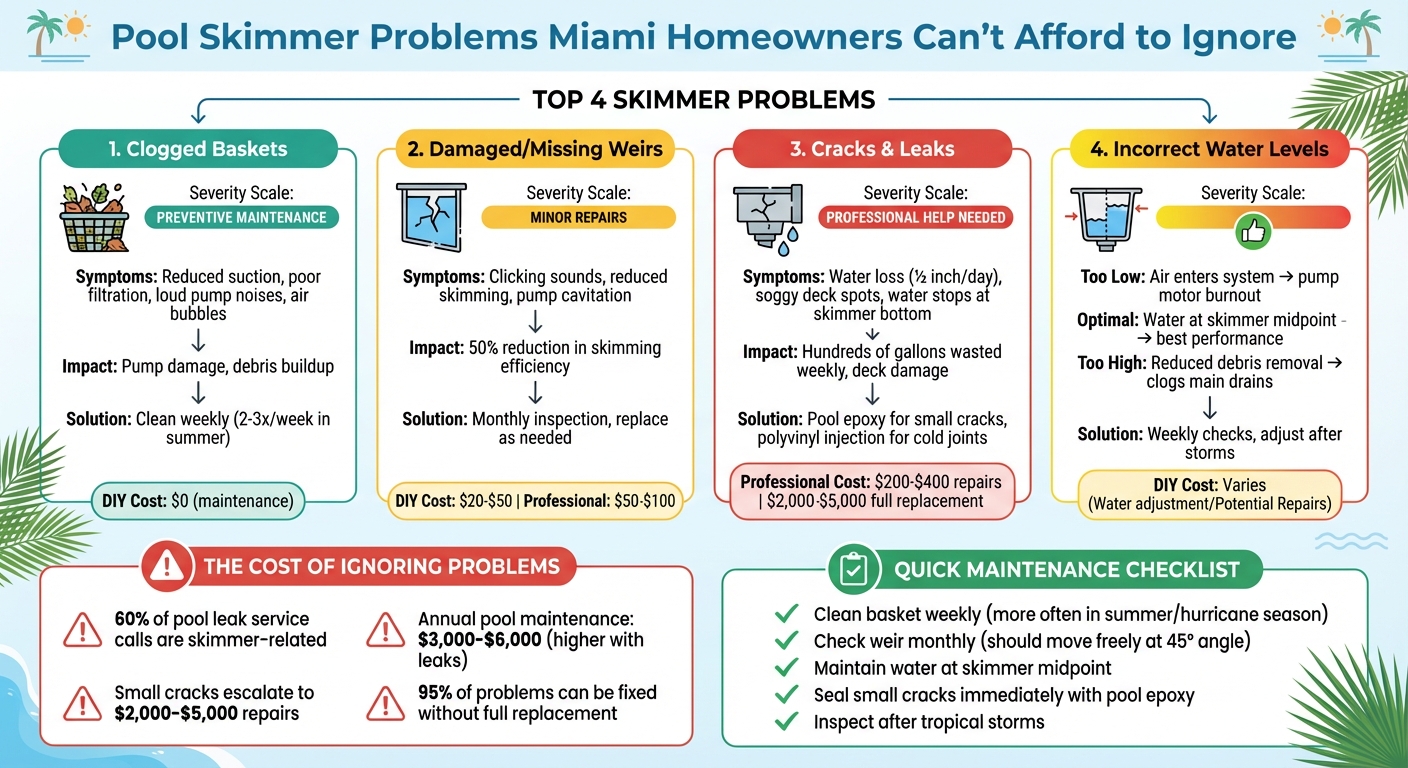
In Miami’s warm, humid climate, skimmer baskets can clog quickly. When debris fills the basket, water flow to the pump is restricted. This can lead to noticeable problems like reduced suction, poor filtration, loud pump noises, or even air bubbles in the pump basket. Over time, surface debris builds up, making your pool less inviting [1].
Miami’s tropical storms and heavy rains often dump leaves, branches, and other debris into pools. After a storm, it’s essential to empty the skimmer basket right away to avoid blockages. Ignoring a clogged basket can cause the pump to lose its prime or, worse, run dry – potentially damaging the motor and leading to expensive repairs [8].
A CL Wizard technician highlights a common mistake:
"Storing tablets in the skimmer saves a few minutes but costs thousands in repairs down the road." [1]
Avoid storing chlorine tablets in the skimmer basket. The chemicals can make the plastic brittle, harming both the pump and the filter. For finer debris, like pollen or grass clippings, consider using a fine mesh skimmer sock to catch what the standard basket can’t [8].
Damaged or Missing Weirs
The weir, or flapper door, inside the skimmer plays a key role in keeping your pool clean. When the pump is running, the weir floats at a 45° angle, pulling in the top layer of water where most debris collects. When the pump shuts off, the weir closes to trap debris and keep it from drifting back into the pool [9].
If the weir is damaged or missing, skimming efficiency can drop by up to 50%. Worse, a stuck or malfunctioning weir can cause pump cavitation, which leads to noisy operation and potential damage. A persistent clicking sound might mean the weir is loose or being affected by turbulent water flow [2][9]. As CoOpPools explains:
"Properly functioning weir doubles skimming efficiency." [9]
Weirs are delicate and can degrade from exposure to pool chemicals, UV rays, or heavy debris. Inspect them monthly to ensure they move freely. Replacing a weir is relatively inexpensive – DIY replacements range from $20 to $50, while hiring a professional might cost $50 to $100. This simple fix can save you hundreds of dollars in maintenance each year [9].
Cracks or Leaks Around the Skimmer
While the weir ensures effective water flow, cracks or leaks around the skimmer housing can lead to significant water loss. Small cracks near the skimmer or at the joint where it meets the pool wall might seem harmless, but they can cause your pool to lose about ½ inch of water per day. These cracks often appear at the "cold joint", where the plastic skimmer connects to the concrete shell. Miami’s sandy soil and shifting ground can worsen the problem.
If your water level consistently drops and stabilizes at the bottom of the skimmer opening, it might indicate a leak in the skimmer housing or cold joint. Such leaks can waste hundreds of gallons of chemically treated water each week. Left unaddressed, these small cracks can lead to repairs costing between $2,000 and $5,000, sometimes involving concrete demolition and plumbing work [1].
Miami’s intense sunlight, high humidity, and salty air speed up the wear and tear on plastic skimmer components. For smaller cracks, polyvinyl injection repairs offer a less invasive and more affordable option than full replacement [1].
Incorrect Water Levels
Your pool’s water level should ideally sit at the midpoint of the skimmer opening – about one-third to one-half of the way up. If the water level drops too low, the pump can pull in air instead of water, causing it to lose prime and potentially damaging the motor. On the flip side, if the water level is too high, the skimmer’s ability to remove debris is reduced, allowing leaves and insects to sink or circulate in the pool [3].
| Water Level Status | Effect on Skimmer | Risk to Equipment |
|---|---|---|
| Too Low | Draws air into the system | Pump motor burnout or loss of prime |
| Optimal | Creates proper suction | Ensures best pump and filter performance |
| Too High | Reduces skimming efficiency | Debris may clog main drains |
In Miami, high evaporation rates and unpredictable tropical rains make maintaining the right water level a constant challenge. The summer heat speeds up evaporation, while heavy rains during hurricane season (June–November) can drastically change water levels overnight. Check your pool’s water level weekly and adjust it after storms to keep it at the skimmer’s midpoint. As Leslie’s Pool Supplies puts it:
"A water level that’s too high or too low won’t allow your skimmer to work efficiently." [5]
What Happens When You Ignore Skimmer Problems
Overlooking minor skimmer issues can snowball into major pool maintenance nightmares. A small crack or a clogged basket might seem insignificant at first, but these problems can escalate, leading to costly repairs and disrupting the overall functionality of your pool.
Higher Repair Costs
A tiny crack in the skimmer’s cold joint can quickly turn into a significant expense. Full skimmer replacements cost anywhere from $2,000 to $5,000, largely due to the labor-intensive process of breaking through concrete [1]. While the replacement skimmer unit itself might only be about $100, the labor costs to install it can multiply that figure by 10 to 20 times because inground skimmers are encased in concrete [5].
But the costs don’t stop there. Leaks from the skimmer can damage the surrounding area. As water seeps into Miami’s sandy soil, it can cause deck pavers to shift, settle, or even sink. Soggy spots around the pool or unusually lush weed growth are telltale signs of water escaping where it shouldn’t [1]. In fact, skimmer leaks make up about 60% of all pool leak service calls [1]. On top of repair bills, even minor leaks can significantly increase your ongoing maintenance expenses.
Water Loss and Higher Utility Bills
A leaking skimmer wastes hundreds of gallons of chemically treated water weekly, driving up your utility costs [1]. Every refill doesn’t just cost you water – it also requires purchasing more chemicals to rebalance the pool’s pH, chlorine, and alkalinity levels.
In Florida, pool maintenance already costs between $3,000 and $6,000 annually [10]. Add a leaking skimmer to the mix, and those expenses climb even higher. The constant loss of water forces your pump to work overtime, leading to higher electricity bills. Worse, if the leak allows air into the system, your pump may lose its prime or run dry. This can destroy the motor, leaving you with a repair bill that could reach into the thousands [1][5].
Dirty Pool Water
A malfunctioning skimmer doesn’t just affect your wallet – it impacts the cleanliness of your pool. Without a properly working skimmer, debris that should be captured at the surface sinks to the bottom, making cleaning more time-consuming and expensive [14][5].
Nelson Inda, Owner and President of Nelson Pool Company, highlights the skimmer’s importance:
"Skimmers are like little buckets built into the side of your pool… Without the skimmers, it will be a lot more difficult for the filter to perform its function efficiently." [14]
When the skimmer fails, circulation suffers, and the filter can’t effectively remove fine dirt, oils, and other contaminants. This poor filtration creates the perfect breeding ground for algae – what pool experts refer to as "organic farms" that thrive in the pores of your pool surfaces [6]. Algae outbreaks require costly chemical treatments and intensive scrubbing to resolve. You might also notice a stubborn scum line forming around the tiles, often called the “bathtub ring,” which demands specialized cleaners and plenty of effort to remove [6]. Between the debris, algae, and murky water, your pool can quickly turn from a relaxing retreat into an eyesore.
Maintenance Tips and DIY Fixes
Addressing skimmer issues early can save you from costly repairs later. Here’s how to keep your skimmer in top shape with practical maintenance steps.
Clean the Skimmer Basket Regularly
Make it a habit to empty your skimmer basket weekly under normal circumstances[3]. In Miami’s tropical climate, you might need to do this 2–3 times per week during the summer or hurricane season, especially after heavy rain. If your pool is surrounded by trees or landscaping, more frequent cleanings may be necessary.
To clean the basket, first turn off the pump. Remove the basket, empty it, and rinse it with a hose. For stubborn grime, use a mild cleaner. Adding a skimmer sock can help trap fine debris like pollen and hair before it reaches your filter. Want an extra trick? Toss a tennis ball into the basket – it can help absorb surface oils.
Check and Replace the Skimmer Weir
The weir door, located inside the skimmer throat, plays a key role in skimming efficiency. It should move freely and rest at about a 45° angle when the pump is running[9]. Check it monthly by gently pushing it; it should snap back without sticking. A functional weir can double skimming efficiency, while a broken or missing one can cut it in half[9].
If the weir is damaged, replacing it yourself is straightforward and costs between $20 and $100. Look for the manufacturer’s part number on the old weir or skimmer basket to ensure you buy the correct replacement. Most weirs for residential pools use spring-loaded pins – press them with a flathead screwdriver to remove the old weir and install the new one. If the weir sticks, apply a light spray of silicone lubricant to the hinges. Also, ensure your pool’s water level is optimal for the best performance.
Keep Water Levels Correct
Proper water level is essential for your skimmer to work effectively. Aim to keep the water level at the midpoint of the skimmer opening – about halfway up. If the level drops too low, air can enter the pump, risking motor damage. If it’s too high, the skimmer won’t capture debris efficiently. In Miami, where weather can change water levels quickly, keeping an eye on this is especially important.
Seal Cracks Around the Skimmer
Fix small cracks around your skimmer as soon as possible using a two-part pool epoxy putty. This works well for minor cracks in the skimmer throat or around the faceplate. For underwater repairs, use products specifically designed for wet surfaces. Lower the water level and clean the area before applying the sealant.
Pay close attention to the “cold joint,” where the plastic skimmer meets the concrete pool shell. This spot is prone to leaks because plastic and concrete expand at different rates in Miami’s heat. If you notice water loss stopping right at the bottom of the skimmer opening or see soggy patches on your deck, perform a dye test. Use pool leak detection dye or food coloring near the suspected cracks. If the dye gets pulled into a gap, you’ve likely found the leak.
When to Call a Professional for Skimmer Repairs
Signs You Need Professional Help
While minor issues can often be handled with routine maintenance, there are times when professional intervention becomes necessary. For instance, if your pool’s water level drops by more than 1/4 inch daily, it could signal a significant leak that requires specialized detection tools to locate [13]. Similarly, persistent bubbles in the pump basket are often a sign that air is entering through a crack in the skimmer [1][6].
Another red flag is a consistent drop in the water level specifically at the skimmer, which typically points to a leak needing professional assessment [14][1]. Wet spots or new cracks on the pool deck near the skimmer area may indicate an underground pipe break [13][12]. If you’ve tried using pool putty to stop water loss but the issue persists, it might suggest a deeper structural problem.
Major structural damage, like a cracked skimmer body, separation from the pool wall, or broken pipes, also calls for professional expertise. In areas like Miami, where sandy soil can shift, the "cold joint" between plastic skimmers and concrete pools is particularly vulnerable. Professionals often address this with flexible polyvinyl injections, which adjust to soil movement, unlike rigid DIY putties that tend to crack within a season [1].
These issues highlight when it’s time to bring in a professional before the damage worsens.
What Professional Services Include
Once a leak or structural issue is identified, professionals use advanced techniques and tools to diagnose and repair the problem effectively. The process often begins with electronic leak detection. Tools like Leaktronics, equipped with sensitive microphones and amplifiers, can pinpoint water escaping through cracks as small as a human hair [12][1]. Pressure testing is another common method, used to isolate the skimmer’s plumbing lines and determine whether the leak is in the underground pipes or the skimmer box itself [13].
For severe clogs caused by root intrusion or heavy debris, professionals may use CO2 tanks or high-pressure water jetting. The cost for these services usually ranges from $75 to over $200, depending on the severity [9][7]. If the skimmer has separated from the pool wall, technicians might use a technique called "pegging." This involves drilling into the pool wall, bending rebar around the skimmer, and securing it with hydraulic cement for a long-lasting bond [14]. For underground pipe breaks, trenchless "no-dig" methods are often employed to fix the issue without major excavation [12].
Crack repairs by professionals typically cost between $200 and $400, while replacing a skimmer entirely can range from $1,500 to $3,000 [9]. Thankfully, about 95% of skimmer problems can be resolved without needing a full replacement [1].
Conclusion
Overlooking your pool skimmer can lead to costly repairs in no time. What might start as a simple clogged basket or a stuck weir could escalate into structural damage, with repair bills exceeding $1,500 [11]. As we always say, "Once a leak starts, it only grows worse."
In Miami’s tropical climate, regular skimmer maintenance isn’t just a good idea – it’s a necessity. A well-maintained skimmer-driven filtration system is key to keeping algae and debris under control [4]. Simple tasks like cleaning the basket weekly, monitoring water levels, and ensuring the weir moves freely can go a long way in preserving your pool’s cleanliness and extending the life of your equipment.
Taking quick action is crucial. Ignoring leaks or structural issues only worsens the problem, often requiring professional intervention. That’s where Alligator Pools steps in. With more than 40 years of experience in Miami-Dade County, our certified technicians specialize in everything from routine maintenance and equipment repairs to skimmer installations and leak detection, all tailored to South Florida’s unique conditions.
Don’t wait for minor issues to turn into expensive headaches. Whether it’s regular maintenance to keep your skimmer in top shape or expert help for existing damage, Alligator Pools delivers dependable service with a 3-year workmanship guarantee. Reach out to us today for a free estimate and enjoy hassle-free pool ownership with Miami’s trusted pool professionals.
FAQs
How often should I check my pool skimmer for clogs or damage?
You should inspect your pool skimmer basket for clogs and damage at least once a week. Regular checks help prevent debris from piling up and ensure your skimmer operates effectively.
During storms, windy conditions, or seasons with heavy leaf fall, you might need to check it more often – especially if your yard is surrounded by trees. Staying on top of this simple maintenance task can keep your pool sparkling clean and help you avoid expensive repairs later.
How can I tell if my pool skimmer is leaking or cracked?
If your pool skimmer has a leak or crack, there are a few telltale signs to watch for. One of the most obvious is a noticeable drop in your pool’s water level – anything more than 1/4 inch per day could signal trouble and might leave you refilling the pool more often than usual. Another red flag is damp or soggy spots around the skimmer or pool deck, which could mean water is escaping from the skimmer housing or gasket. Keep an eye out for visible cracks, gaps, or signs of corrosion on the skimmer itself or where it attaches to the pool wall – these often point to damage.
You might also notice air bubbles in the pump, a sign that air is being pulled in through a crack in the system. If your pump seems to be working harder than normal or your water bill unexpectedly spikes, it could be due to treated water leaking out. Spotting any of these signs means it’s time to get your skimmer inspected and repaired quickly to prevent further issues or expensive fixes down the line.
How do I know when it’s time to call a professional for pool skimmer repairs?
If you spot consistent water loss, damp areas on your pool deck, or your pump acting up, it’s time to reach out to a professional. These signs could point to more serious issues, like a skimmer leak, that go beyond what basic cleaning or DIY fixes can handle.
When tasks like cleaning the skimmer basket or adjusting the water level don’t solve the problem, it’s wise to get expert assistance. Addressing the issue promptly can help you avoid bigger damage and expensive repairs, keeping your pool in great shape – especially in Miami’s challenging climate.