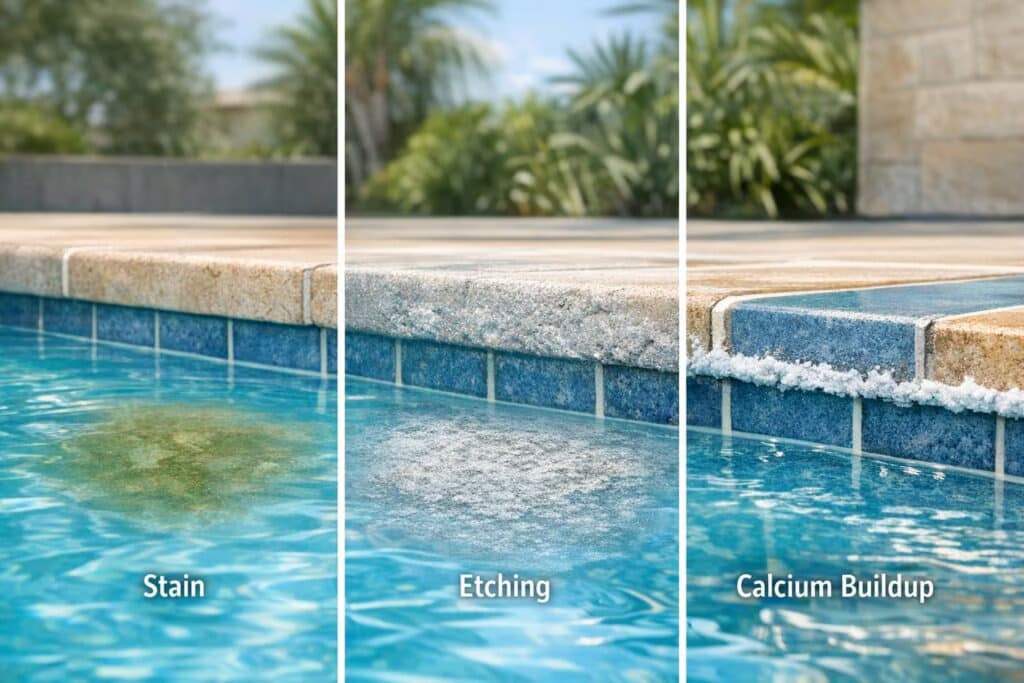
Your Miami pool’s surface might be showing discoloration, rough patches, or crusty deposits. These issues – stains, etching, and build-up – are common due to Miami’s intense sun, warm water, and mineral-rich hard water. Here’s how to identify and fix them:
- Stains: Cosmetic discolorations caused by organic debris or metals. Test with chlorine, Vitamin C, or acid to confirm the type.
- Etching: Rough, pitted surfaces from low pH or calcium imbalance. Requires resurfacing for severe cases.
- Build-up (Scaling): Crusty mineral deposits from hard water and evaporation. Remove with vinegar, pumice stones, or acid washing.
Quick Tips:
- Test water twice weekly to maintain pH (7.2–7.6) and calcium levels (200–400 ppm).
- Brush pool walls weekly to prevent build-up.
- After storms, rebalance chemicals immediately.
For severe issues like rough surfaces or spreading stains, consult professionals like Alligator Pools, who specialize in Miami’s challenges. Regular maintenance can save you costly repairs and keep your pool looking great year-round.
How to Get Rid of Stains and Scale in Your Pool | Leslie’s

How to Identify Pool Surface Problems
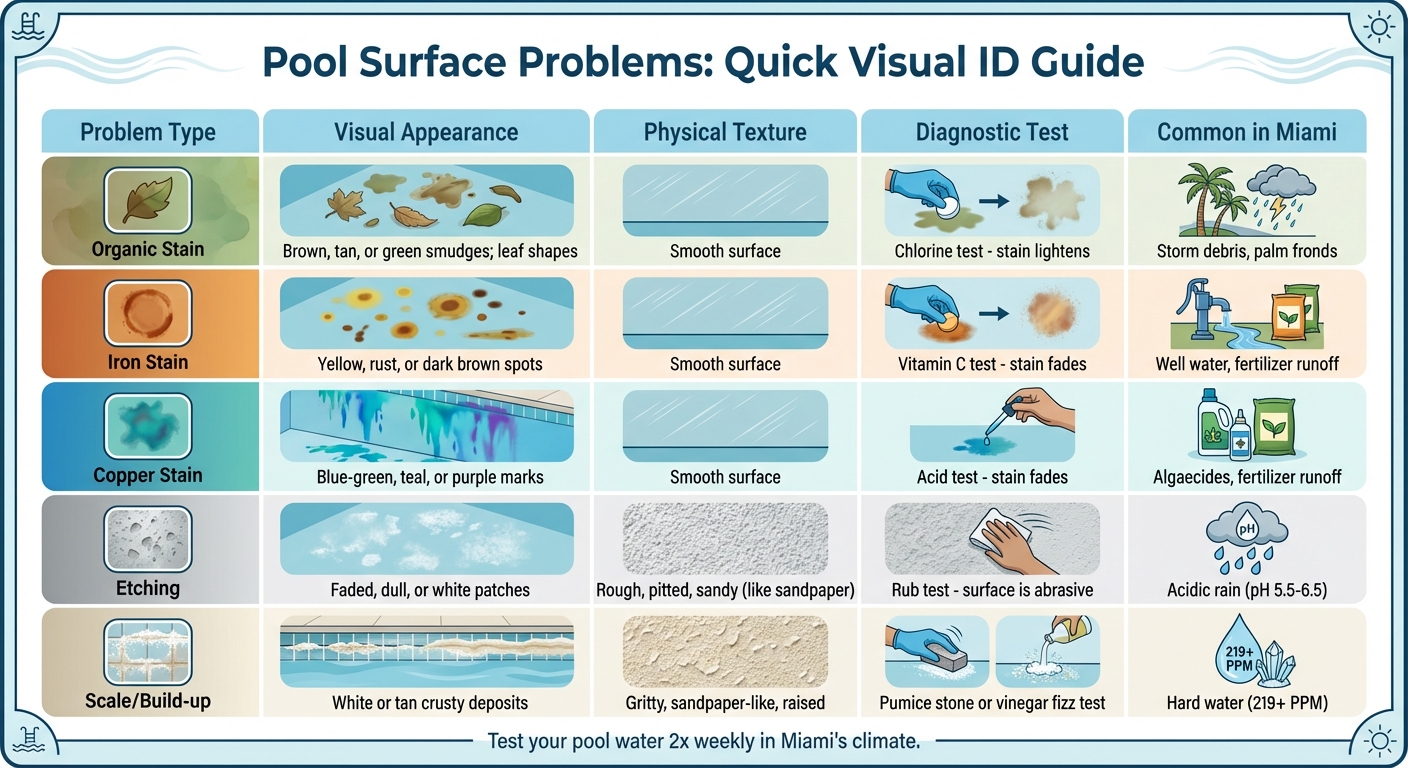
Miami Pool Surface Problems: Visual Identification Guide for Stains, Etching, and Scale
Before diving into pool repairs, it’s essential to pinpoint the exact issue with your pool’s surface. Proper identification ensures effective maintenance, especially in a place like Miami, where unique environmental factors can affect pools. Stains, etching, and build-up each have distinct characteristics. With a few simple tests, you can determine the cause of the problem and take the right steps to address it.
Identifying Pool Stains
Pool stains generally fall into two categories: organic and metal-based. Organic stains often appear as brown, tan, or green smudges – sometimes resembling the shape of leaves. These stains are typically caused by tannins from storm debris, fertilizer runoff, or algae growth, all of which are common in South Florida. On the other hand, metal-based stains have a different set of appearances: rust or orange spots usually indicate iron, while blue-green or purple marks suggest copper. Dark brown or black stains are often linked to manganese, which is commonly found in well water [5].
Here’s how to test for different types of stains:
- Chlorine Test (for organic stains): Place a trichlor puck or sprinkle granular chlorine directly on the stain. Wait a few minutes. If the stain fades or disappears, it’s organic [5][8].
- Vitamin C Test (for iron stains): Crush Vitamin C tablets, place them in a sock, and press it against the stain for 3–5 minutes. If the stain fades, it’s iron-based [5][8].
- Acid Test (for copper stains): Apply acid using a sock and rub it on the stain. If the discoloration lifts, it’s copper-based [8].
In Miami, copper stains are especially prevalent due to the use of copper-based algaecides and fertilizer runoff from landscaping. As water evaporates, metals concentrate on the pool surface, leading to stubborn stains over time.
Once you’ve identified the stain, it’s time to assess the texture of your pool’s surface to rule out other issues like etching or scale.
Identifying Pool Etching
Texture can provide valuable clues about your pool’s condition. Etching refers to permanent damage that leaves the surface rough, pitted, or gritty – similar to sandpaper. Unlike stains, etched areas feel abrasive and can even scrape your feet. Visually, these areas often look faded, dull, or worn, and you might notice the small stones in the plaster (known as aggregate) becoming more visible [6].
If your pool surface feels rough or gritty to the touch, it’s likely etched. This issue is usually caused by water that’s too acidic (low pH) or water that lacks enough calcium, which gradually eats away at the plaster. As Alligator Pools explains:
"Etching and aggregate exposure create an abrasive surface that’s uncomfortable and unsafe. In Miami’s sun, this progresses faster" [1].
Identifying Build-Up on Pool Surfaces
Build-up, or scaling, appears as white, gray, or tan crusty deposits, often forming along the waterline, on tiles, or around pool fittings. Unlike stains, scaling is raised and rough to the touch, with a gritty texture similar to sandpaper [9][3]. This problem is caused by Miami’s hard tap water, which is rich in calcium and other minerals. As water evaporates, these minerals become more concentrated, leading to deposits.
To confirm if you’re dealing with scale, try these tests:
- Rub Test: If a chalky or powdery residue comes off when you rub the area, it’s likely scale. This may also indicate that the plaster is deteriorating [6].
- Vinegar Test: Dampen the area with vinegar. If it fizzes, the deposit is calcium carbonate [3].
- Pumice Stone Test: Rub a wet pumice stone over the rough area. If the material scrapes off, it’s build-up. If the surface remains rough and pitted, you’re likely dealing with etching instead [9][3].
Here’s a quick reference table to summarize these issues:
| Problem Type | Visual Appearance | Physical Texture | Diagnostic Test |
|---|---|---|---|
| Organic Stain | Brown, tan, or green smudges; leaf shapes | Smooth | Chlorine test (stain lightens) |
| Iron Stain | Yellow, rust, or dark brown | Smooth | Vitamin C test (stain fades) |
| Copper Stain | Blue-green, teal, or purple | Smooth | Acid test (stain fades) |
| Etching | Faded, dull, or white patches | Rough, pitted, sandy | Rub test (surface is abrasive) |
| Scale/Build-up | White or tan crusty deposits | Gritty, sandpaper-like | Pumice stone or chalky wipe test |
What Causes Pool Surface Problems in Miami
Now that we’ve identified common issues like stains, etching, and scaling, let’s explore how Miami’s unique climate and water chemistry contribute to these problems. Together, these factors make pool maintenance in this region particularly challenging.
South Florida Environmental Factors
Miami’s sunny, hot climate significantly accelerates pool surface wear and tear. Intense UV rays not only degrade pool surfaces but also deplete chlorine more quickly, creating the perfect conditions for algae growth and etching. For instance, traditional white plaster pools in Miami often last around five years – far less than in cooler, less sunny regions [1].
High evaporation rates in Miami’s heat concentrate minerals like calcium, iron, and copper in pool water. This buildup leads to visible issues like white scale deposits and rust-colored stains, especially during the scorching summer months [5].
Heavy rainfall and tropical storms also play a major role. These weather events introduce organic debris, release tannins, and lower pH levels in your pool water. South Florida’s rainwater is naturally acidic, with a pH ranging between 5.5 and 6.5. A single day of heavy rain can drop your pool’s alkalinity by 5 to 10 ppm, creating an acidic environment that eats away at plaster and causes etching – a rough, pitted texture on the surface [11].
Water Chemistry Imbalances
While Miami’s environment lays the groundwork, the area’s tap water adds another layer of complexity to pool maintenance. Miami’s tap water averages 219 PPM (12 grains) of hardness, which encourages rapid scaling [12][13]. Some neighborhoods fare worse: Hialeah measures 290 PPM, while Coral Springs reaches 298 PPM [13]. This high mineral content means calcium scale builds up quickly, especially if your pool’s pH rises above 7.8.
Balancing pH is critical. Low pH (below 7.2) makes water acidic, eroding plaster and grout, leading to permanent etching. On the other hand, high pH (above 7.8) causes calcium to separate from the water, forming white, crusty scale deposits. Calcium hardness is another key factor – when levels fall below 200 PPM, the water becomes "hungry" for calcium and pulls it from your pool’s finish, leaving behind a rough, deteriorated surface [4].
Together, Miami’s climate and water chemistry create a perfect storm for pool surface problems. It’s no surprise that pool owners in this area spend about 30% more on maintenance than the national average [2]. To stay ahead of these issues, testing your pool water at least twice a week is crucial for catching imbalances before they cause lasting damage [2].
How to Fix Pool Stains, Etching, and Build-Up
Now that we’ve identified common pool surface problems, let’s dive into how to fix them and keep your Miami pool looking its best. Many of these issues can be resolved with DIY methods, especially if you catch them early. Here’s a guide to tackling these problems effectively.
Removing Pool Stains
The first step in dealing with pool stains is figuring out what caused them. A simple tablet test can help: use chlorine for organic stains and Vitamin C for metal stains.
- Organic stains (like those from storm debris or palm fronds): Start by shocking your pool with a high dose of chlorine, focusing on the stained area. Scrub the spot thoroughly with a stiff pool brush, then follow up with an enzyme cleaner to break down any oily residues [15][7].
- Metal stains (often from well water or fertilizer runoff): Begin by lowering your pool’s pH to 7.2. Sprinkle ascorbic acid (Vitamin C powder) directly onto the stain and let it sit for a few minutes. Then, scrub the area and add a metal sequestrant to prevent metals from redepositing on your pool’s surface [15][16]. Ascorbic acid works well for copper and manganese stains, while oxalic acid is more effective for stubborn iron (rust) stains [15][10].
Here’s a quick reference table for common stain types and their treatments:
| Stain Color | Likely Cause | Common Miami Source | DIY Treatment |
|---|---|---|---|
| Green, Brown, Black | Organic (Leaves/Algae) | Storm debris, palm fronds | Chlorine Shock & Brushing |
| Reddish-Brown/Rust | Iron | Well water, fertilizers | Oxalic Acid or Vitamin C |
| Blue-Green/Teal | Copper | Algaecides, heater corrosion | Ascorbic Acid |
| Purple/Black | Manganese | Well water, fertilizers | Ascorbic Acid |
| White/Grey (Chalky) | Calcium Scale | Hard water, high pH | Muriatic Acid or Pumice Stone |
Once the stains are gone, it’s time to smooth out your pool surface to address etching.
Repairing Etched Pool Surfaces
Etching happens when water that’s too acidic eats away at your pool’s plaster, leaving a rough texture that can snag swimsuits or irritate skin. The severity of the etching determines the solution:
- For minor etching, balance your water chemistry promptly. Use sodium bicarbonate (baking soda) to raise Total Alkalinity to 80–120 ppm, or soda ash to adjust both pH and alkalinity to the ideal range of 7.4–7.8 [17].
- For moderate damage, an acid wash can remove a thin layer of plaster, exposing a smooth surface underneath. Keep in mind, acid washing should only be done every five years to avoid wearing down your pool’s plaster too quickly. In Miami, professional acid washing services typically cost around $750 [18].
- For severe etching, where aggregate is exposed or widespread cracks appear, professional resurfacing is necessary. Traditional white plaster in Miami lasts about five years, while more durable finishes like Diamond Brite can last 7–10 years with proper care. Glass tile installations, known for their resistance to chemical wear and UV fading, can last 20–30 years or more [1].
Removing and Preventing Build-Up
Mineral build-up, especially calcium scaling, is another common issue. Appearing as white, crusty deposits along the waterline and tiles, calcium build-up can be identified by applying a few drops of muriatic acid: fizzing indicates calcium carbonate (easier to remove), while no reaction points to calcium silicate (more challenging to address) [15].
- For light build-up, try a mix of white vinegar and water, or create a baking soda paste. Apply it to the affected area and scrub gently with a soft brush [3].
- For stubborn deposits, use a wet pumice stone on tile or plaster surfaces, scrubbing in gentle circular motions. Always keep both the pumice stone and the surface wet to avoid scratches [3][9].
- For severe scaling, professional acid washing may be necessary. As Anas Naami from Flamingo Blue Pools explains:
"Acid washing is a cleaning method that uses a special acid solution to remove stains and buildup from the pool’s surface… This method is often used for pools with rough surfaces like plaster or concrete" [19].
Professional cleaning in Miami Beach starts at around $100, while full acid washing can cost several hundred dollars depending on the pool’s size [3].
Preventing build-up is easier than dealing with it later. In Miami’s hard water conditions, keep your pool’s pH between 7.2–7.6, Total Alkalinity between 80–120 ppm, and Calcium Hardness between 200–400 ppm [3][9]. Regular maintenance, like brushing your pool walls and tiles weekly, helps prevent mineral accumulation. Using sequestering agents or monthly scale control treatments can also keep minerals dissolved in the water [9][8]. Given Miami’s heat and humidity, which can throw off water chemistry quickly, it’s a good idea to test your pool water weekly instead of monthly [9].
When handling muriatic acid for descaling, always wear proper safety gear and remember to add acid to water – not the other way around – for safe mixing [19].
sbb-itb-a36f8f1
How to Prevent Future Pool Surface Problems
Fixing issues with your pool’s surface is one thing, but keeping them from coming back is a whole different challenge. To avoid recurring problems, a solid maintenance routine tailored to Miami’s unique climate is key.
Water Testing and Maintenance Schedule
Miami’s heat and humidity can throw your pool’s water chemistry out of balance in no time. To stay ahead of this, test your pool water at least twice a week during the summer months [2]. Aim for these levels:
- pH: 7.2–7.6
- Total Alkalinity: 80–120 ppm
- Calcium Hardness: 200–400 ppm
- Free Chlorine: 1.0–3.0 ppm
- Cyanuric Acid: 30–50 ppm [3].
Keep your pump running 10–14 hours a day in the summer and 6–8 hours during the winter to maintain proper circulation [14]. Don’t forget to brush the pool walls, steps, and waterline weekly to remove biofilm and prevent mineral buildup [14].
After heavy rain or storms, take immediate action: run the pump continuously for 24 hours, shock the pool, and rebalance the pH and alkalinity. Rainwater dilutes your pool’s chemicals and introduces organic debris, which can lead to stains on the pool floor [2].
If this all sounds like too much to handle, there’s always the option to bring in the pros.
Alligator Pools Maintenance Plans

For pool owners who find Miami’s maintenance demands overwhelming, professional services can make life much easier. Alligator Pools offers Complete Service and Limited Service plans specifically tailored to South Florida’s climate [20]. These plans include chemical balancing, filter cleaning, and equipment checks, all handled by CPO®-certified technicians familiar with the area’s unique challenges [20].
The cost of professional maintenance in Miami typically ranges from $100 to $200 per month, while handling chemicals yourself costs around $80 to $150 monthly [2]. Investing in regular maintenance can extend the lifespan of your pool equipment by 40% to 60% [2]. Considering that Miami pool owners already spend about 30% more on maintenance than the national average – thanks to salt air, intense UV rays, and tropical storms – staying proactive can save you from expensive resurfacing or equipment replacements down the line [2].
When to Call Alligator Pools for Professional Help
Sometimes, no matter how hard you try, stains or scaling in your pool just won’t budge. When DIY solutions fall short, it’s probably time to bring in the professionals. Minor stains and buildup might be manageable on your own, but more severe problems require specialized tools and know-how to fix properly [6].
If your pool walls feel rough, like sandpaper, that’s a sign of severe etching – something you can’t tackle with home remedies [6]. Widespread or recurring stains are another red flag that calls for expert evaluation [3]. And if you notice a chalky white residue after running your hand along the wall, it means your pool’s plaster finish is deteriorating and needs professional attention [6].
Cracks that are getting bigger point to structural problems that go beyond what DIY fixes can handle [1]. Losing more than 1/3 of an inch of water per day? That’s likely a structural leak, not just evaporation [21]. Persistent cloudy water or green walls, even after multiple treatments, could indicate deeper circulation or filtration issues that require professional diagnostic tools [21].
"If the water loss surpasses a third of an inch per day, it’s likely a structural or plumbing problem." – Finn’s Pool Services [21]
Professionals have access to advanced tools and treatments that aren’t available to homeowners. For pools in Miami, where intense UV rays, warm water, and frequent storms are the norm, professional help can prevent small problems from spiraling into costly repairs. When these persistent issues arise, it’s smarter – and often cheaper in the long run – to call in the experts.
Alligator Pools Services for Surface Problems
Alligator Pools has been a trusted name in Miami-Dade for over 40 years, specializing in pool resurfacing and remodeling [22]. They know the unique challenges pools face in this area, from constant sun exposure to storm-related wear and tear, and they offer customized solutions to address these issues. Whether it’s fixing a localized crack or doing a complete resurfacing, they use high-quality materials like Diamond Brite, which lasts 7–10 years, or glass tile installations that can hold up for 20–30+ years in Miami’s climate [22].
Their process begins with an on-site consultation to evaluate your pool’s structure, equipment, and surface conditions. This thorough assessment helps identify whether you need targeted repairs or a full resurfacing job [22]. During these inspections, hidden leaks – often found near waterline tiles, return jets, or skimmers – are uncovered and repaired, stopping water loss and keeping your bills from climbing higher [22].
"We offer a solid 3-year guarantee on all our work against applicator errors like flaking, blistering, or peeling. This guarantee is further backed by a 10-year warranty from the manufacturer for added peace of mind." – Alligator Pools [22]
Most resurfacing projects in Miami-Dade are completed in just 3 to 5 days [22]. Along with resurfacing, they can replace outdated waterline tiles with modern glass tiles, which are more resistant to staining. They also provide upgrades like energy-efficient LED lighting and skimmer replacements to improve circulation [22]. For homeowners looking to stay ahead of potential problems, Alligator Pools offers Complete and Limited maintenance plans. These plans include CPO®-certified technicians who handle chemical balancing, surface brushing, and filter cleaning, ensuring your pool stays in top shape [20].
For a personalized estimate, you can use their Pool Resurfacing Cost Calculator. And if an issue can’t be identified or another contractor disputes their findings, the $125 diagnostic visit fee is refundable [23].
Conclusion: Keep Your Miami Pool in Good Condition
Maintaining your Miami pool isn’t just about keeping it visually appealing – it’s about safeguarding your investment. Miami’s tough weather can accelerate wear and tear. What might begin as a small stain or a slightly rough surface can quickly escalate into costly structural damage.
The good news? Most of these problems can be avoided with regular upkeep. Simple habits like testing your water twice a week, brushing the walls, and keeping chemical levels balanced can do wonders. In fact, these practices can extend the lifespan of your pool equipment by 40–60% and help preserve the finish for years to come[2].
Of course, there are times when a DIY approach just won’t cut it. Persistent stains, rough surfaces, or spreading cracks often require professional attention. Ignoring water chemistry problems, for instance, could lead to repairs that might set you back $4,000 or more[2]. That’s where experts like Alligator Pools step in. With over 40 years of experience tackling Miami’s unique pool challenges, they offer a range of services – from targeted stain removal to full resurfacing, all backed by a 3-year workmanship guarantee [1].
Don’t wait for small issues to spiral into major headaches. Whether you handle maintenance on your own or call in the pros, staying ahead of potential problems ensures your pool remains a safe, clean, and enjoyable space for years to come.
FAQs
How can I tell if a pool stain is organic or caused by metals?
To figure out whether a pool stain is organic or metal-based, you can start with a quick visual inspection and a simple chlorine test.
Organic stains usually show up as brown, tan, or greenish marks. They often resemble the shape of leaves, berries, or other debris that has settled on the pool’s surface. Metal stains, however, tend to be more uniform in appearance. These might look reddish-brown (from iron), blue-green (from copper), or black/gray, and they don’t follow any specific shape or pattern.
For a quick test, place a small chlorine tablet directly on the stain and leave it there for a few minutes. If the stain fades or disappears, it’s organic – chlorine is effective at breaking down organic material. If the stain doesn’t change, it’s likely metal-based. In that case, you’ll need a metal-sequestering agent or possibly professional help to address it. Additionally, checking your pool’s water conditions can offer clues. Metal stains often worsen when pH levels are too low or too high, while organic stains are more likely to appear after heavy rain or when debris builds up in the pool.
How can I prevent etching on my pool surface?
Maintaining balanced water chemistry is the first step to preventing pool surface etching. Make it a habit to test your water weekly, keeping the pH between 7.2 and 7.6, total alkalinity between 80–120 ppm, and calcium hardness at 200–400 ppm. Be cautious with harsh acids like muriatic acid, as overuse can damage plaster or aggregate finishes. Instead, opt for gentler solutions like soda ash to raise low pH levels.
Regular cleaning is equally important. Brush the pool walls and tiles weekly to clear away debris and prevent the formation of acidic spots. For light mineral deposits, a soft brush and diluted white vinegar solution can work wonders in dissolving buildup gently. Save stronger methods, such as acid washes, for severe scaling, and use them sparingly to minimize surface damage. Additionally, applying a protective sealant every 3–5 years can help shield your pool’s finish, reducing the effects of chemical wear over time.
When should I hire a professional for pool maintenance?
If your pool is dealing with problems that regular cleaning or DIY efforts can’t fix, it’s probably time to bring in a professional. Issues like stubborn stains, rough or chalky surfaces, visible cracks, or calcium deposits along the waterline can signal surface damage or structural concerns that need expert attention. On top of that, if you’re constantly battling to keep pH, alkalinity, or sanitizer levels in check despite frequent testing, or if your equipment – like the pump, filter, or heater – is leaking or making strange noises, a professional inspection can help you address these problems before they escalate.
Even if everything seems to be running smoothly, scheduling an annual maintenance check is a smart move. Professionals can balance your water chemistry, catch early signs of wear and tear, and service your equipment – especially before the busy swimming season kicks off in late spring. Regular check-ups not only keep your pool in top shape but also save you money over time and ensure it remains a safe, enjoyable space for your family.