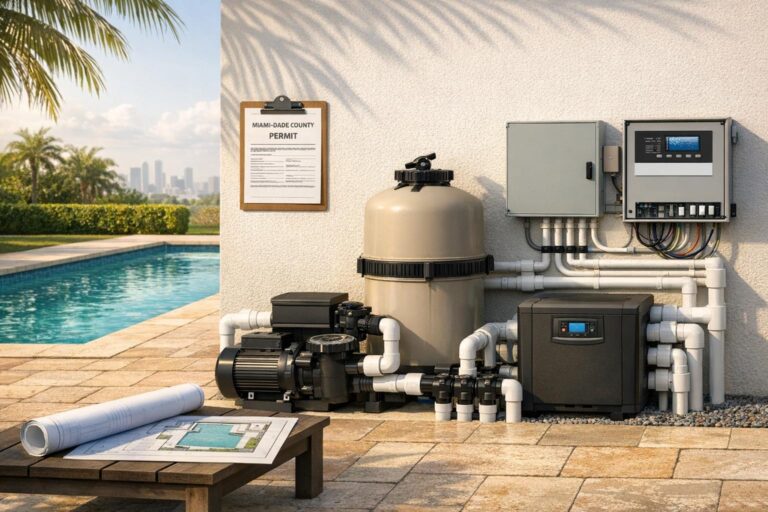

Draining a pool in Miami is risky due to the city’s high water table and hydrostatic pressure. Removing pool water can lead to "pool popping", where groundwater forces the empty pool shell upward, causing severe structural damage. This risk is heightened during heavy rains or hurricane season.
Draining is sometimes necessary for severe contamination, algae, or repairs, but it should always be handled by licensed professionals to prevent costly mistakes. Safer alternatives include partial water replacement and advanced filtration systems like Reverse Osmosis, which clean water without fully draining the pool.
Key Takeaways:
- Draining a pool removes the weight that counters groundwater pressure, increasing the risk of damage.
- Avoid draining during rainy seasons or when the ground is saturated.
- Use partial water replacement or filtration systems to maintain water quality.
- Hire licensed professionals if a full drain is unavoidable to manage risks properly.
Bottom Line: Fully draining a pool in Miami should be a last resort and done with expert guidance to avoid expensive repairs.
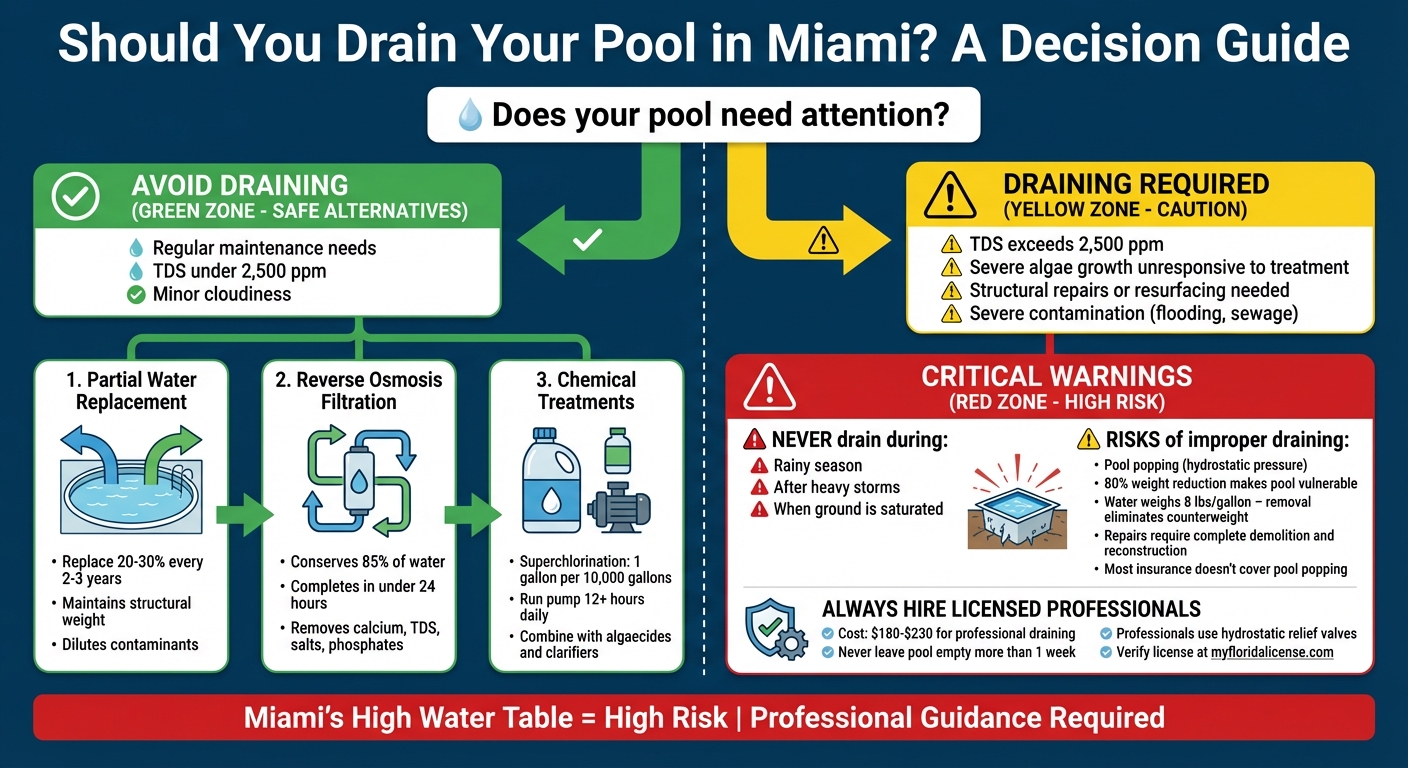
Pool Draining Decision Tree: When to Drain vs. Alternatives in Miami
Miami’s High Water Table and Hydrostatic Pressure
Miami’s unique conditions make hydrostatic pressure a major concern for pool owners.
What is Hydrostatic Pressure?
Hydrostatic pressure refers to the upward force groundwater exerts against the bottom and sides of your pool structure [6]. In Miami, where the soil is often saturated, this force constantly pushes against the pool shell, trying to lift it.
Under normal conditions, the weight of the water in your pool – about 8 pounds per gallon – balances out the groundwater pressure [3]. But when you drain the pool, you remove this counterweight. During or after heavy rains, groundwater pressure can quickly overwhelm the empty shell. AQUAVIX Pools explains:
"Pool popping occurs when hydrostatic pressure exceeds the weight of the pool structure and its water" [6].
Draining a pool can reduce its weight by as much as 80%, leaving it vulnerable to Miami’s fast-rising groundwater levels during heavy rainfall [3]. This creates the perfect scenario for pool popping – a risk that can’t be ignored.
The Risk of Pool Popping
When hydrostatic pressure lifts a pool shell out of the ground, the results can be disastrous. Pool popping can lead to cracked floors, broken PVC plumbing, damaged concrete decks, and compromised electrical systems [7]. Yvonne Florian from the University of Florida’s IFAS program highlights the danger:
"In a storm, when many inches of rain are expected, the ground surrounding a pool will become saturated. All that extra water on the outside of even a partially drained pool could cause the pool to crack under the weight of water" [2].
The financial fallout is steep. Once a pool pops, repairs often require complete demolition and reconstruction [6], which is far more expensive than routine maintenance. Investing in professional pool maintenance can help identify issues before they lead to such catastrophic failures. Worse yet, most homeowners insurance policies don’t cover this type of damage [7].
To manage this risk, licensed professionals in South Florida rely on hydrostatic relief valves – those small white rings on your pool floor. These valves allow groundwater to flow into the pool, equalizing the pressure when the shell is empty [7]. If your pool needs to be drained for repairs, it’s crucial to follow these guidelines:
- Never leave the pool empty for more than one week [7].
- Avoid draining the pool during the rainy season or immediately after storms when the ground is saturated [7].
When You Need to Drain Your Pool in Miami
Sometimes, draining your pool becomes unavoidable. Knowing the right circumstances for it – and when to avoid it – can save you from costly errors.
Severe Contamination
Over time, pool water can become saturated with chemicals and minerals. Total Dissolved Solids (TDS) from evaporation, debris, and chemical treatments can exceed 2,500 ppm, making it nearly impossible to maintain water balance [8]. Nilson Silva, Owner of Master Touch Pools, explains:
"Draining your entire pool is rarely necessary, but in some cases, it may be the best option: High Total Dissolved Solids (TDS)… Unmanageable Chemical Levels… Severe Algae Growth… Pool Repairs or Resurfacing" [8].
Flooding can make these issues worse by introducing contaminants like fertilizers, pesticides, or even sewage overflow – problems that chemical treatments alone may not fix. After hurricanes, it’s also wise to check for unexpected visitors like alligators or snakes in your pool [3,6]. If algae or cloudiness persists despite treatments, draining might be the only solution.
For example, in March 2025, Master Touch Pools tackled a case in Boca Raton where a homeowner struggled to maintain proper pH levels and clear algae. Testing revealed TDS levels exceeding 2,500 ppm. A 30% water replacement, followed by chemical adjustments, successfully restored the pool’s clarity and balance [8].
Structural issues, however, require a different approach.
Repairs and Resurfacing
Damage repair often necessitates draining your pool. Fixing cracks, leaks, or applying a new finish requires an empty pool. Draining also allows for a thorough inspection of plaster, tiles, and coping [9]. Deep cleaning methods, like acid washing to remove stubborn stains or scale buildup, also call for a full drain. Similarly, replacing equipment or pressure testing plumbing lines for leaks can’t be done with water in the pool.
Katie Roundtree from the Northern Palm Beach County Improvement District advises:
"Drain only when necessary. Avoid draining/backwashing your pool during periods of drought and during significant rainfall events" [1].
Before draining for repairs, it’s crucial to ensure the surrounding landscape is dry. Miami’s high water table poses unique risks, and licensed professionals are equipped to assess safe drainage conditions and manage hydrostatic pressure [3,6]. Always rely on experts to handle the process safely and avoid potential damage.
Alternatives to Draining Your Pool
If you’re worried about the risks of draining your pool, there are safer ways to maintain water quality without jeopardizing its structure. This is especially important in Miami, where the high water table can create challenges like hydrostatic pressure. Keeping your pool’s water balanced is key to avoiding damage.
Partial Water Replacement
Partial water replacement is a smart way to refresh your pool’s chemistry while maintaining the water’s weight, which helps counteract hydrostatic pressure. This method dilutes contaminants like Total Dissolved Solids (TDS), calcium, and cyanuric acid without putting your pool’s structure at risk.
When TDS levels exceed 1,550 ppm [12], it’s time to consider partial replacement. Lower the water level just enough for maintenance or to manage overflow from heavy rain. Make sure any standing water on your property has drained first, and never lower the water below the skimmer to avoid damaging your pump motor [2]. Discharge the water slowly over a permeable area to allow natural filtration. To protect local ecosystems, stop adding chlorine at least a week before draining or use a neutralizer. Keep in mind that many Florida municipalities ban discharging chlorinated water into storm drains [11].
For a more hands-off approach, advanced filtration systems can treat your water continuously without the need to drain.
Filtration Systems and Chemical Treatments
Modern filtration systems can clean your pool water without removing it. Reverse Osmosis (RO) systems, like the Puripool Process, extract and filter water before returning it to your pool. This method conserves up to 85% of your existing water and allows you to keep using your pool during the process [10]. Ken Scheer from Pool Water Recycling highlights its benefits:
"Instead of draining you could recycle the swimming pool water with Reverse Osmosis filtration which is a great alternative to draining and it conserves up to 85% of the existing water" [10].
RO filtration removes contaminants like calcium, cyanuric acid, TDS, salts, and phosphates in less than 24 hours. The result? Water that’s nearly drinkable. Compare this to a traditional drain-and-refill process, which takes two to three days, uses all your water, and carries structural risks.
For pools impacted by storms or heavy debris, chemical treatments can also be effective. Superchlorination, which involves raising chlorine levels to very high concentrations, can oxidize organic waste, body oils, and other impurities without the need to drain [13][14]. A common approach is to use 1 gallon of liquid chlorine per 10,000 gallons of pool water, applied at night to avoid UV degradation [13]. To boost the process, combine algaecides and clarifiers, and run your pump for at least 12 hours daily to ensure thorough water circulation [13].
sbb-itb-a36f8f1
Professional Pool Draining and Maintenance in Miami
Why Hire Licensed Professionals?
Draining a pool might seem straightforward, but in Miami, it’s anything but simple. The risks tied to this process are significant, and mistakes can lead to catastrophic damage. One of the biggest concerns is groundwater pressure. When you drain a pool, it loses most of its weight, making it susceptible to hydrostatic pressure from the saturated ground. As the Florida Swimming Pool Association warns:
"When a pool is drained, it is exposed to hydrostatic pressure from the saturated ground. This could cause the entire pool to ‘float’ out of the ground, also known as ‘popping a pool,’ which results in a TOTAL LOSS." [4]
Licensed professionals are equipped to handle these challenges. They use relief valves, submersible pumps to prevent motor burnout, and other specialized methods to manage pressure effectively. Plus, they carry insurance that protects against damages like pool popping [3][4][5][17].
In Miami-Dade, pool electrical work is another area where expertise matters. By law, only licensed electricians can perform these tasks. Maintenance workers without proper licensing are not only breaking the law but could also create dangerous – and potentially fatal – situations [16]. To avoid risks, always verify a contractor’s license at www.myfloridalicense.com before hiring [4]. It’s also important to note that a "CPO" (Certified Pool Operator) certification only covers water chemistry – it’s not a license for structural repairs or equipment work [4].
This level of expertise is what sets Alligator Pools apart in Miami-Dade.
Alligator Pools‘ Pool Care Services

Alligator Pools offers a full range of pool care solutions, from resurfacing and remodeling to regular maintenance. Their licensed technicians handle every aspect of pool care with precision, starting with structural assessments before draining and finishing with exact startup chemistry to protect new surfaces [15]. By using techniques tailored to Miami’s high water table and unique climate, they reduce the risk of costly structural damage.
Their services include Diamond Brite resurfacing, crack repairs, equipment installations, and weekly maintenance. All work is backed by a 3-year workmanship guarantee. They also understand the importance of timing – concrete pools should never remain empty for more than two weeks [3]. To prevent surface damage in Miami’s heat, they apply methods designed specifically for the local environment.
Professional pool draining services typically range from $180 to $230 [5], which is a small price to pay compared to the potential devastation of a popped pool. With Alligator Pools, you’re not just getting pool care – you’re getting peace of mind.
Conclusion
Draining a pool in Miami is not something to take lightly. With the region’s high water table, the risks of hydrostatic pressure are very real. This pressure can push an empty pool out of the ground, causing catastrophic structural damage. When a pool is drained, it becomes highly vulnerable to the upward force of groundwater, which can lead to cracked shells and damaged plumbing. Because of this, fully draining a pool is rarely done and is reserved only for specific situations like severe contamination, resurfacing, or major structural repairs.
For most maintenance needs, partial water replacement – swapping out just 20–30% of the water every 2–3 years – combined with advanced filtration systems can address common issues without the need for a full drain [8].
If a full drain is unavoidable, professional guidance is a must. Miami’s unique conditions require expertise in managing hydrostatic pressure, such as using relief valves and timing the drainage carefully based on groundwater levels. As Nilson Silva from Master Touch Pools explains:
"Draining your entire pool is rarely necessary… Improper draining can cause a pool to lift or crack due to Florida’s high water table" [8].
With over 40 years of experience, Alligator Pools has the knowledge to handle Miami-Dade’s challenging conditions. Their licensed technicians know when draining is truly necessary and how to do it safely, protecting your pool from costly damage. In fact, hiring professionals for this task is far more cost-effective than dealing with the aftermath of structural failure [5].
FAQs
What are the potential risks of draining a pool in Miami?
Draining a pool in Miami is not without its challenges, mainly because of the region’s high water table. An empty pool can shift, float, or even "pop" out of the ground, leading to serious structural issues like cracks in the pool shell. Beyond that, it may also cause expensive damage to plumbing, pumps, and electrical systems.
If not done correctly, draining can harm not just your pool but also the surrounding property. To minimize these risks, it’s important to carefully evaluate whether draining is absolutely needed and to seek advice from a professional if you’re unsure.
When should you drain your pool in Miami?
Draining a pool in Miami is something you should only do when absolutely necessary. The region’s high water table can lead to serious risks, like structural damage or even the pool lifting out of the ground. Situations that might call for a full drain include severe water contamination, major repairs, resurfacing, or when water tests show unmanageable levels of cyanuric acid, calcium hardness, or total dissolved solids.
Before committing to a full drain, explore other options like partial water replacement or consulting a professional. If a full drain is unavoidable, it’s crucial to proceed carefully and with expert guidance to prevent expensive damage.
Are there safer alternatives to draining a pool in Miami?
Draining a pool in Miami comes with its challenges, mainly due to the region’s high water table. This can lead to serious problems like structural damage or even the pool "popping" out of the ground. To avoid these risks, it’s often better to explore safer alternatives for maintaining water quality.
For smaller issues, partial water replacement is a smarter and safer choice. You can drain a portion of the water and refill it right away to maintain the pool’s stability and weight. Before discharging any water, test it to ensure the pH is between 6.5 and 7.8 and chlorine levels are within a safe range. Also, make sure not to release the water into storm drains or septic systems – it’s important to follow local guidelines.
Regular maintenance can go a long way in keeping your pool in good condition without the need for draining. Cover the pool to reduce evaporation, clean and backwash the filter routinely, and occasionally top it off with fresh water.
If a full drain is absolutely necessary – for repairs or resurfacing – it’s best to leave the job to a licensed pool contractor who knows how to handle the process safely. In most cases, maintaining the pool, addressing problems early, and avoiding unnecessary drains will help you keep it in great shape while steering clear of potential hazards.