
When your pool’s plaster starts showing signs of wear, acting quickly can save you thousands in repair costs and prevent structural damage. Plaster protects your pool’s underlying concrete, maintains water balance, and ensures swimmer safety. Ignoring issues like cracks, rough textures, or discoloration can lead to leaks, algae growth, and skyrocketing maintenance expenses. Here’s what to look for:
- Cracks and leaks: Even small cracks can lead to significant water loss and structural damage.
- Rough surfaces: Sandpaper-like textures hurt swimmers and trap dirt, making cleaning harder.
- Chalking or peeling: White residue or flaking plaster signals advanced wear.
- Stains and discoloration: Persistent stains mean the protective layer is breaking down.
- Unusual water loss: Losing more than 1/4 inch daily may indicate plaster failure.
- Chemical imbalances: Deteriorating plaster throws off pH levels, increasing chemical use by 30%.
- Pitting and erosion: Small craters grow into costly structural problems if ignored.
Replastering costs range from $5,000 to $15,000, depending on the material, but delaying repairs can triple expenses. Addressing these issues early ensures a safer, more efficient, and visually appealing pool while avoiding hefty long-term costs.
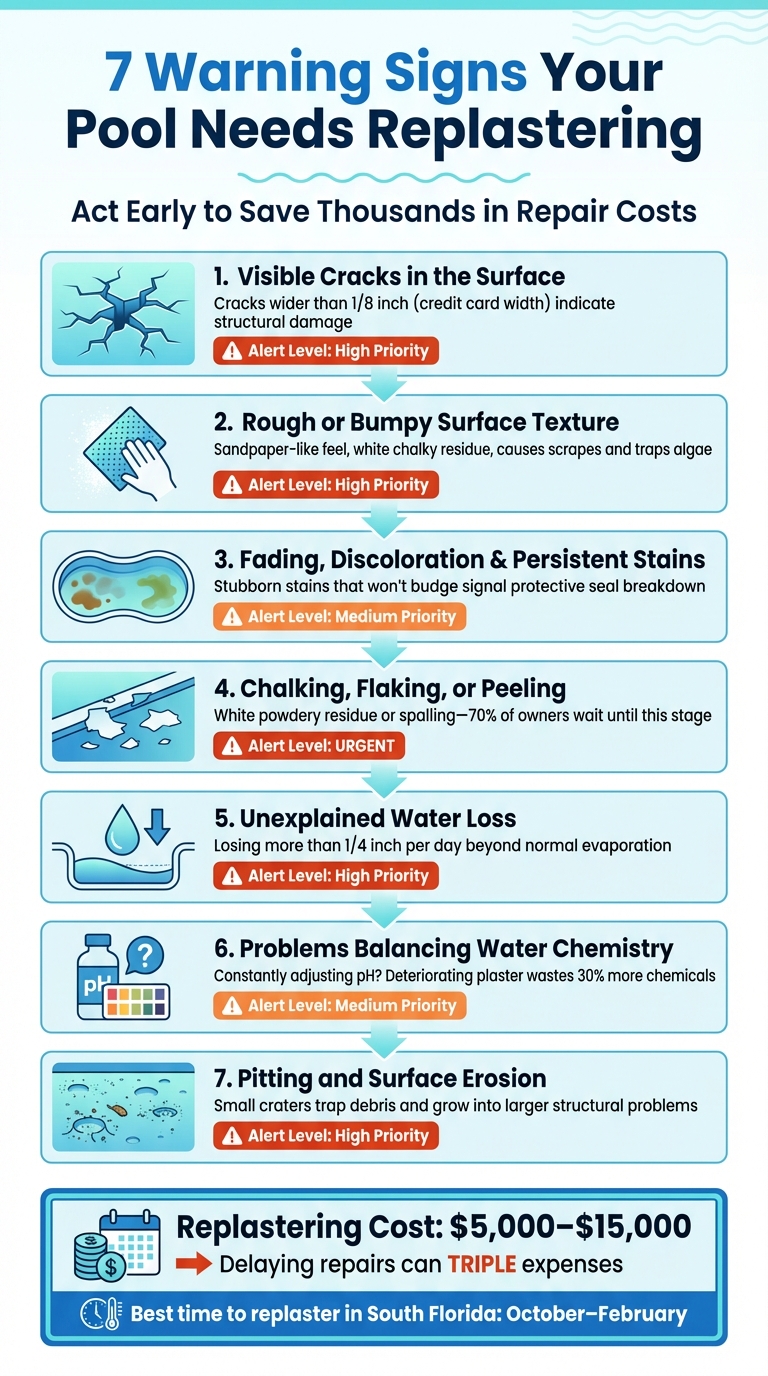
7 Warning Signs Your Pool Needs Replastering
Pool Plaster Basics and Expected Lifespan
What Pool Plaster Does
Pool plaster is a thin, cement-based coating – measuring about 1/4 to 1/2 inch thick – that serves several purposes. First, it waterproofs the pool shell, safeguarding the underlying concrete or gunite structure from damage [7]. It also creates a smooth, swimmer-friendly surface, enhances the pool’s overall appearance with a variety of colors and textures, and helps maintain balanced water chemistry by resisting biofilm and algae buildup [1]. Keeping this protective layer in good condition is essential to avoid the issues we’ll discuss later.
Expected Lifespan of Pool Plaster
When properly cared for, pool plaster can last anywhere from 7 to 15 years [2][4][6]. However, if you live in Miami-Dade, the story might be different. The area’s intense UV rays, high humidity, warm water temperatures, and frequent storms can shorten the lifespan to just 5–7 years [6].
"Miami’s UV exposure, warm water, and frequent storms accelerate surface wear, leading to stains, etching, rough texture, and cracks." – Alligator Pools [1]
Up next, we’ll cover the early warning signs that indicate your pool plaster may be failing, so you can address issues before they become expensive repairs.
sbb-itb-a36f8f1
10 Signs It’s Time To Resurface Your Pool Plaster
7 Warning Signs Your Pool Needs Replastering
Spotting these signs early can save you from costly repairs and prevent serious damage to your pool’s structure. Here are seven key indicators that your pool’s surface may be in trouble – and why they shouldn’t be ignored.
Visible Cracks in the Surface
Hairline cracks (less than 1/8 inch wide) might seem minor, but they can deepen into structural cracks (big enough to slide a credit card into), which can compromise your pool’s seal and lead to leaks [2][4].
"Hairline surface cracks (under 1/8 inch) are cosmetic. Cracks you can fit a credit card into? That’s structural damage requiring immediate attention before your pool leaks hundreds of gallons daily." – John Chavez, Founder, Sublime Pools & Spa [4]
Signs like delamination (a hollow sound when you tap the surface) or pitting (small craters) suggest the plaster is separating from the concrete or being damaged by chemicals [4][8][9]. These cracks often lead to a rougher pool surface, which is another red flag.
Rough or Bumpy Surface Texture
Does your pool surface feel rough like sandpaper? If it leaves a white, chalky residue on your hands, that’s a sign of deeper problems [4]. This rough texture isn’t just uncomfortable – it can cause scrapes, cuts, and even snagged swimsuits [4][9].
Rough patches also create a haven for algae. Tiny craters trap dirt, debris, and organic material, making it nearly impossible to keep the surface clean, no matter how much brushing or chemical treatment you use [1].
Fading, Discoloration, and Persistent Stains
A faded pool finish or stubborn stains that won’t go away indicate that the protective seal is breaking down [4]. Once this happens, chemicals can no longer restore the surface to its original appearance.
"Staining that won’t budge signals surface breakdown. When metals and minerals penetrate deteriorating plaster, no amount of acid washing helps." – Sublime Pools & Spa [4]
Discoloration also creates porous areas where algae can take hold, making it harder to maintain a sanitary pool.
Chalking, Flaking, or Peeling
A white, powdery residue (known as chalking) is an early warning sign that your plaster is deteriorating. Flaking or peeling (spalling) is an even clearer indication that the damage is beyond repair and replastering is urgently needed [3][4][8].
"When pool surfaces start to fail, the first place you may notice it is around the steps or floor. Flaking or peeling plaster in these areas is known as spalling." – Eagle Pool Service [8]
Shockingly, about 70% of pool owners wait until their pool reaches this stage of failure, leading to skyrocketing repair costs [4].
Unexplained Water Loss
If your pool is losing more than 1/4 inch of water per day (beyond normal evaporation), it could mean cracks in the plaster are allowing water to seep into the concrete below [3][2][4][9][8]. This kind of structural damage is already underway, so constant refilling is a clear sign you need a professional inspection.
Problems Balancing Water Chemistry
Are you constantly adjusting your pool’s pH? Deteriorating plaster could be releasing calcium into the water, throwing off the chemical balance and speeding up surface wear [4]. This imbalance not only wastes up to 30% more chemicals but also worsens the underlying problem [4]. Pitting often accompanies these chemical issues, marking another stage of surface failure.
Pitting and Surface Erosion
Small pits and craters caused by chemical or mineral damage aren’t just cosmetic – they trap debris and can grow into larger holes that weaken the concrete shell [9].
"Pitting is more than just an eyesore. These craters can mess with your feet, your pool brush, and your overall good vibes. If you ignore them, these spots can grow, letting water sneak under the shell and cause bigger headaches – think crumbling concrete or peeling plaster." – Mia Remodeling Contractors [9]
What starts as a few small imperfections can quickly snowball into widespread damage, making total replastering unavoidable. Addressing these issues promptly is essential to maintaining your pool’s integrity.
What Happens If You Delay Replastering
Spotting the warning signs is just the beginning. Ignoring them can turn small issues into costly, dangerous, and even irreversible problems. What might start as a minor cosmetic flaw can quickly spiral into structural damage, higher maintenance costs, and safety risks that could leave your pool unusable.
Structural Damage and Water Leaks
When pool plaster begins to fail, it loses its watertight seal. This allows water to seep in, potentially damaging the pool’s structure over time [5]. Small cracks can grow into larger fractures, leading to significant leaks and even damage to the surrounding pool deck [2][10].
"If you don’t replaster after your pool plaster shows signs of failing, you will notice an increase in cracking and leaking, which could result in structural damage over time." – Ralph Tarulli, Pools and Construction Expert, The Spruce [5]
Exposed concrete is particularly vulnerable. Without the protective plaster layer, pool chemicals can attack the concrete directly, accelerating its deterioration. If the foundation becomes compromised, structural repairs could cost upwards of $30,000 [5]. The longer you wait, the more expensive and extensive the repairs become, turning what could have been a manageable fix into a financial headache.
Higher Maintenance and Chemical Costs
Worn plaster creates tiny pits that trap algae and debris, making cleaning and maintenance more time-consuming and expensive [4][11]. A resurfaced pool, on the other hand, can cut chemical costs by about 30% [4]. As plaster deteriorates, it begins to dissolve into the water, a process called chalking. This raises the pool’s pH levels, forcing you to use additional acid to restore chemical balance [4][11]. Every gallon of water lost to leaks or evaporation also requires rebalancing, which further drives up costs [3][4][11].
Safety Hazards and Poor Appearance
The consequences of delaying replastering extend beyond maintenance and repair bills. Rough, sandpaper-like plaster can cause injuries to swimmers and damage swimsuits. It also detracts from your pool’s appearance, reducing its overall value and appeal [2][3][4]. Around 70% of pool owners wait for a major failure before resurfacing, but this can be a costly mistake [4]. Choosing the right pool resurfacing materials early can prevent these issues. Homes with freshly resurfaced pools often sell for about 7% more than those with older, deteriorated finishes [10].
How Pool Replastering Works
Replastering a pool usually takes about 1–2 weeks, though factors like weather and pool size can influence the timeline [14].
The Replastering Process Step by Step
The process starts with a professional inspection. Once that’s done, the pool is drained using a submersible pump, which takes 1–2 days. In areas with high water tables, an additional main drain pump may be used to counteract hydrostatic pressure [12][5].
Next comes surface preparation. Crews remove any loose plaster and use sand- or hydro-blasting to create a rough surface that ensures the new plaster adheres properly [12]. Deep cracks are filled with hydraulic cement or epoxy, and hollow spots are patched to restore the pool’s structure. A bonding agent is applied to prevent peeling or separation, and this bond coat needs 8 to 10 hours to dry before the new plaster is applied [5].
The new plaster material – whether it’s standard plaster, quartz, or pebble – is mixed on-site and applied by spraying or troweling. Crews work within a 4 to 6-hour window to avoid visible seams [12]. For quartz or pebble finishes, the top cement layer is lightly acid-washed to expose the decorative stones or crystals [4].
Once the new finish is in place, the pool is refilled without interruption until the water reaches the mid-tile line. Stopping mid-fill can result in permanent "bathtub rings" [1]. During the first 30 days, the surface must be brushed twice daily, and pH, alkalinity, and calcium levels should be carefully maintained to prevent staining. The filtration system should run continuously for the first 72 hours to 7 days to capture plaster dust [13].
Plaster Material Options
The type of plaster you choose will impact both the cost and how long it lasts:
- Standard white plaster: Costs $3–$5 per square foot, or $5,000–$7,000 total, and lasts 5–10 years. It offers a smooth, classic look but is more prone to staining and chemical damage, especially in warm climates like Miami [4].
- Quartz finishes: Priced at $7–$10 per square foot, or $8,000–$12,000 total, and lasts 10–15 years. The blend of quartz crystals and plaster creates a sparkling surface that resists stains, UV damage, and etching [4].
- Pebble finishes: Costs $8–$12 per square foot, or $10,000–$15,000 total, and lasts 15–25 years. Made with small river stones, this finish offers a natural, slip-resistant texture that hides stains well. However, it may feel rough on sensitive feet [4].
- Glass tile: Ranges from $15–$75 per square foot and can last 20–30+ years. This non-porous option resists algae, doesn’t fade under sunlight, and is one of the easiest to clean and maintain [1].
Timeline for Replastering
Replastering generally requires 10–14 days: 2–4 days for draining and preparation, 1–3 days for application, and 2–5 days for curing and refilling. Swimming can usually resume 3–7 days after refilling, once the water’s chemical balance is restored [14][13].
However, a 30-day intensive care period follows. During this time, avoid using the pool heater for at least 3 weeks, as early heating can cause calcium scaling that might stain the new surface permanently [13]. Robotic cleaners and automatic vacuums should also be kept out of the pool for at least 28 days to protect the fresh plaster [5]. If you have a saltwater system, wait 28–30 days before adding salt to allow the finish to fully cure [1].
In South Florida, the best time to replaster is between October and February. Cooler temperatures during these months help the plaster cure more evenly, reducing the risk of cracks. Avoid the rainy season, as high humidity and heavy rain can delay drying and curing [14].
Next, find out when to schedule a professional inspection to address plaster issues.
How to Take Action on Plaster Problems
When to Schedule a Professional Inspection
If you notice any signs of plaster deterioration, it’s time to call in a licensed pool contractor. Waiting too long can increase repair costs by up to 30% [4].
Before reaching out to a professional, take a few steps yourself. Start by documenting the damage with clear photos of cracks, stains, or peeling areas [15]. Then, perform a couple of simple tests. First, try the chalk test – run your hand along the pool wall; if you see white residue, it’s a sign of active plaster deterioration. Next, do a bucket test: place a bucket filled with water on a pool step, mark the water level inside the bucket, and compare it to the pool’s water level after 24 hours. If the pool’s water level drops more than the bucket’s, you might have a leak [4][15].
A professional inspection is vital for identifying common pool repairs and structural problems before they escalate into emergencies. In South Florida, the best time to schedule this inspection is between October and February, as the cooler weather creates ideal conditions for replastering [4].
Once your inspection is scheduled, it’s time to consider why Alligator Pools might be the perfect partner for your replastering needs.
Why Choose Alligator Pools for Your Replastering Project

After an inspection confirms you need replastering, choosing a provider with local knowledge makes all the difference.
Alligator Pools has been serving Miami-Dade for over 40 years, bringing unmatched expertise in how the area’s intense UV rays, humidity, and heat affect pool surfaces [16]. The company also prioritizes your peace of mind with a $1 million general liability insurance policy to safeguard your property during renovations [17].
Their work is backed by strong guarantees. You’ll receive a 3-year workmanship guarantee covering issues like flaking, blistering, or peeling, along with a 10-year manufacturer warranty [16]. Alligator Pools specializes in durable, high-quality finishes such as Diamond Brite exposed aggregate and glass tile, designed to endure South Florida’s challenging conditions [16].
The process is straightforward and efficient. It starts with a professional on-site inspection, followed by transparent pricing and flexible scheduling. Most projects are completed within just 3–5 days, ensuring minimal disruption to your routine [17].
Conclusion
Spotting the early warning signs of pool plaster deterioration can save you from expensive repairs and potential structural damage. Your pool’s plaster plays a crucial role in preventing water loss, minimizing maintenance costs, and protecting the pool’s structure. Noticeable cracks larger than 1/8 inch, a rough surface, or chalky residue are all clear indicators that your pool may need attention [4].
Waiting too long to address these issues can be costly – delays often result in repair costs increasing by up to 30%, with 70% of pool owners postponing necessary fixes [4]. What might start as a $5,000–$7,000 replastering project can spiral into a much larger expense if left unchecked [4].
Taking action early puts you in control. Replastering your pool not only helps avoid structural problems but also reduces ongoing chemical costs by about 30%. It ensures your pool remains safe for your family, eliminating hazards caused by rough plaster surfaces.
If you notice signs of wear, act promptly. Perform a chalking test, document any visible issues with photos, and schedule a professional pool inspection. In South Florida, the best time for replastering is between October and February, when conditions are ideal [4]. By addressing problems early, you’ll maintain your pool’s functionality and appearance while protecting your investment for years to come.