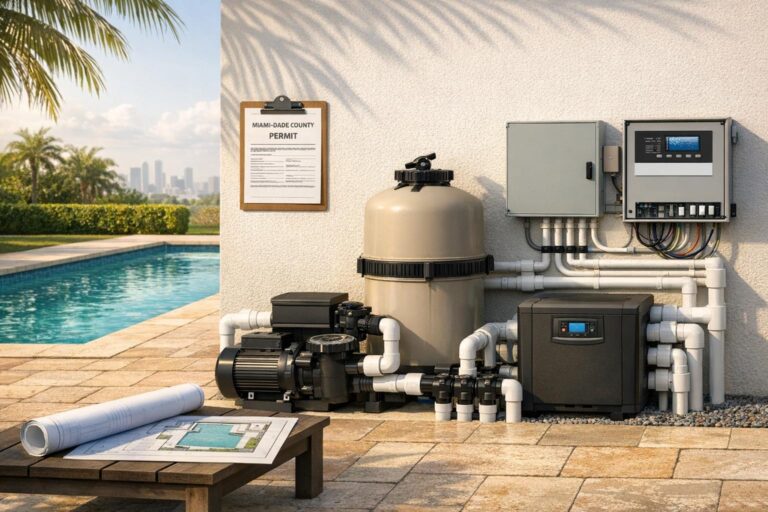

Poor water circulation can destroy your pool plaster, especially in Miami’s hot and humid climate. Without proper flow, chemicals don’t reach all areas, leading to algae growth, discoloration, and surface damage like etching and scaling. Fixing circulation issues can save you thousands in resurfacing costs and extend your pool’s lifespan.
Key Points:
- Stagnant Water Problems: Dead spots form in low-flow areas (corners, steps), causing algae, stains, and chemical imbalances.
- Miami’s Climate Impact: High heat accelerates damage, with UV rays and rain disrupting water chemistry.
- Common Warning Signs: Discoloration, rough patches, cracks, and scaling often signal circulation issues.
- Solutions: Upgrade to variable-speed pumps, adjust return jets, and maintain proper water flow with regular cleaning and brushing.
- Repair Options: Resurfacing with durable materials like Diamond Brite can restore plaster but won’t help if circulation problems persist.
Addressing circulation issues early protects your pool plaster and reduces long-term repair costs. Proper equipment and consistent maintenance are key for Miami pool owners.
Scaling and Etching of your Swimming Pool Plaster: Causes and Cures
How Poor Circulation Damages Pool Plaster
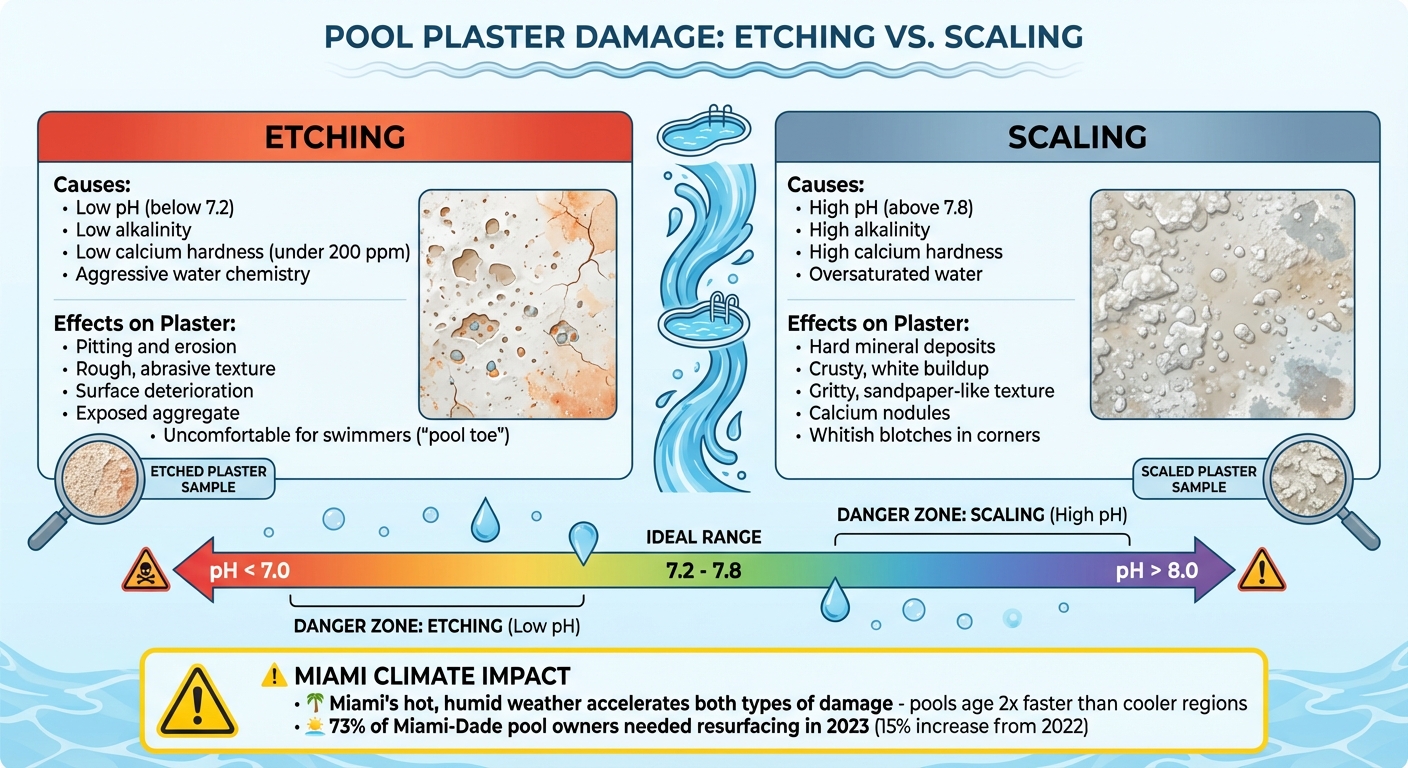
Pool Plaster Damage: Etching vs Scaling Causes and Effects
When pool circulation falters, it creates areas where water stagnates – often behind ladders, steps, or near skimmers. These "dead spots" prevent sanitizers from reaching all parts of the pool, leading to gradual plaster damage.
Discoloration in Low-Flow Areas
Stagnant water disrupts the even distribution of chemicals throughout the pool. While the majority of the water might remain balanced, areas with poor flow, like deep corners or pockets, are left untreated. Without proper sanitizer levels, black algae can thrive in these zones, leaving dark, persistent stains on the plaster.
"The growth of black algae can be evidence of slow or ‘dead spots’ in the pool that occur because poor circulation to those areas causes insufficient amounts of sanitizer or algaecide to reach those areas frequently enough to be effective." – Swim Pool Society [6]
In addition to algae, debris such as leaves, grass clippings, and minerals often settle in these stagnant areas. Over time, these materials can release pigments or oxidize, causing permanent stains. Miami’s frequent storms exacerbate this issue by dumping organic debris into pools. Without strong circulation to guide it toward the skimmer, this debris embeds into the plaster, leaving behind discoloration [2]. Beyond the visible stains, stagnant zones also create chemical hot spots that contribute to etching and scaling.
Etching and Scaling from Chemical Imbalances
Poor circulation can cause localized chemical imbalances that harm plaster, even when the overall water chemistry seems fine. In stagnant areas, chemicals like muriatic acid can settle and concentrate, creating highly acidic pockets that burn the plaster surface [7].
"Since too high or too low concentrations of any chemical you add to your pool could be hazardous to swimmers or the pool itself, the last thing any pool owner wants is saturated pockets of chemicals while the rest of the water is completely unaffected." – Pool Parts To Go [4]
When water becomes "aggressive" – with a pH below 7.2, low alkalinity, or calcium hardness under 200 ppm – it seeks chemical balance by pulling calcium directly from the plaster. This process leads to etching, which creates a rough, pitted surface. On the flip side, oversaturated water (high pH and calcium levels) deposits hard, crusty scale that feels like sandpaper. Pool plaster, made from Portland cement and marble dust, is especially susceptible to these calcium-related reactions [3].
| Condition | Cause | Effect on Plaster |
|---|---|---|
| Etching | Low pH, low alkalinity, low calcium | Pitting, rough texture, and surface erosion |
| Scaling | High pH, high alkalinity, high calcium | Hard mineral deposits and a gritty texture |
In Miami’s climate, these chemical imbalances cause damage at an accelerated rate.
Faster Plaster Damage in Miami’s Heat
Miami’s hot, humid weather makes circulation issues even more problematic. High temperatures speed up chemical reactions, so stagnant water with imbalanced chemistry damages plaster much faster than in cooler regions [9][11].
"Miami’s hot, humid weather can make your pool surface age twice as fast as pools in other cities." – Anas Naami, Pool Expert [9]
Warm, stagnant water encourages algae blooms within days [9][10]. Frequent heavy rains disrupt pH and alkalinity levels, and without proper circulation to evenly distribute chemicals, these imbalances quickly harm the plaster [9][12]. Additionally, Miami’s intense UV rays, heat cycles, and high evaporation rates worsen plaster wear. In 2023, 73% of pool owners in Miami-Dade County needed resurfacing, marking a 15% increase from the previous year [9].
Warning Signs of Circulation Problems
Spotting early warning signs of circulation issues can save you from expensive repairs down the line. For pool owners in Miami, keeping an eye out for specific changes in your pool’s appearance and texture is essential to catch problems before they worsen. Stagnant water can cause damage to the plaster, and recognizing these signs early is key.
Discoloration and Staining
One of the first signs of circulation trouble is whitish blotches that often appear in corners, behind ladders, or near steps. These light patches are caused by increased surface porosity or calcium scaling. The porous areas reflect more light than the surrounding plaster, creating an uneven look [14].
Mineral staining is another indicator, showing up as colored spots – brown, blue-green, or black – caused by metals precipitating on the surface [3][15]. You might also notice a chalky, powdery residue, which points to plaster breakdown or calcium buildup in areas with poor water flow [13][5]. Additionally, mottling, which appears as grayish, uneven shading across the plaster, may become more pronounced due to poor circulation. While some mottling is normal, stagnant water can make it worse [3].
"The fact that we have a spot, or a lightened area is due to the fact you have an increased porosity." – Dr. Boyd Clark, Senior Materials Specialist, Construction Technology Labs [14]
Miami’s intense sunlight can also lead to pigment bleaching. This happens when concentrated chlorine or UV rays fade colored plaster in areas where water isn’t circulating well enough to distribute chemicals evenly [14][2].
But discoloration isn’t the only sign – there are physical changes to watch for, too.
Cracks, Spalling, and Rough Surfaces
Take a closer look at your pool’s surfaces, especially the floors and steps. If the finish feels rough, sandy, or abrasive, it’s a sign of etching or aggregate exposure caused by acidic conditions in stagnant spots [2]. Miami’s hot climate can speed up this deterioration, making the surface uncomfortable for swimmers. If anyone in your family is experiencing "pool toe" – scraped skin from rough plaster – this could be a result of chemical imbalances in low-flow areas [16].
"Low pH levels in a pool create spot etching or corrosion of soft areas in the plaster, areas of delamination, or in areas where the plaster is ‘bent’, such as on steps and in corners." – In The Swim [3]
Another red flag is spalling, where the top layer of the plaster – about 1/8" thick – lifts off or breaks away. This happens when "aggressive" water chemistry pulls calcium hydroxide from the cement binder, especially in areas with poor circulation [17]. You might also notice calcium nodules, which are bumps that form where aggressive water has attacked weak spots beneath the surface [17]. Crazing, or fine hairline cracks, can also appear. While these cracks sometimes result from temperature changes during curing, they can also signal thinning plaster due to chemical wear [17][3].
Pay special attention to steps and corners, as these "bent" areas are particularly prone to localized corrosion and delamination when water circulation is poor [3]. Addressing these warning signs early can prevent minor issues from turning into major structural damage, such as cracks in the gunite shell. Repairs for such damage, like re-plastering, can cost upwards of $5,000 [3][13]. Catching these problems early allows for timely fixes before they become more severe.
sbb-itb-a36f8f1
How to Fix Poor Water Circulation
Improving water circulation often comes down to smart upgrades and consistent care. In Miami’s unique climate, solutions that work in cooler regions might not cut it. By focusing on the right equipment and maintenance habits, you can enhance circulation and protect your pool’s plaster.
Upgrade to Energy-Efficient Pumps
Swapping out single-speed pumps for variable-speed pumps (VSPs) can make a big difference. These pumps keep water moving consistently while using much less energy than older models [1]. They’re especially useful during Miami’s high-temperature months when constant circulation is critical [18].
"Choose a variable-speed pump that offers constant circulation, adequate turnover, and low energy consumption. Ensure the pump is sized appropriately to your pool volume." – Pool Marvel [1]
To maximize efficiency, match your pump to your pool’s size so it completes a full turnover in 8–10 hours daily [1]. In Miami-Dade, pump run times vary by season: 10–14 hours per day in summer, 8–10 hours in spring and fall, and 6–8 hours in winter [18]. Alligator Pools offers professional pump installation across Miami-Dade County, complete with a 3-year workmanship guarantee, ensuring your pump is correctly sized and installed for peak performance.
Once you’ve upgraded your pump, it’s time to ensure water flows evenly throughout your pool.
Adjust Return Jets and Flow Patterns
Properly positioned return jets are key to eliminating dead zones in areas like corners, behind ladders, and around steps. Aim all return jets downward at about a 45° angle and direct them in a circular motion, moving debris toward the skimmers [1]. This setup not only clears debris but also helps distribute chemicals evenly throughout the pool.
If you notice algae or discoloration forming in specific areas, consider adding or repositioning jets to target those trouble spots [2]. After Miami’s frequent storms, check that debris or high-pressure cleaning hasn’t shifted your jets – misaligned jets can cause staining and disrupt circulation [18]. Alligator Pools provides tailored circulation solutions for pools of all shapes and designs, addressing unique flow challenges.
Maintain Your Pool Regularly
Even with the best equipment and jet placement, regular maintenance is crucial to keeping circulation in top shape. Brush your pool walls and steps weekly to break up biofilm and early algae growth, helping your sanitizer work more effectively [18]. Keep an eye on your filter’s pressure gauge – if it reads 8–10 PSI higher than its clean starting pressure, it’s time to backwash or clean the filter to restore proper flow [1].
"Brushing disrupts biofilm and early algae growth so your sanitizer can finish the job. Think of it as ‘making chlorine more effective.’" – Alligator Pools [18]
Maintain the water level between 50–67% of the skimmer opening to avoid running the pump dry [1]. Skim the surface daily and vacuum weekly to prevent organic debris from settling and causing stains [19][8]. Alligator Pools offers weekly maintenance services tailored to Miami’s climate, including chemical balancing, debris removal, and equipment checks to catch circulation issues before they lead to costly plaster damage.
Repairing Circulation-Damaged Plaster
When poor circulation damages your pool’s plaster, stains and rough patches won’t simply go away on their own. Once you’ve fixed the circulation issues, the next step is to restore your plaster to its original condition.
Resurfacing with Diamond Brite
Diamond Brite is a popular choice for pool resurfacing because it combines cement and quartz to create a tough, long-lasting finish. It’s designed to resist etching, mottling, and UV damage – qualities that are especially important in Miami’s sun-soaked climate. While standard white plaster typically lasts about 5 years in Miami, Diamond Brite can extend that lifespan to 7–15 years with proper maintenance [20].
"Diamond Brite by SGM is widely used in Miami for its color range, toughness, and warranty support." – Alligator Pools [2]
Alligator Pools typically completes resurfacing projects in 3–5 days and provides a 3-year guarantee against application errors, such as flaking or peeling. Additionally, the materials come with a 10-year manufacturer warranty [21]. Resurfacing can also reveal hidden cracks near jets or skimmers, allowing you to address leaks and lingering circulation problems at the same time [22].
Protecting Your New Finish
After resurfacing, it’s essential to take steps to prevent future damage and extend the life of your pool’s new finish. Proper circulation remains key to keeping your pool in top condition.
The first 28 days after resurfacing are particularly important. During this time, follow these steps to ensure a smooth cure and prevent issues like scaling or discoloration:
- Brush the pool surface twice a day for the first 3 days, then daily for the next two weeks to clear plaster dust.
- Maintain water chemistry with a pH of 7.4, total alkalinity of 120 PPM, and calcium hardness of 200 PPM.
Alligator Pools provides detailed startup and maintenance protocols to help Miami-Dade pool owners protect their investment for years to come. Their ongoing services ensure that your pool stays in great shape long after the resurfacing is complete.
Conclusion
Keeping water moving efficiently is crucial for maintaining durable pool plaster in Miami. Stagnant water leads to algae buildup and uneven chemical distribution, which can significantly shorten your pool plaster’s lifespan. With Miami’s intense heat and constant UV exposure, proper circulation can extend plaster longevity from 5–7 years to 7–10 years or more[5]. Achieving this requires upgrades like better pumps and smart jet placement, as outlined earlier.
Routine maintenance becomes even more critical after Miami’s frequent storms, which can throw off water chemistry[1][12]. Addressing circulation issues is not just about balancing chemicals – it’s the foundation for keeping your pool plaster in top shape for years.
If your pool plaster is already showing signs of wear, like discoloration, rough surfaces, or etching, resurfacing with durable materials such as Diamond Brite can bring it back to life. However, resurfacing alone won’t solve the problem if circulation issues remain unresolved[2]. Even the highest-quality resurfacing will fail without proper water flow.
With over 40 years of experience in Miami-Dade County, Alligator Pools is your go-to for equipment upgrades and resurfacing services designed to withstand Miami’s challenging climate [18]. Their licensed technicians are well-versed in how local conditions impact pools and can deliver customized solutions – from pump installations to complete resurfacing projects, all backed by a 3-year workmanship guarantee[21].
Protect your pool and ensure its longevity by relying on local experts. Contact Alligator Pools today for a free estimate on maintenance, pump upgrades, or resurfacing services tailored to your needs.
FAQs
What are the signs of poor pool circulation?
Poor pool circulation can manifest in several noticeable ways. For starters, cloudy or green water is a common red flag, often signaling that pool chemicals aren’t being evenly distributed. You might also spot algae growth or dead spots – areas in the pool where water movement is minimal or nonexistent. Other signs include weak water flow from the return jets, air bubbles in the pump, or a low water level in the skimmer. Another potential culprit? A full skimmer basket, which can disrupt the flow of water.
Tackling these problems quickly is crucial. It not only protects your pool’s plaster but also ensures the water stays clean and safe for swimming.
What are the advantages of using a variable-speed pool pump in Miami?
A variable-speed pool pump brings a host of advantages, especially for those living in Miami’s warm and humid climate. By operating at lower speeds during daily filtration, these pumps consume far less electricity compared to single-speed models – potentially cutting energy costs by up to 75%. Plus, you can fine-tune the pump’s speed to suit specific tasks like routine circulation or heating, ensuring the system runs efficiently without unnecessary strain.
Designed to withstand Miami’s challenging weather conditions, variable-speed pumps are built to last longer and perform more reliably than traditional options. They also run much quieter, making them a great fit for residential neighborhoods. Better water circulation not only helps maintain balanced water chemistry but also protects your pool’s plaster from problems like etching and scaling caused by stagnant water. For Miami pool owners, these pumps are a smart and energy-conscious investment.
How does Miami’s climate affect the durability of pool plaster?
Miami’s warm, tropical climate can take a toll on pool plaster, thanks to its unique combination of weather factors. The constant UV exposure from the area’s abundant sunshine dries out plaster, making it more porous and vulnerable to issues like etching, scaling, and discoloration. On top of that, the high heat and humidity create the perfect breeding ground for algae and bacteria. This often means using more chemicals to keep the pool clean, but if water chemistry isn’t carefully managed, it can lead to problems like surface staining or even pitting.
During Miami’s wet season, which runs from May through October, heavy rainstorms bring their own set of challenges. Rain can wash debris into the pool, dilute the carefully balanced chemicals, and allow moisture to seep into tiny cracks in the plaster, gradually worsening the damage. To tackle these issues, pool owners in Miami should focus on maintaining good water circulation, keeping chemical levels balanced, and scheduling regular inspections to protect their pool plaster from wear and tear.