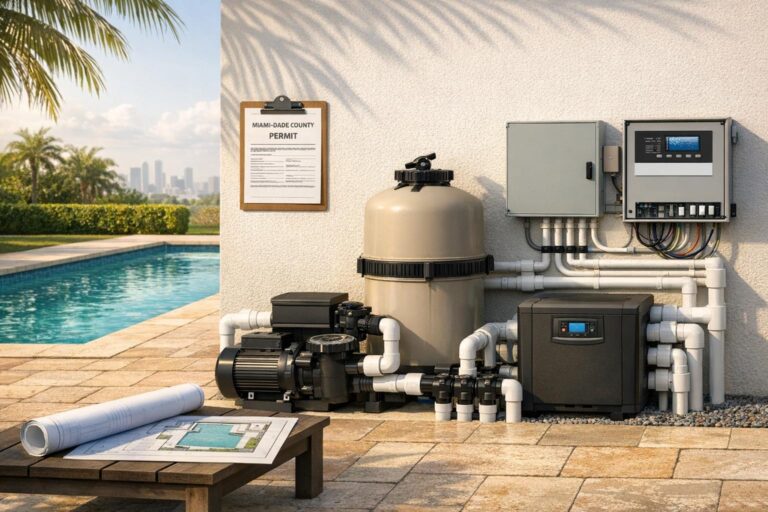

If your pool filter is struggling in Miami’s challenging climate, it might be time for an upgrade. Miami’s warm, humid weather and frequent storms create tough conditions for pool maintenance, making a reliable filtration system essential. Here’s what you need to know:
- Sand Filters: Affordable ($300–$1,000) but require frequent backwashing and are less effective at filtering fine particles. Best for budget-conscious pool owners.
- Cartridge Filters: Mid-range cost ($300–$800), conserve water, and need less frequent cleaning. Ideal for water-saving and moderate maintenance.
- DE Filters: The most effective (1–4 microns) but pricier ($500–$1,500) and higher maintenance. Perfect for those prioritizing crystal-clear water.
Signs You Need an Upgrade: Cloudy water, algae growth, reduced water flow, or rising pressure readings. Filters older than 5–7 years often struggle with Miami’s conditions, leading to higher energy costs and more frequent repairs.
Maintenance Tips: Regular cleaning, monitoring pressure levels, and seasonal deep cleanings are key to keeping your filter efficient. For persistent issues, consult a professional.
Upgrading your filter can improve water quality, lower maintenance demands, and reduce energy bills. Choose a system that fits your pool size, usage, and Miami’s unique climate challenges.
Tips for Upgrading Your Pool Filter
3 Types of Pool Filters and How They Work
Miami’s climate presents unique challenges for pool owners, and choosing the right filtration system can make all the difference. There are three main types of pool filters, each with its own way of functioning, benefits, and drawbacks. Understanding these options can help you select the best system for your budget, maintenance preferences, and water clarity needs.
Sand Filters: Affordable and Straightforward
Sand filters clean water by pushing it through a bed of specially graded sand, which traps debris as small as 20–25 microns. The sand acts like a sieve, allowing clean water to flow back into the pool while capturing dirt and particles.
These filters are a popular choice in Miami due to their relatively low cost, ranging from $300 to $1,000 depending on size and brand. However, they require regular backwashing – typically every one to two weeks – which can use up to 300 gallons of water per session [2]. Over time, the sand may develop "channels" that reduce its effectiveness, meaning it needs to be replaced about every five years at a cost of roughly $120.
While sand filters are cost-effective and simple to operate, their maintenance demands and higher water usage may not appeal to everyone. Still, they remain a practical option for Miami pools that require moderate upkeep.
Cartridge Filters: Efficient and Low-Maintenance
Cartridge filters use pleated fabric elements to trap particles as small as 10–15 microns, delivering better water clarity than sand filters. The pleated design increases the filtration surface area, ensuring more thorough cleaning.
These systems are priced between $300 and $800, and replacement cartridges, which last three to five years, cost $150 to $250. Unlike sand filters, cartridge filters don’t require backwashing, making them more water-efficient. Instead, the cartridges need to be removed and rinsed every few months – an easy task for most homeowners.
In March 2023, a Miami resident switched from a sand filter to a cartridge filter and reported a 30% reduction in water usage, along with noticeably clearer water, as noted by Flamingo Blue Pools [1].
"Cartridge filters are becoming increasingly popular in Miami due to their efficiency and lower water usage." – Medallion Energy [2]
Cartridge filters are especially effective in Miami, where fine debris from storms can be a common issue. Their ability to handle smaller particles with less frequent maintenance makes them a favorite among local pool owners.
DE Filters: Superior Filtration for Pristine Water
Diatomaceous Earth (DE) filters provide the highest level of filtration, capturing particles as small as 1–4 microns. They work by coating internal filter grids with diatomaceous earth powder, a natural material made from fossilized algae. This coating traps even the tiniest particles, resulting in exceptionally clear water.
DE filters are more expensive, with prices ranging from $500 to $1,500, but their performance justifies the cost. According to a 2024 study by Medallion Energy, DE filters deliver the clearest water in residential pools [2].
"DE filters offer the finest filtration at 3-4 microns for crystal-clear water." – Amenity Pool Services [3]
However, these filters require more upkeep. After each backwash, fresh DE powder – about $50 for a 24-pound bag – must be added to recharge the system. While the maintenance is more involved, DE filters are ideal for Miami homeowners who prioritize water quality above all else.
Comparing Your Options
Here’s a quick breakdown of how the three filter types stack up:
| Filter Type | Filtration Level | Initial Cost | Maintenance Frequency | Water Usage |
|---|---|---|---|---|
| Sand | 20–25 microns | $300–$1,000 | Backwash every 1–2 weeks | High (300 gallons per backwash) |
| Cartridge | 10–15 microns | $300–$800 | Clean every few months | Low (no backwashing) |
| DE | 1–4 microns | $500–$1,500 | Regular cleaning/recharging | Moderate |
For Miami pools, the right choice depends on your specific needs. Sand filters are a budget-friendly option if you don’t mind frequent maintenance. Cartridge filters strike a balance between efficiency and ease of use, making them great for conserving water. And for those who want the clearest water possible and are willing to put in extra effort, DE filters are the gold standard.
Signs Your Pool Filter Needs an Upgrade
Miami’s warm climate and frequent storms can put a lot of stress on your pool’s filtration system. Spotting early warning signs of a struggling filter can save you from expensive repairs and help maintain crystal-clear water.
Performance Problems to Watch For
If your pool water looks cloudy or murky, it’s a clear sign your filter might not be doing its job. Even if your chemical levels are perfectly balanced, murky water often points to a filter that’s underperforming.
"Cloudy water is a common problem that can indicate a serious issue with your pool’s cleanliness and health."
– Lalaine Garcia, Krevco [9]
Algae growth is another telltale sign. If you notice green, yellow, or black algae forming, your filter may not be capturing the fine particles that help prevent algae blooms. In January 2025, Sunseeker Pool and Spa highlighted how poor filtration can lead to algae and bacteria growth [5].
Decreased water flow from your pool’s return jets is another red flag. This often means your filter is clogged, which reduces circulation and allows debris to linger in the water longer than it should.
If you find yourself backwashing frequently, it might mean your filter media has worn out or is too small for your pool’s needs.
Pay attention to rising pressure readings on your filter’s gauge. A pressure increase of around 10 PSI usually signals clogs that need immediate attention. John Watt, a Product Specialist at Pentair, advises, "cleaning the filters when there is a 10-pound increase in pressure is especially important with cartridge and D.E. filters as it can prolong the life of the filter" [7].
These performance issues are often linked to aging filters, which can lead to more serious problems over time.
Age and Efficiency Problems
Filters that are over 5–7 years old or have worn-out media often struggle to keep up, even if they appear to be functioning. This can lead to higher energy bills and persistent water quality issues [8]. Different types of filters show wear in unique ways:
- Sand filters can develop channels that allow debris to bypass the sand entirely.
- Cartridge filters may lose their shape, reducing their ability to trap particles.
- D.E. filter grids can crack or tear, preventing them from holding the diatomaceous earth coating effectively.
Older or clogged filters not only reduce water circulation but can also drive up energy costs. Clear Swim Pool Care notes that clogged filters often result in lower water flow and higher energy consumption if left unaddressed [4].
If you hear strange noises or vibrations coming from your pump system, it could mean your filter is creating back-pressure. Pool pumps older than 8 years often show these symptoms, along with reduced water circulation, signaling it might be time for a replacement.
Even with balanced chemicals, persistent water quality problems can suggest your filter isn’t up to Miami’s challenges. High temperatures, heavy rainfall, and elevated calcium levels in the local water supply can all strain older filtration systems.
Repair costs for filters typically range between $50 and $200, depending on the type and severity of the issue [1]. If your filter frequently needs repairs or shows signs of inefficiency, upgrading to a modern system can provide better performance and long-term energy savings [8].
sbb-itb-a36f8f1
How to Choose the Right Filter for Your Miami Pool
Picking the right filter for your pool in Miami involves more than just looking at price tags. You need to think about your pool’s size, how often it’s used, and how South Florida’s unique climate affects maintenance and performance.
What to Consider When Choosing
Start by assessing your pool’s size and how frequently it’s used. Larger pools that see heavy activity will need a stronger filtration system, while smaller, residential pools can often manage with simpler options.
Water conservation is a growing priority in Miami. For instance, in May 2025, a Miami homeowner switched from a sand filter to a cartridge filter and reduced water usage by 30%. This change eliminated the need for backwashing and still delivered clearer water. The decision aligned with local conservation efforts and reduced maintenance demands[13].
Maintenance preferences are another key factor. If you prefer minimal upkeep, sand filters are the easiest to manage but offer basic filtration. For those willing to do more frequent cleaning in exchange for better water quality, cartridge filters are a solid choice. If your goal is crystal-clear water and you don’t mind a bit more effort, DE filters are the way to go.
Ongoing costs also play a role. Sand filters are affordable upfront, with sand replacement costing $50–$100 every 3–5 years[14]. Cartridge filters have higher initial costs, and cartridges need replacing every 1–3 years at $50–$100[13]. DE filters are the most expensive, with DE powder costing $2–$4 per pound and grid replacements ranging from $200–$300[11].
"Cartridge filters are ideal for smaller pools and eco-conscious owners due to their easy maintenance and water-saving design." – PoolLogic[10]
Miami’s warm and humid climate amplifies these considerations, making filter performance and efficiency even more essential. By weighing these factors, you can find a filter that balances performance, cost, and conservation.
Filter Type Comparison Chart
Here’s a quick comparison of the main filter types to help you decide:
| Filter Type | Filtration Efficiency | Water Usage | Maintenance Frequency | Initial Cost | Ongoing Costs | Best For |
|---|---|---|---|---|---|---|
| Sand Filter | 20–40 microns | High (requires backwashing) | Backwash every 4–6 weeks | Low | $50–$100 sand replacement every 3–5 years | Large pools, budget-friendly choice |
| Cartridge Filter | 10–20 microns | Low (no backwashing) | Clean every 4–6 weeks; replace every 1–3 years | Medium | $50–$100 cartridge replacement | Water-saving, moderate maintenance |
| DE Filter | 1–5 microns | High (requires backwashing) | Backwash every 4–8 weeks; add DE powder | High | $2–$4 per pound DE, $200–$300 grid replacement | Crystal-clear water enthusiasts |
Filtration efficiency measures how small the particles are that the filter can trap. DE filters lead the pack, capturing particles as tiny as 1–5 microns. Sand filters, on the other hand, handle particles down to 20–40 microns. Cartridge filters sit in the middle, with most models filtering down to 10–20 microns, though some can go as low as 5–7 microns[12].
Water usage is another big consideration, especially during Miami’s dry spells. Sand and DE filters require backwashing, which uses a lot of water. Cartridge filters avoid this entirely, as they only need to be removed and cleaned.
Maintenance complexity varies by type. Sand filters are the simplest – just backwash when needed. Cartridge filters require you to remove and clean the cartridges, but the process is straightforward. DE filters, while offering the clearest water, demand the most effort, including handling DE powder and frequent backwashing.
For most Miami pools, cartridge filters strike the best balance. They handle the area’s debris challenges well while being easier to maintain than DE systems. But if achieving the clearest water possible is your top priority and you’re okay with more work, DE filters are unmatched in performance, even under South Florida’s demanding conditions.
How to Maintain Your Filter and Make It Last Longer
Taking care of your pool filter is crucial, especially in Miami’s challenging climate. A consistent maintenance routine not only keeps your pool water sparkling clear but also extends the life of your filter, helping it handle Miami’s unique weather patterns.
Regular Maintenance Schedule
The type of filter you have determines the care it needs, so it’s important to follow the right steps for your specific system.
Sand filters are relatively low-maintenance but still need regular attention. Backwash the filter every 4–6 weeks or whenever the pressure gauge shows an increase of 8–10 PSI above the normal level. During Miami’s rainy season, which runs from May to October, you may need to backwash more often due to extra debris and algae buildup. Replace the sand every 3–5 years – or sooner if you notice a drop in water quality despite consistent backwashing.
Cartridge filters require more frequent cleaning but conserve water better. Remove and rinse the cartridges every 2–4 weeks using a garden hose. To extend their lifespan, keep two sets of cartridges on hand and rotate them, allowing one set to dry completely before reuse. This is especially important in Miami’s humid conditions to prevent mold growth. Perform a deep cleaning every month with a specialized cartridge cleaner, and replace the cartridges every 1–3 years, depending on how often you use your pool and the water conditions.
DE filters offer the best filtration but demand the most upkeep. Backwash them every 4–8 weeks, adding fresh DE powder after each cleaning – typically 1 pound per 10 square feet of filter area. Inspect the grids every 3–4 months or after severe weather, and replace any damaged grids promptly to prevent DE powder from contaminating your pool.
No matter which filter you use, weekly water testing is essential. Miami’s high temperatures and frequent storms can quickly disrupt water chemistry. Test for pH, chlorine levels, and alkalinity every week, and adjust as needed. Keeping water chemistry balanced not only improves water quality but also reduces the workload on your filter.
Twice a year, give your filter a deep cleaning – once before hurricane season in May and again after it ends in November. This should include cleaning all filter components, checking for storm-related damage, and replacing any worn parts.
If regular maintenance doesn’t resolve an issue, it’s time to bring in a professional.
When to Hire a Professional
Certain tasks are best left to certified experts. If your filter is making strange noises, losing pressure quickly, or showing signs of internal damage, it’s better to call a professional than attempt a DIY repair.
Scheduling annual inspections with a certified pool technician can help detect small problems before they turn into costly repairs. In Miami, where salt air and humidity can accelerate wear and tear, these inspections are especially valuable. Professionals can check for proper water flow, identify early signs of malfunction, and ensure all components are working efficiently.
For filter housing repairs – such as fixing cracked housings, damaged pressure gauges, or malfunctioning multiport valves – professional help is essential. DIY repairs can void warranties and create safety risks, so it’s better to leave these to the experts.
If you’re struggling with persistent water chemistry issues despite regular maintenance, it could point to a larger problem with your filtration system. A certified technician can determine whether your filter is the right size for your pool or if an upgrade is needed.
After severe storms, a professional inspection can uncover hidden damage that might lead to costly breakdowns during peak swimming season. Addressing these issues proactively ensures your filter stays efficient and your pool remains a relaxing retreat.
Conclusion: Get Better Water Quality with the Right Filter
Miami’s unique climate makes having a reliable pool filter a must for keeping your water sparkling and clean. From dealing with hurricane debris to managing high calcium levels or pesky algae growth, the right filter can make pool maintenance much easier and more effective.
Today’s filtration systems are designed to enhance water clarity, maintain balance, and even cut down on maintenance expenses. If you’re frequently backwashing or noticing cloudy water that won’t clear up, it might be time to consider an upgrade. These common issues highlight the specific challenges of maintaining a pool in Miami’s environment.
With the city’s salt-laden air, frequent storms, and year-round pool use, you need a filter that can handle heavy debris and keep your water in top shape. Choosing the right filter for your pool’s needs is the key to keeping it in perfect condition.
Upgrading your filter now can save you from costly repairs later and make caring for your pool far less of a hassle. By tackling potential problems early, you can turn your pool into the relaxing oasis you’ve always envisioned. Don’t wait – invest in the ideal filter today to enjoy clearer water, easier upkeep, and lower energy bills.