
Yes, you can reduce your pool pump hours during Miami’s winter – but only to a certain extent. Running your pump for 4–6 hours daily is typically enough to maintain clean, balanced water while cutting energy costs. Cooler temperatures slow algae growth and reduce chlorine breakdown, meaning your pool doesn’t need as much filtration as it does in the summer. However, cutting pump hours too much can lead to stagnant water, chemical imbalances, and costly repairs.
Here’s what you need to know:
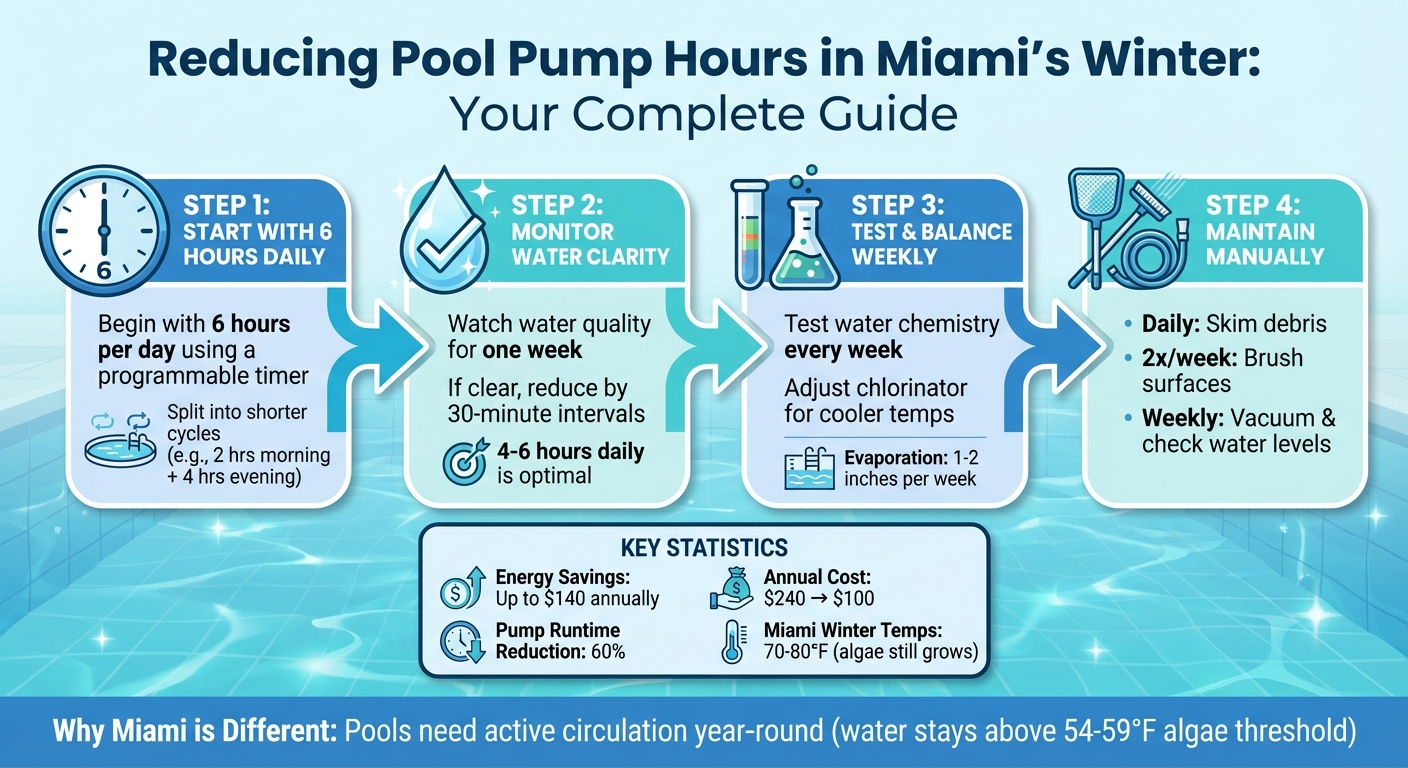
- Start with 6 hours per day and monitor water clarity. If clear, reduce runtime in 30-minute intervals to as low as 4 hours daily.
- Use a programmable timer to split runtime into shorter cycles (e.g., 2 hours in the morning and 2–4 hours in the evening).
- Test water weekly, adjust chemical levels, and skim debris daily to prevent issues caused by reduced pump operation.
- Winter evaporation lowers water levels by 1–2 inches per week, so check and refill as needed.
How to Reduce Pool Pump Hours in Miami Winter: 4-Step Guide
How Long Should I Run My Swimming Pool Pump Motor?
The Problem: Energy Costs vs. Water Quality
If you own a pool in Miami, you’re likely familiar with the struggle: your pool pump could be one of the biggest energy drains in your home, costing up to $270 annually in utility bills [3]. That’s a hefty expense, especially when you’re trying to keep energy costs manageable. Naturally, you might think about cutting back on pump usage to save money. But here’s the catch – reducing pump hours too much can lead to problems that could cost you even more in the long run.
It’s a balancing act: save on energy without letting your pool turn into a haven for algae and bacteria. Cut pump hours too drastically, and you might find yourself spending extra on chemicals, shock treatments, or even repairs from overworked equipment. On the flip side, running your pump at full capacity during Miami’s mild winter wastes energy unnecessarily. Let’s dig into how Miami’s unique winter climate complicates this balance.
How Miami’s Winter Stands Apart
In colder cities like New York or Chicago, pool owners typically "winterize" their pools by draining them, clearing out the pipes, and shutting everything down for the season. This works because freezing temperatures naturally stop algae growth. But Miami’s winter is a completely different story. With temperatures hovering between 70°F and 80°F, your pool water stays well above the 54°F to 59°F threshold where algae growth slows significantly. That means Miami pools require "active wintering", where filtration and circulation systems stay running year-round to maintain water quality [7][8].
The cooler weather does slow algae growth, but it doesn’t eliminate it. Plus, the pool’s chemical activity continues, so you can’t afford to completely cut back on maintenance.
The Risks of Over-Cutting Pump Hours
Even though Miami’s winter demands ongoing circulation, cutting pump hours too aggressively can lead to a host of issues.
- Stagnant water breeds trouble: Without enough circulation, chemicals don’t spread evenly, leaving untreated areas where algae and bacteria can flourish [2][9]. This can quickly turn your water cloudy or even green, forcing you to spend more on shock treatments and extended pump use to fix the problem [8].
- Debris buildup invites algae: Poor circulation allows debris to settle, creating a perfect environment for algae to grow. It also leads to deposits in your filters, salt systems, and heaters, increasing pressure and potentially causing long-term damage to your equipment [1][2].
- Chemical imbalances worsen: Without proper flow, maintaining stable chemical levels becomes a challenge. Combine this with Miami’s dry season evaporation rate of 1 to 2 inches per week [1], and you’ve got a recipe for ongoing headaches. Inconsistent circulation can also speed up equipment wear and tear, adding to your maintenance costs.
Finding the right balance between energy savings and water quality is no small task, especially in Miami’s unique climate. But understanding these risks is the first step toward making smarter decisions for your pool.
The Answer: Reduce Hours to 4-6 Per Day
You can cut down your pool pump’s runtime without compromising water quality. In Miami’s mild winter, this balance is essential for keeping energy costs low while maintaining a clean pool. Running your pump for just 4–6 hours daily during the cooler months is an effective approach. Lower temperatures slow algae growth and reduce chlorine breakdown, meaning your pool doesn’t need as much filtration as it does during the summer.
How Many Hours to Run Your Pump in Winter
Start with 6 hours per day as a starting point. This amount of runtime ensures a full turnover of your pool water within 24 hours. In Florida’s winter conditions, most pools can achieve this turnover in just 4–6 hours [2]. If your pool water stays clear after running the pump for 6 hours daily over a week, try reducing the runtime by 30‑minute intervals [3]. In fact, Miami‑Dade County advises limiting pump operation to 4 hours per day during winter to conserve energy [5].
Instead of running the pump in one long session, break it into shorter cycles throughout the day. This prevents debris from settling and ensures better water circulation without increasing your total runtime [3]. Using a programmable timer to automate these shorter cycles – and scheduling them during off‑peak hours – can help you save even more on energy costs [2][4]. This approach keeps your water circulating properly while reducing your utility bills.
How Much Energy You’ll Save
These adjustments can lead to noticeable savings. A study of 120 pools conducted by the Center for Energy Conservation at Florida Atlantic University found that reducing pump runtime by 60% slashed the pumping portion of electric bills by the same percentage. Annual costs dropped from around $240 to roughly $100, saving pool owners approximately $140 [3][10].
Interestingly, many pool owners in the study reported being satisfied with their water quality even when their pumps ran for less than 3 hours per day [3]. This shows you can achieve meaningful savings while keeping your pool clean and healthy.
sbb-itb-a36f8f1
How to Adjust Your Pump Schedule
Fine-tuning your pump schedule can help you maintain a clean pool while saving energy. Here’s how to do it: set a timer, balance your water chemistry, and stay on top of manual cleaning.
Set Up a Timer for Your Pump
Invest in a dependable programmable timer to automate your pump cycles. Set it to run for 4–6 hours daily, splitting the time into shorter sessions – like 2 hours in the morning and 2–4 hours in the evening [3].
To save on energy costs, schedule these cycles during off-peak electricity hours, which are usually late at night or early in the morning [12][2]. If you’re using a variable-speed pump, run it on high for a few hours during the day to catch debris, then switch to low speed at night for filtration [12]. This approach prevents debris from settling for long periods and ensures consistent water circulation without increasing your pump’s runtime.
Once the timer is set, keep an eye on water quality with regular testing to ensure everything stays balanced.
Test and Balance Your Water Chemistry
Test your pool water every week to catch any chemical imbalances early [1]. Maintain the recommended chemical ranges and adjust your chlorinator as temperatures drop [1][11]. Always correct alkalinity first before adjusting pH to keep the chemistry stable [13].
Cooler water naturally slows algae growth, so you’ll need less chlorine than you would in the summer. Reduce the output of your salt chlorine generator or manual chlorinator to avoid over-chlorination [1]. If water temperatures fall below 60°F, salt cells will shut off automatically. In that case, use a floating chlorinator with tablets to maintain sanitizer levels [11].
Keep Your Pool Clean with Regular Tasks
When running your pump for fewer hours, manual cleaning becomes even more important. Skim debris daily to prevent buildup. Brush the pool surfaces twice a week to stop algae from forming. Vacuum weekly to remove dirt and debris from the pool floor [9][1].
Empty skimmer and pump baskets frequently to maintain proper flow [9][1]. Check your water levels weekly, ensuring they stay at the mid-skimmer line. Winter evaporation can lower water levels by 1–2 inches per week [1]. Finally, clean or backwash your filter every 2–6 weeks – or whenever the pressure rises by 8–10 psi – to keep the water clear [9].
When to Get Professional Help
Handling pump schedules and water chemistry during Miami’s mild winter can challenge even seasoned pool owners. This is where professional help becomes a smart investment. Experts can simplify routine maintenance and make technical adjustments to keep your pool running smoothly and efficiently.
Weekly Maintenance Services
Alligator Pools provides weekly maintenance services designed to take the stress out of winter pool care. Their technicians handle tasks like vacuuming the pool, clearing debris from traps and skimmers, and monitoring water levels to protect your pump and filtration system from potential damage [8]. Keeping water levels in check is especially important during the cooler months to prevent the pump from pulling in air, which could cause costly damage.
Additionally, professionals fine-tune chemical levels to adapt to the season’s cooler temperatures, ensuring the water stays clear and balanced. They also adjust chlorine generators to meet reduced winter demands, preventing over-chlorination and extending the lifespan of your equipment [8][14].
Equipment Setup and Optimization
Beyond the basics, professional services can also enhance energy efficiency and overall pool performance. Technicians can adjust pump settings for winter by installing programmable timers that run multiple short cycles, ensuring efficient water circulation [10][3]. They also perform essential equipment checks, inspecting for leaks, unusual noises, or clogs in the filtration system – issues that can overwork your pump and increase energy consumption [6][10].
For homeowners aiming to slash energy costs, upgrading to a variable-speed pump is a game-changer. For example, a variable-speed pump operating at 600 rpm for 24 hours uses roughly 480 watts, while a 1HP single-speed pump running for just 3 hours consumes around 2,250 watts [7]. Professionals can also recommend downsizing to a 0.75-horsepower pump, which is sufficient for most Florida pools and further reduces energy use [10][3]. Combining a smaller, efficient pump with shorter runtimes can lead to energy savings of up to 75% compared to traditional setups [10][3].
Conclusion
Miami’s mild winters bring a unique opportunity to save on energy costs while maintaining excellent water quality. By running your pool pump for just 4–6 hours per day during the cooler months, you can keep your water clear and properly circulated without the high electricity bills of summer. The cooler temperatures and reduced sunlight naturally slow algae growth and chlorine breakdown, meaning your pool simply doesn’t require the same level of filtration as it does during the blazing summer heat.
A good starting point? Set your pump to 6 hours daily using a programmable timer. If the water remains clear, you’re all set. If you notice any cloudiness, simply increase the runtime in 30-minute increments until clarity is restored. Don’t forget to regularly test your water chemistry and monitor levels, especially during Miami’s dry winter season when evaporation can lower water levels by 1 to 2 inches per week [1].
Fine-tuning your pump’s runtime not only keeps your pool in great shape but can also lead to major energy savings. Research shows that optimizing pump schedules can reduce energy costs significantly, with some pool owners cutting their pumping bills by as much as 75% [3][10].
Prefer professional assistance? Alligator Pools provides weekly maintenance services and equipment optimization throughout Miami-Dade County. Their certified technicians can adjust your pump schedule, balance water chemistry for winter conditions, and ensure your equipment operates efficiently. For personalized care, trust Alligator Pools to handle all your winter maintenance needs.
FAQs
How do I know if my pool pump isn’t running enough during Miami’s winter?
Even during Miami’s mild winter months, spanning November to April, it’s essential to run your pool pump enough to keep the water clear and the chemicals balanced. If the pump isn’t running long enough, you might notice cloudy water, dips in chlorine or pH levels, or even small green algae patches starting to form. Another red flag is if the filter pressure climbs more than 8–10 psi above its clean baseline. This usually means debris isn’t being filtered out effectively.
To figure out if your pump is running enough, you can calculate your pool’s turnover time using this formula:
Turnover = Pool volume (gallons) ÷ Pump flow rate (gpm) ÷ 60
If the turnover time is more than 12 hours, your pump isn’t running long enough. Ideally, most pools in Miami aim for a full turnover every 8 hours. That said, running the pump for about 6 hours daily is often enough during the winter. Keep an eye on water clarity, filter pressure, and chemical levels (chlorine should be between 1–3 ppm, and pH between 7.2–7.6). If you notice any problems, try increasing the pump runtime by 1–2 hours and check again to ensure the water stays clean and balanced.
How can I tell if my pool’s chemistry is off during Miami’s winter?
Even though Miami’s winters are mild, your pool’s chemistry can still go off balance due to reduced use or shifts in conditions. You might notice signs like cloudy or discolored water, green algae growth, or a strong chemical smell. Swimmers could also experience skin or eye irritation, which often points to pH levels straying from the ideal range of 7.2–7.6.
A low pH can lead to corrosion on metal fixtures, like ladders, while high pH or alkalinity might cause calcium deposits to form on pool walls or equipment. If chlorine levels fall below 1.0 ppm, algae can quickly take over, and the water’s sanitation will decline. On the flip side, too much chlorine can harm your pool’s components. To avoid these problems, make it a habit to test your pool’s pH, free chlorine (1–3 ppm), total alkalinity (80–120 ppm), and calcium hardness (200–400 ppm) regularly. This ensures your pool stays in top condition throughout the winter.
Is a variable-speed pool pump worth it for saving energy during Miami’s winter?
Investing in a variable-speed pool pump is a savvy choice, particularly during Miami’s mild winter months. This upgrade can cut down electricity usage, saving you an estimated $300 to $316 per year on energy bills. While the initial cost might be higher than standard pumps, the long-term savings on utilities make it a smart financial decision.
Beyond savings, these pumps are excellent at maintaining consistent water circulation. This helps prevent algae buildup and ensures your pool stays in great shape all year long. It’s an energy-conscious solution designed to fit Miami’s climate and pool care requirements.