
Quick takeaway: Cheap pool repairs might save you money upfront, but they often lead to recurring issues, higher costs, and even serious damage over time. In South Florida, where heat, humidity, and hard water strain pool systems, cutting corners can make problems worse. Fixing leaks, algae, or equipment with temporary solutions often results in repeated failures, wasted resources, and skyrocketing expenses.
Key reasons cheap repairs cost more:
- Leaks: Temporary fixes like epoxy patches fail under pressure, leading to structural damage and repair bills as high as $20,000.
- Algae treatments: Single shock treatments don’t address the root causes, allowing algae to return quickly.
- Equipment repairs: Replacing parts without fixing the underlying issue results in frequent breakdowns and wasted money.
Better alternative: Invest in quality repairs that address root problems, use durable materials, and reduce long-term costs. For example, replacing a $700 pump upfront can save thousands compared to repeated $150 fixes.
Cost comparison:
| Repair Type | Upfront Cost | 2-5 Year Total | Long-Term Impact |
|---|---|---|---|
| Cheap/Temporary Fix | $150-$300 | $3,000-$7,500+ | Recurring failures, wasted resources |
| Quality/Root Cause | $700-$1,500 | $1,000-$2,000 | Fewer breakdowns, better efficiency |
| No Repair/Neglect | $0 | $20,000-$50,000 | Major damage, system failure |
Bottom line: Spending more now on high-quality repairs can save you thousands in the future, especially in demanding climates like South Florida. Choose professionals who focus on durable, long-term solutions. If you need reliable pool repair in Coral Gables, prioritize quality over quick fixes.
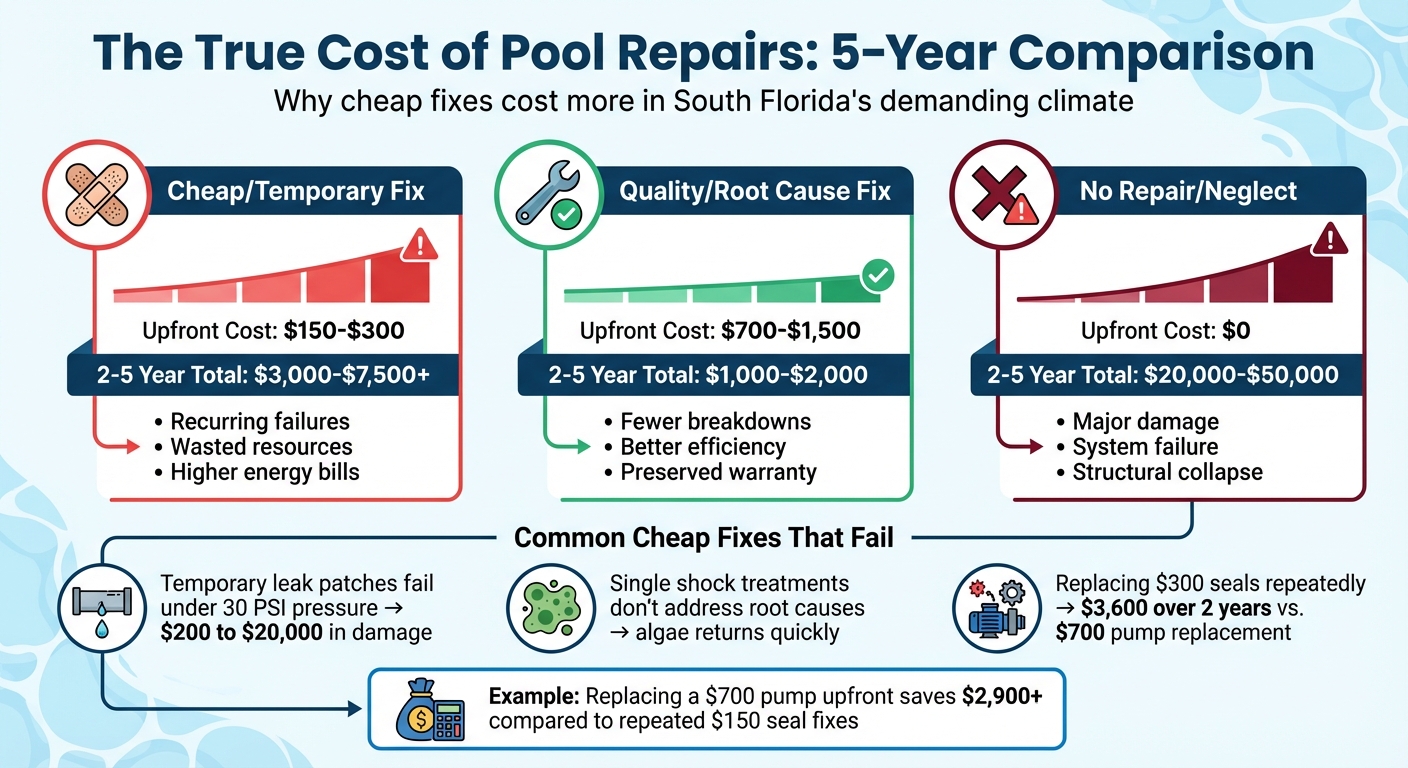
Pool Repair Cost Comparison: Cheap vs Quality Fixes Over 5 Years
Watch This If You PAY For Pool Maintenance!
sbb-itb-a36f8f1
Common Cheap Fixes That Fail Over Time
Saving money with quick fixes might seem smart now, but these shortcuts often lead to bigger, more expensive problems down the line.
Improper Leak Fixes
Using epoxy or silicone to patch a leaking pipe might feel like a cheap and easy solution, but it rarely holds up. Pool plumbing systems operate under pressure – up to 30 PSI – and deal with constant vibration and temperature changes. These conditions quickly wear down temporary fixes. As pool expert Swimming Pool Steve puts it:
"The constant movement, shuttering, expansion, contraction and vibration of swimming pool pipes makes the potential for a topical pipe leak repair very low" [10].
What starts as a small leak can escalate into a major issue. A temporary patch often allows water to erode the surrounding soil, potentially causing structural damage. The repair costs can skyrocket from $200 to as much as $20,000 [9][11]. The only reliable fix? Cut out the damaged section and re-plumb it properly. Taping over the problem just delays the inevitable – and makes it worse.
Now, let’s shift to another common shortcut: algae treatments.
Inadequate Algae Treatments
Giving your pool a single shock treatment when algae appears might clear things up for a moment, but it’s far from a permanent solution. Algae spores can hide in cracks and crevices, waiting for the right conditions to bloom again. Without maintaining a consistent "shock level" of chlorine – a process known as SLAM (Shock, Level, And Maintain) – you’re likely to see algae return in no time [6].
Quick fixes often overlook other key factors like imbalanced water chemistry, dirty filters, or poor circulation. These issues are especially problematic in places like South Florida, where summer temperatures frequently climb above 90°F. In that heat, chemical reactions speed up, giving algae the perfect environment to thrive. Ignoring these factors can even turn your pool into a mosquito breeding ground. With eggs hatching in just 7 to 10 days, a neglected pool can produce millions of mosquitoes in a single summer [6].
Temporary chemical treatments might seem convenient, but they’re no substitute for addressing the root causes. The same principle applies to equipment repairs.
Temporary Equipment Repairs
When your pool pump starts making grinding noises, it’s a sign of trouble – usually a failing bearing or damaged seal. Replacing a $300 seal repeatedly might seem cheaper than spending $700 to $1,500 on a new pump, but it’s a band-aid fix. Underlying issues, like a damaged impeller shaft or poor hydraulic design, remain unaddressed [1].
Here’s a real-world example: In June 2024, Patriot Water Works Co. encountered a resort where two $8,000 pumps were failing every few months. Contractors had been charging $1,500 to $5,000 per visit to replace parts, but no one fixed the root cause – a 90-degree elbow installed too close to the pump intake. This design flaw caused turbulent flow and cavitation, leading to repeated failures. Tom Soukup’s team solved the problem by re-piping the system for under $5,000, ending years of costly repairs [1].
Other temporary fixes, like using non-stainless hardware, often backfire too. Galvanized or standard steel screws corrode quickly in chlorinated water, creating rust "clouds" and requiring constant replacements [10]. Even worse, bypassing safety features like spill switches or heater sensors to extend equipment life can lead to dangerous situations, including fire or explosions. No savings are worth that risk [1].
The Long-Term Costs of Poor-Quality Repairs
Opting for cheap fixes might look like a money-saver at first, but they often lead to recurring expenses, higher utility bills, and even widespread damage to your system.
Repeated Repair Costs
Paying for the same repair over and over can quickly drain your wallet. Take this example: replacing a $150 seal every month for two years adds up to $3,600. Compare that to a one-time $700 pump replacement, which would have saved over $2,900 – not to mention the time and frustration.
"The previous contractor had been routinely replacing the seal on this pump every month without investigating the underlying cause… the impeller shaft was damaged, which was causing it to cut the seal." – Tom Soukup, Principal, Patriot Water Works Co. [1]
Impact on Pool Efficiency
The costs of poor-quality repairs go beyond your wallet – they affect your pool’s overall performance. Faulty repairs can lead to wasted electricity and ineffective water treatment, resulting in cloudy water and the need for expensive chemical treatments [1].
Leaks are another hidden drain on resources. Even a small, undetected pool leak can waste thousands of gallons of water every month. This constant water loss forces you to refill the pool frequently and use more chemicals to maintain balance. What starts as a minor issue can end up costing hundreds of dollars in wasted water and chemicals before you even realize there’s a problem [9][2].
These ongoing inefficiencies highlight why investing in quality repairs pays off in the long run.
Cost Comparison: Cheap vs. Quality Repairs
The numbers make it clear: cutting corners doesn’t save money. Here’s how the costs stack up over time:
| Repair Strategy | Initial Cost | 2-5 Year Total | Long-Term Impact |
|---|---|---|---|
| Cheap/Temporary Fix | $150 – $300 | $3,000 – $7,500+ | Repeated failures, higher energy bills, system breakdown [1][7] |
| Quality/Root Cause Fix | $700 – $1,500 | $1,000 – $2,000 | Optimized efficiency, lower utility bills, preserved warranty [1][2][12] |
| Neglect/No Repair | $0 | $20,000 – $50,000 | Total equipment failure, structural collapse, municipal fines [8][6] |
While quality repairs may have a higher upfront cost, they’re the smarter financial choice over time. Plus, many manufacturers require professional installation to maintain warranty coverage. Skipping this step could leave you footing the full bill when equipment fails – no exceptions [2][12].
South Florida Climate and Water Challenges
Miami-Dade’s tropical climate puts a lot of strain on pool systems, making quick, inexpensive fixes a short-term solution at best. The combination of intense heat, constant moisture, and tough water conditions can lead to early equipment breakdowns and damage to pool surfaces.
Heat and Humidity Effects
South Florida’s extreme weather speeds up the deterioration of pool components. The strong UV rays and high temperatures can make materials like vinyl brittle, while traditional plaster surfaces in Miami often last only about five years[13]. The heat also ramps up evaporation, forcing pumps and filters to work overtime, which adds wear and tear to these systems[14]. On top of that, the high humidity creates the perfect environment for algae and biofilm to grow quickly, meaning temporary repairs can fail in just a few months.
"Use high-quality sealants rated for Florida’s heat and UV exposure. Cheap sealants may fail within months under constant sunlight." – Florida Detail[4]
In Miami, professional pool repairs require materials and techniques designed specifically for the region’s hot, humid climate. For example, bond coats and primers must be rated for these conditions to ensure proper adhesion and to prevent new materials from peeling or cracking[13]. Products that work well in cooler climates often don’t stand up to South Florida’s weather.
But it’s not just the heat and moisture. The local water composition adds another layer of difficulty.
Hard Water Challenges
Miami’s water is naturally high in minerals, which makes pool maintenance even tougher. The elevated calcium levels lead to scaling, surface etching, and stubborn stains that are especially hard on traditional plaster finishes[15]. Plaster surfaces often require resurfacing more frequently compared to newer options like exposed aggregate or glass tile[13].
Low-quality repairs can make the problem worse. Inadequate sealants and patchwork fixes allow mineral buildup to continue unchecked, corroding grout and eventually causing structural leaks[4][5]. These water-related issues highlight why investing in durable, long-term solutions is crucial to avoiding escalating maintenance costs over time.
How Alligator Pools Delivers Long-Lasting Repairs
For over 40 years, Alligator Pools has been a trusted name in Miami-Dade, known for providing pool repairs that last. Unlike quick fixes that lead to repeated issues, they focus on addressing the root causes. Their certified technicians use materials specifically designed to withstand South Florida’s unique challenges – heat, humidity, and hard water.
Our Approach to Quality Repairs
Every repair starts with a deep dive into the problem. Instead of simply replacing broken parts, Alligator Pools technicians investigate the underlying causes. They examine hydraulic systems to ensure proper pipe configurations, inspect components like impeller shafts that could damage new seals, and test electrical systems to avoid future failures[1].
"A competent pool specialist should engage with the facility manager or owner about their objectives for the pool system… rather than merely replacing parts without addressing the broader system needs." – Tom Soukup, Principal, Patriot Water Works Co.[1]
For leaks, they use ultrasonic tools to locate the exact problem[12]. Surface repairs are done with precision – prepping areas with acid-washing and sanding to ensure a strong mechanical bond, which prevents peeling over time[17]. Materials like pebble and quartz finishes are chosen for their durability, resisting chemical erosion and UV damage far better than standard plaster[16].
This thorough process ensures that every repair is built to last.
Alligator Pools Repair Services
| Service Feature | What You Get |
|---|---|
| Diagnostic Visit | $125 fee (waived if no issue is found; credited toward repair costs)[18] |
| Minor Repairs | Included at no extra charge if costs are under $125 |
| Workmanship Guarantee | 3-year warranty on all repairs completed by certified technicians |
| Emergency Response | Urgent issues typically addressed within 24 hours[18] |
| Quality Materials | Parts and finishes designed for South Florida’s climate [18] |
| Manufacturer Support | Warranty coverage on resurfacing materials like Diamond Brite and Gem Finishes |
Alligator Pools also provides detailed, itemized quotes, so you’ll know exactly what to expect in terms of labor, parts, and timelines – no surprises[3].
How to Find a Reliable Repair Service
Looking for a pool repair service that delivers lasting results? It’s all about finding a provider who prioritizes long-term solutions. Here’s what to look for:
- Certified technicians who perform thorough diagnostics instead of just swapping parts.
- Warranties on both workmanship and materials, ensuring quality and peace of mind[1][3].
- Licensed professionals, as many manufacturers won’t honor warranties if repairs are done by unqualified individuals[3].
Ask for references from recent projects in your area and consider scheduling major repairs during the off-season to save money and avoid the busy summer period[12]. And remember, addressing problems early can prevent minor issues from turning into costly repairs down the line.
Conclusion
Opting for cheap pool repairs might seem like a good way to save money initially, but quick fixes that overlook deeper problems – like faulty hydraulics or subpar materials – often lead to escalating costs and repeated service calls. South Florida’s tough climate, with its intense sunlight, high humidity, and hard water, makes it even harder for low-quality materials to stand the test of time.
That’s why taking the time to invest in high-quality repairs from the beginning is so important. These repairs not only address the root of the problem but also use materials specifically designed to withstand South Florida’s demanding conditions. Plus, they often come with warranties that provide peace of mind and protect your investment for years to come.
"A small crack or leak might seem insignificant at first, but untreated leaks can cause significant structural damage over time… Repairing a minor leak now can save you from expensive repairs down the road." – Poolie Team [9]
In South Florida’s harsh environment, prioritizing quality repairs isn’t just a smart choice – it’s a necessity. For over 40 years, Alligator Pools has been helping Miami-Dade homeowners avoid costly mistakes by offering repairs that last. With certified technicians, premium materials, and a 3-year workmanship guarantee, they ensure your pool stays in top condition.
Don’t risk your investment with shortcuts. Contact Alligator Pools today for a diagnostic visit and get the reliable pool care you deserve.