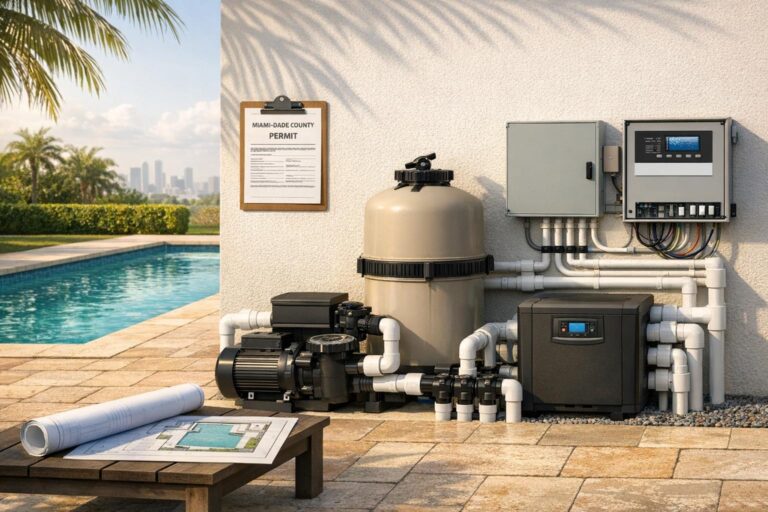

Owning a pool in Miami means dealing with constant heat, UV rays, humidity, and frequent rainstorms – all of which can quickly turn your pool into a maintenance headache. Here’s a quick breakdown to help you keep your pool clean, safe, and enjoyable in just 30 days:
- Safety First: Ensure your pool area meets Miami-Dade safety regulations, including barriers, self-latching gates, and safety equipment.
- Equipment Checks: Inspect pumps, filters, and heaters for noise, leaks, or wear. Maintain proper water levels and test your filtration system daily.
- Water Chemistry: Test and adjust chlorine, pH, alkalinity, calcium hardness, and cyanuric acid levels weekly. Miami’s heat and UV rays break down chlorine faster, so stay on top of it.
- Routine Cleaning: Skim, brush, and vacuum weekly to prevent debris and algae buildup. Pay extra attention to shaded areas and waterline tiles.
- Long-Term Care: Monitor for wear, leaks, and scaling. Schedule professional pool cleaning and maintenance to catch hidden issues and extend the life of your pool.
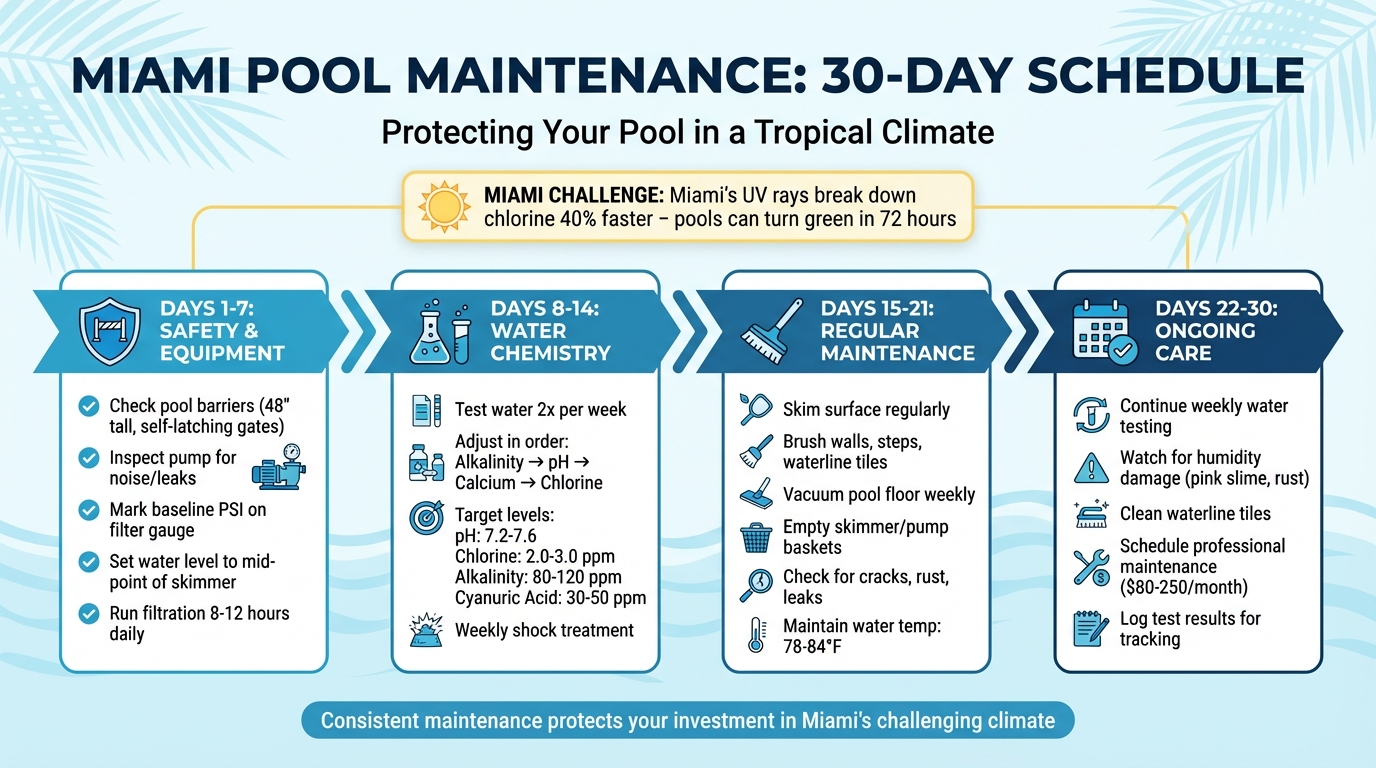
30-Day Miami Pool Maintenance Timeline for New Owners
POOL MAINTENANCE For Beginners [Step-By-Step ACTION PLAN]
sbb-itb-a36f8f1
Days 1-7: Safety and Equipment Checks
Start your pool maintenance journey by focusing on safety and ensuring all equipment is functioning properly. Before diving into chemical treatments or cleaning routines, make sure your pool area is secure, and your systems are ready to handle the workload.
Check Pool Safety Features
Florida has one of the highest drowning rates for children aged one to four, with drowning being the leading cause of accidental death for this age group. Most tragedies occur in the brief moments when an adult steps away [8]. Miami-Dade County, in particular, enforces strict pool barrier requirements to reduce these risks.
Ensure your pool barriers meet local regulations: they should be at least 48 inches tall, have self-latching gates, and include alarms on access doors. Secure drain covers and suction grates to prevent entrapment [7][8][9]. Keep essential safety equipment, like a reaching pole, rope, and a U.S. Coast Guard-approved life ring, easily accessible poolside [8][9].
Remove pool toys from the area after use to avoid tempting children to approach the water unsupervised [8]. If you have an above-ground pool, take down the ladder when it’s not in use [8]. Also, check that your pool deck is slip-resistant to minimize the risk of falls [5].
Inspect All Pool Equipment
Miami’s warm climate demands extended filtration times, so daily equipment checks are crucial. Start by turning on your pump and listening closely. Sounds like squealing, rattling, or grinding often signal mechanical issues [6][4]. Check the pump basket for debris and inspect the housing for leaks, rust, or cracks [6][4].
Locate your filter’s pressure gauge and mark the current PSI reading directly on the tank with a permanent marker – this will serve as your "clean" benchmark [6]. When the pressure climbs 8–10 PSI above this baseline, it’s time to clean or backwash the filter [6][4]. If the gauge doesn’t drop back to zero when the pump is off, it’s likely broken and needs replacement [6].
For the heater, confirm proper ignition and look for signs of leaks or rust [4]. Examine plumbing joints for leaks, and lubricate O-rings, gaskets, and valve handles monthly to keep them in good condition [2].
Test Pool Systems
Your pool’s water level should be at the mid-point of the skimmer opening [11][6]. If it’s too low, the pump may cavitate, causing permanent damage. If it’s too high, the skimmer won’t effectively clear surface debris [11][6].
Run the filtration system 8–12 hours daily, increasing to 12–18 hours during hotter months to ensure the entire pool volume is filtered at least once a day. Regularly empty baskets to maintain water flow [5][11].
Test GFCI outlets and electrical bonding during daylight hours to easily spot issues [10]. Confirm that timers and automation systems are set correctly for your schedule [5], and check that emergency shut-off switches are functioning properly [5][2].
| System Component | What to Check | What You Want to See |
|---|---|---|
| Pump | Prime status and noise level | Quiet operation; no air in strainer basket [6] |
| Filter | Pressure gauge reading | Record baseline PSI for future reference [6] |
| Water Level | Height at skimmer | Mid-point of skimmer opening [11] |
| Electrical | GFCI and bonding | No tripped breakers; secure connections [1] |
| Baskets | Debris accumulation | Clear of leaves and landscaping waste [5] |
Days 8-14: Water Chemistry for Miami‘s Climate
Week two is all about mastering water chemistry. Getting this right is critical for avoiding algae growth and reducing strain on your pool equipment. Miami’s intense UV rays break down chlorine about 40% faster than in cooler northern climates, and the warm water speeds up chlorine consumption even more. If left unchecked, chemical imbalances can lead to algae growth in as little as 72 hours.
Test and Adjust Chemical Levels
Testing your pool water at least twice a week is essential to keep up with Miami’s unique climate challenges[12]. Start by running your pump on high for an hour, then collect your sample 12–18 inches below the surface, away from return jets[14]. While test strips are handy for quick, daily checks, using a liquid titration kit once a week gives you more precise results.
When adjusting chemicals, follow this order: Total Alkalinity, pH, Calcium Hardness, and finally Chlorine. Aim for these levels:
- Total Alkalinity: 80–120 ppm. If you need to adjust, add sodium bicarbonate and wait 6–24 hours before retesting.
- pH: 7.2–7.6. This range prevents equipment corrosion and skin irritation[12].
- Calcium Hardness: 200–400 ppm. Maintaining this prevents scaling or surface damage.
- Chlorine: 1–3 ppm. During summer or after storms, aim for 2.0–3.0 ppm for better protection[13].
In Miami’s climate, it’s also important to maintain Cyanuric Acid levels between 30–50 ppm. This helps shield chlorine from UV breakdown[12].
| Chemical Parameter | Target Range | Why It Matters |
|---|---|---|
| pH | 7.2–7.6 | Prevents corrosion and skin irritation[12] |
| Free Chlorine | 2.0–3.0 ppm | Kills bacteria and prevents algae[4] |
| Total Alkalinity | 80–120 ppm | Stabilizes pH levels[13] |
| Cyanuric Acid | 30–50 ppm | Shields chlorine from UV rays[12] |
| Calcium Hardness | 200–400 ppm | Prevents scaling or surface corrosion[12] |
Manage Heat and Humidity Effects
Miami’s warm, humid environment is a breeding ground for algae, so staying proactive is key. Shock your pool weekly to eliminate any contaminants[4]. After heavy rain or a busy pool day, shocking is even more important to counteract dilution and stop algae from taking hold[3].
"During the summer or after heavy rain, test 2–3 times per week to account for rapid chlorine loss and rainfall dilution." – Miami Home Service[4]
Don’t forget to brush your pool walls, steps, and benches weekly, especially in shaded areas where algae tends to thrive. To ensure proper circulation and chemical distribution, run your filtration system for 10–12 hours daily during the hottest months[3].
Clean the Filtration System
A clean filtration system is essential for maintaining balanced water chemistry. Watch your pressure gauge – if it reads 8–10 PSI above your baseline, it’s time to backwash or clean the filter[4]. Skimmer baskets should be emptied at least twice a week to remove debris, which can block water flow. If cleaning doesn’t bring the pressure back to normal, check for blockages or consider replacing the filter media[6].
Days 15-21: Regular Maintenance Routine
By the time you hit the third week, it’s time to settle into a weekly routine that keeps your pool sparkling and your equipment running smoothly. This consistent upkeep can prevent small problems from turning into expensive repairs. In Miami’s warm and humid climate, debris and algae can accumulate quickly, so staying on top of maintenance is a must.
Clean the Pool Weekly
Make it a habit to skim the surface regularly to remove leaves, bugs, and other debris that can encourage algae growth. Don’t stop there – grab a brush and scrub the walls, steps, and waterline tiles. Pay extra attention to shaded areas and tricky spots like behind ladders, where algae love to hide. For gunite or concrete pools, a stainless steel brush is great for tackling stubborn algae. If your pool has a vinyl or fiberglass surface, use a soft nylon brush to avoid damage.
Vacuuming the pool floor is just as important. Whether you use a manual vacuum or an automatic cleaner, removing settled dirt and contaminants once a week keeps your pool looking great and your water sanitary. Don’t forget to empty the skimmer and pump baskets weekly to maintain proper water circulation.
After the cleaning is done, take a few minutes to inspect your pool for any signs of wear or damage.
Check for Wear and Damage
Give your pool a careful once-over to catch any issues early. Look at the coping, ladders, and rails for cracks, rust, or loose parts. Listen for any unusual noises from your pump or heater – these could be early warning signs of equipment trouble. Keep an eye on the tiles, especially along the waterline, for white scale or calcium buildup. If you notice your water level dropping significantly without explanation, it could be a sign of a leak in the pool’s surface or plumbing.
To prevent leaks, lubricate O-rings, gaskets, and valve handles monthly. If you find structural cracks, major leaks, or equipment problems that seem beyond a quick fix, it’s time to call in the pros. Reach out to Alligator Pools for a professional inspection – catching these issues early can save you from bigger headaches (and costs) down the road.
Once you’ve ensured everything is in good shape, it’s time to check the water temperature.
Check Water Temperature
Water temperature isn’t just about comfort – it’s also key to maintaining chemical stability. After cleaning and inspections, confirm that your pool heater keeps the water between 78°F and 84°F. This range ensures a pleasant swimming experience and helps maintain balanced chemical levels. Keep in mind that water temperatures above 80°F can double your chlorine consumption[3]. If your heater isn’t performing well or starts emitting strange odors, don’t wait – get it serviced promptly.
Days 22-30: Ongoing Care and Professional Help
As you wrap up your first month of pool care, it’s time to focus on long-term maintenance. By now, you’ve tackled the basics like safety checks and chemical balancing. The next step is creating habits that keep your pool in top shape year-round. In Miami’s warm climate, chlorine levels can drop quickly, and a neglected pool can turn green in just 72 hours [3]. Consistency is key.
Test Water Chemistry Weekly
Make weekly water testing a priority. Aim to keep your pool’s chemistry within these ranges:
- Free Chlorine: 2.0–3.0 ppm
- pH: 7.4–7.6
- Total Alkalinity: 100–150 ppm
- Cyanuric Acid: 30–50 ppm
- Calcium Hardness: 200–400 ppm
Logging your test results helps you notice changes over time. After heavy rain or lots of pool use, consider adding a shock treatment [4]. Regular testing not only maintains balance but also helps you understand how weather and usage affect your pool’s chemistry.
Watch for Humidity Damage
Miami’s high humidity creates the perfect environment for mold, mildew, and algae, particularly on decks and equipment areas. Check your pool deck for pink streaks or spots – these could indicate "pink slime", a bacteria-based biofilm that thrives in damp, low-flow areas [15]. Inspect metal parts for rust or corrosion caused by salt air, and clean waterline tiles with a mild cleaner and soft sponge to remove oils and grime where bacteria can grow.
Pay attention to other signs of trouble, like GFCI outlets that keep tripping or calcium scaling on tiles. Addressing these problems early can prevent bigger issues, like electrical hazards or structural damage.
Consider Professional Maintenance
Even with diligent DIY care, professional maintenance can catch problems you might overlook. Pool technicians bring expertise that ensures your pool stays in excellent condition. Services like those offered by Alligator Pools include cleaning, chemical balancing, and equipment checks. In Miami, professional maintenance typically costs between $80 and $250+ per month [4].
A technician will fine-tune your filtration system, lubricate O-rings, and inspect equipment for wear and tear.
"Knowing when to call a pool professional can save you thousands in repairs, extend the life of your pool, and lend you peace of mind" [16].
Schedule a professional visit before the end of your first month. Establishing a relationship with a licensed contractor who understands the unique challenges of South Florida‘s climate can help protect your investment.
Conclusion
The first 30 days as a Miami pool owner have set the stage for a summer full of enjoyable swims. By sticking to this checklist, you’ve tackled Miami’s intense UV rays and high temperatures – conditions that can transform a sparkling pool into a green, murky mess in as little as 72 hours. Regular water testing, proper filtration, and timely chemical adjustments are your key tools in keeping your pool in top shape [3].
Local experts emphasize this approach:
"When you understand how to work with Miami’s climate instead of fighting against it, pool maintenance becomes a manageable routine that protects your investment while maximizing your swimming enjoyment." – Dream Pools of South Florida [3]
The habits you’ve developed not only safeguard your pool equipment but also extend its lifespan. And with Alligator Pools’ professional support, you benefit from over 40 years of Miami-specific expertise, helping you catch issues early before they turn into costly repairs [17].
FAQs
What steps can I take to make my Miami pool safe for children?
To keep your Miami pool safe for children, start by setting up a secure fence around the pool. It should be at least 4 feet tall and include self-closing, self-latching gates to prevent unsupervised access. Adding pool alarms to doors and windows that lead to the pool area provides an extra layer of security. Also, make sure the yard is free of objects that kids could climb to gain entry.
Constant adult supervision is a must. Always have a responsible adult keeping an eye on children around the pool. If you’re hosting a gathering, assign a "water watcher" whose only job is to monitor the pool. Teaching kids how to swim and removing pool toys when not in use are also important steps to reduce risks.
Lastly, check that all safety devices, like drain covers and pool alarms, are functioning properly. By combining these precautions with active supervision and teaching kids about pool safety, you can create a safer space for everyone to enjoy.
What chemical levels should I maintain in my Miami pool for optimal water quality?
To keep your Miami pool in top shape, it’s crucial to maintain the right chemical balance. Here’s what you should aim for:
- pH: Keep it between 7.2 and 7.6 for water that’s neither too acidic nor too basic.
- Free Chlorine: Maintain 1–3 ppm to effectively sanitize the water and kill harmful bacteria.
- Total Alkalinity: Aim for 80–120 ppm to stabilize pH levels and prevent sudden changes.
- Calcium Hardness: Stay within 200–400 ppm to protect your pool’s surfaces and equipment from scaling or corrosion.
- Cyanuric Acid (Stabilizer): Outdoor pools should have 30–50 ppm to shield chlorine from being broken down by sunlight.
These levels not only keep algae at bay but also help guard your pool equipment and ensure the water feels pleasant for swimmers. Regularly testing and making adjustments are particularly important in Miami’s humid climate, where conditions can quickly impact water chemistry.
When should I hire a professional for pool maintenance?
If you’re facing persistent pool issues that seem beyond your control, it might be time to bring in a professional. Common warning signs include stubborn algae growth, cloudy water, trouble maintaining proper chemical balance, or equipment that’s not functioning as it should. Unusual water loss – more than what you’d expect from normal evaporation – can also signal the need for expert assistance.
It’s also smart to hire a professional during key times, like preparing for hurricane season in South Florida, or when tackling complex repairs. Regular professional inspections can help you avoid expensive damage and ensure your pool stays safe and in top-notch condition, especially given the unique challenges of Miami’s climate.