
Think your pool’s water loss is just evaporation? Think again. Miami’s tropical climate makes it easy to mistake leaks for normal water loss, but ignoring the signs can cost you thousands in repairs. Here’s the truth:
- Evaporation vs. Leak: Pools lose about 1.5–3 inches of water weekly in summer due to evaporation. Anything more? Likely a leak.
- DIY Myths: Food coloring tests and surface crack checks often miss hidden issues like underground plumbing leaks.
- Cost of Delay: A small leak can waste up to 80 gallons daily, erode soil, damage equipment, and lead to sinkholes.
- Professional Tools Matter: Experts use advanced methods like pressure testing, electronic sensors, and thermal imaging to pinpoint leaks without unnecessary digging.
If your pool’s water level drops over 3.5 inches weekly, it’s time to call a licensed professional. Don’t let myths lead to bigger problems – routine inspections and expert help can save you time and money.
How To Find a Pool Leak Like a PRO! (pt. 1)
Myth 1: All Water Loss Is Just Evaporation
While Miami’s high temperatures do contribute to natural evaporation, assuming that all water loss is due to this can hide a costly leak.
How Much Water Actually Evaporates in Miami
In South Florida, pools typically lose about 1/4 to 1/2 inch of water daily, which adds up to 1.5 to 3 inches per week during the summer months [1]. Seasonal changes affect evaporation rates, with less water loss in the cooler winter months (around 0.75 to 1.5 inches weekly) and more during the hot, dry summer days [1]. Factors like temperature, sunlight, wind, and humidity all play a role. For example, heated pools can lose up to 50% more water than unheated ones because warmer water evaporates faster [1].
If your pool is losing more than 3.5 inches per week, it’s likely a leak rather than just evaporation. To put it into perspective, even a small leak in a standard 16′ x 32′ pool can waste approximately 80 gallons of water every day [8].
| Season | Estimated Weekly Water Loss (Evaporation) |
|---|---|
| Summer | 1.5 – 3.0 inches |
| Spring | 1.35 – 2.7 inches |
| Fall | 1.2 – 2.4 inches |
| Winter | 0.75 – 1.5 inches |
Source: Alligator Pools [1]
To determine whether your water loss is due to evaporation or a leak, a simple test can provide clarity.
The Bucket Test: How to Tell Evaporation from a Leak
The bucket test is a tried-and-true DIY method to figure out whether water loss in your pool is caused by natural evaporation or a leak [1] [6]. The idea is simple: under the same conditions, both your pool and a bucket of water should lose water at the same rate. If your pool’s water level drops more than the bucket’s, you likely have a leak [6][8].
Here’s how to perform the test:
- Step 1: Fill a 5-gallon bucket with pool water and place it on a pool step. This ensures the water in the bucket stays at the same temperature as the pool [7][9].
- Step 2: Align the water level in the bucket with the pool’s water level [4].
- Step 3: Use a grease pencil or waterproof tape to mark the water levels inside the bucket and on the pool wall [6].
- Step 4: Turn off the pool pump and any auto-fill systems, then wait exactly 24 hours [6].
After 24 hours, check the water levels. If the pool’s water level has dropped more than the bucket’s, it’s a strong sign of a leak. To narrow down the issue, repeat the test with the pump running. If the water loss increases, the leak might be in the plumbing or filtration system [1].
For the most accurate results, perform this test during calm, dry weather [6][8]. If your pool is losing more than 3.5 inches per week or the bucket test confirms a leak, it’s time to call in the experts. Reach out to Alligator Pools for a professional inspection [2].
Myth 2: Food Coloring Tests Work for Finding Leaks
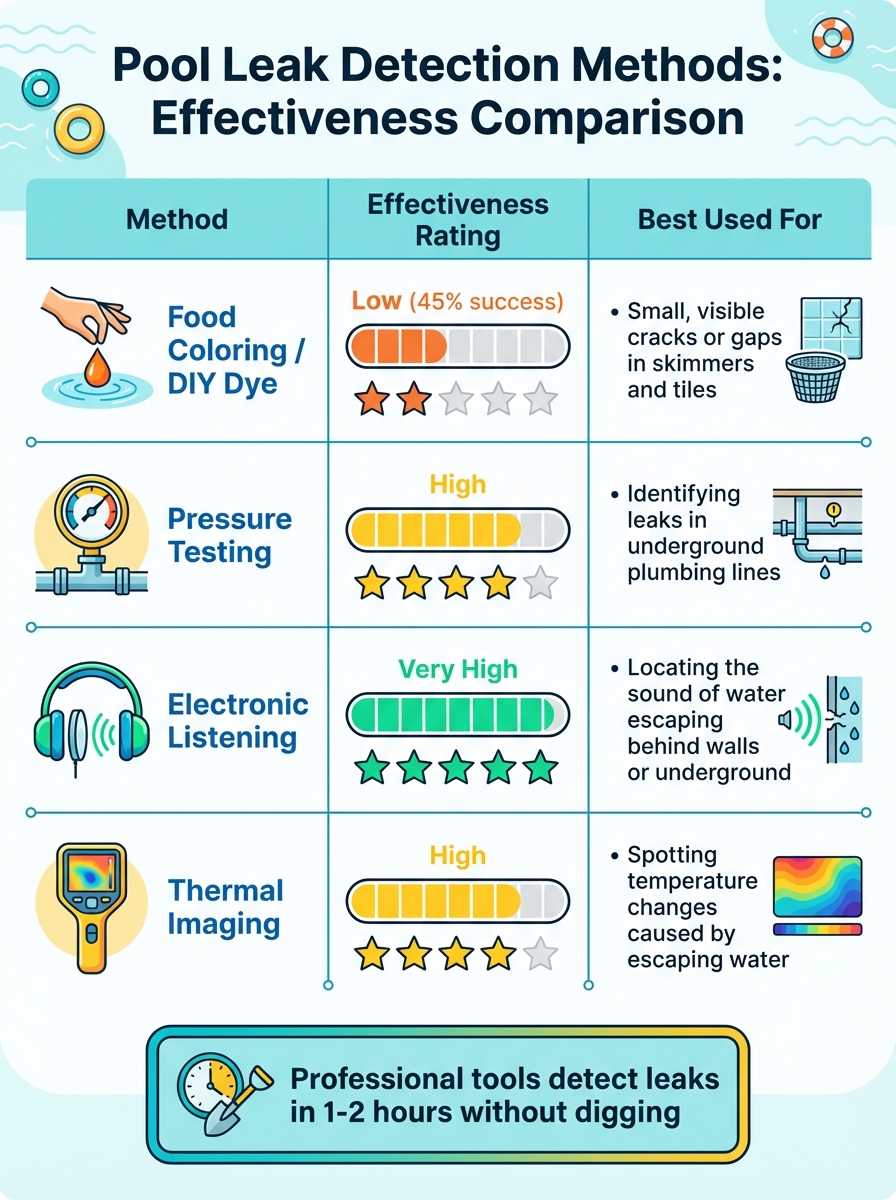
Pool Leak Detection Methods Comparison: DIY vs Professional Tools
Some Miami homeowners turn to food coloring tests when trying to locate pool leaks. The concept seems straightforward: drop some food coloring near a suspected crack or fitting, and if the dye flows toward that area, it might indicate a leak. While this method is popular, it’s far from reliable due to various environmental factors.
Why Food Coloring Tests Fall Short
Food coloring tests only work under very specific conditions, and even then, they’re not particularly accurate. For starters, your pool pump needs to be completely off, and the water must remain perfectly still – no ripples, no breeze, no movement. Even the slightest disturbance can scatter the dye, making it nearly impossible to track where it’s going.
Additionally, food coloring tests are limited to areas you can easily access, like tile cracks, skimmers, or return jets. They won’t help you find leaks in underground plumbing or behind pool walls. And let’s be honest – trying to perform this test at the bottom of the pool or in deep areas means getting uncomfortably close, which isn’t ideal for most people.
Smarter Alternatives to Food Coloring
Fortunately, there are much more effective ways to locate pool leaks. Professional leak detection methods use advanced tools that provide accurate results without the guesswork. Here are some of the best options:
| Method | Effectiveness | Best Used For |
|---|---|---|
| Food Coloring / DIY Dye | Low (about 45% success) | Small, visible cracks or gaps in skimmers and tiles |
| Pressure Testing | High | Identifying leaks in underground plumbing lines |
| Electronic Listening | Very High | Locating the sound of water escaping behind walls or underground |
| Thermal Imaging | High | Spotting temperature changes caused by escaping water |
For example, pressure testing introduces air or water under pressure into your pool’s plumbing lines. If the pressure drops, it indicates a leak. Electronic listening devices amplify the sound of water escaping, making it possible to pinpoint hidden leaks in walls or underground. Thermal imaging uses infrared cameras to detect temperature changes caused by escaping water, creating a visual map of moisture issues.
If your bucket test confirms a leak but food coloring doesn’t lead you to the source, the issue is likely in the underground plumbing. In this case, reaching out to Alligator Pools for a professional inspection is your best bet. With specialized tools and expertise, they can find leaks that DIY methods simply can’t uncover.
Myth 3: Visible Cracks Are Always Where Leaks Come From
When Miami homeowners notice water loss in their pools, the first instinct is often to hunt for visible cracks in the plaster or tiles. It seems logical – if you see a crack, it must be the culprit, right? Unfortunately, this assumption can lead to wasted effort. Most visible cracks are purely cosmetic and rarely cause significant water loss [12][11].
"Though not always indicative of a leak, cracks or gaps can be potential entry or exit points for water." – Lou Tobia, Pool Expert, Gator Leak Detection [11]
Where Most Pool Leaks Actually Happen
Surprisingly, the majority of pool leaks occur at junction points – those spots where different materials meet, like where plastic components connect to the concrete shell [12]. Common trouble areas include skimmers, return jets, and light housings. In fact, about 75% of pool leaks originate in these components rather than in the pool’s main structure.
Here’s a breakdown of where leaks typically hide:
| Leak Source | Common Issue |
|---|---|
| Skimmers | Separation between the plastic unit and concrete shell [13] |
| Light Housings | Leaking conduit or worn gaskets in the light niche [13] |
| Return Jets | Failing fittings where jets meet the pool wall [12] |
| Underground Plumbing | Cracked pipes or bad glue joints in buried PVC [13] |
| Equipment Pad | Worn pump seals, faulty valves, or filter drips [4][1] |
Underground plumbing is another frequent trouble spot. Shifting ground or deteriorating pipes can lead to leaks deep below the surface, often leaving no visible clues on the pool itself [4][12]. Similarly, the equipment pad – where your pump, filter, heater, and valves are located – is a common source of water loss that homeowners sometimes overlook while focusing on surface cracks [10][1].
"Many leaks start at pumps, filters, heaters, valves & unions." – Gator Leak Detection [10]
One helpful tip: if your pool’s water level stops dropping at a specific height, like the bottom of the skimmer or at the level of a pool light, it’s a strong indication that the leak is at that fixture – not at some random crack elsewhere [1].
Why You Need a Professional Inspection
Given that most leaks occur in hard-to-reach areas, professional inspections are crucial for accurate detection. Experts use advanced tools like pressure testing, electronic listening devices, and thermal imaging to pinpoint hidden problems that DIY methods often miss [10][14]. These techniques are especially useful for identifying leaks in underground plumbing or equipment connections that might look fine on the surface.
For underground pipes, small CCTV cameras can be threaded through the lines to visually inspect for blockages, root intrusion, or structural damage [14].
In Florida, professional leak detection services typically cost between $350 and $550, depending on the complexity of your pool [12]. This investment can save you money in the long run, as roughly 95% of pool leak issues turn out to be minor repairs when caught early [5]. Licensed technicians from companies like Alligator Pools ensure every potential source of water loss is thoroughly evaluated – not just the visible cracks that might mislead you.
sbb-itb-a36f8f1
Myth 4: DIY Methods Can Find Any Leak
Some Miami homeowners think they can locate any pool leak with simple DIY methods like a bucket test or dye test. While these techniques can confirm the presence of a leak, they fall short when it comes to pinpointing the exact location – especially when the issue lies in hard-to-reach areas like underground plumbing [10]. This is where professional expertise becomes essential.
The bucket test, for example, measures water loss but doesn’t identify whether the leak originates from your skimmer, a buried pipe, or another part of your pool system. Finding the precise source requires specialized tools that go beyond what DIY methods can achieve.
Why Underground Leaks Are So Tricky
Underground leaks are particularly challenging because they’re hidden beneath layers of soil, concrete, or your pool deck [4]. While you might notice indirect signs – like soggy patches in your yard, uneven grass growth, or air bubbles in the pump basket – these clues won’t tell you exactly where the issue is.
Dye tests also have their limits. They only work in perfectly still water and require direct visibility of the leak. If the problem lies inside a pressurized pipe or behind a structural wall, you won’t see any dye movement [4]. Trying to locate leaks by digging blindly can lead to property damage and higher repair costs. For these reasons, professional tools and techniques are often the only reliable solution.
"Specialized diagnostic equipment can listen for water escaping underground pipes, pinpointing leaks without digging up your yard."
- Gator Leak Detection [4]
Tools Professionals Use to Find Leaks
Licensed technicians rely on advanced tools that far surpass what a homeowner can do with a bucket or dye test. These tools are designed to locate leaks with precision while minimizing disruption to your property.
| Professional Tool | What It Does | Why DIY Methods Fall Short |
|---|---|---|
| Pressure Testing | Pressurizes plumbing lines to detect pressure drops [10] | Homeowners can’t safely pressurize lines or monitor changes. |
| Electronic/Acoustic Sensors | Amplifies the sound of escaping water [10] | DIY methods can’t pick up faint sounds through solid materials. |
| Thermal Imaging | Identifies temperature changes caused by moisture [10] | DIY tools can’t detect hidden moisture through surfaces. |
| CCTV/Pipe Cameras | Provides a detailed view inside plumbing [14] | Specialized cameras aren’t accessible to homeowners. |
These tools allow professionals to locate leaks with pinpoint accuracy, often without the need for invasive digging or demolition [14]. This not only saves time and money but also prevents unnecessary damage to your property.
How Miami’s Climate Makes Pool Leaks Harder to Spot
Miami’s unique weather and geological conditions can make spotting pool leaks a real challenge. Frequent rain and high evaporation rates often disguise water loss, requiring specialized methods to detect leaks effectively.
Weather Conditions That Hide Leaks
Frequent Rainfall
Tropical storms and regular heavy rains in Miami naturally refill pools, making it tough to notice if water is disappearing due to a leak[5]. This constant replenishment can mask what would otherwise be clear signs of a problem, like a drop in water level.
High Evaporation Rates
Miami’s warm climate leads to significant evaporation, especially in heated pools where rates can increase by as much as 50% compared to unheated ones[1]. When combined with a small leak, this natural water loss can make it even harder to pinpoint the issue without proper testing.
High Groundwater Levels and Hydrostatic Pressure
South Florida has one of the highest water tables in the country[15]. This, along with the region’s porous limestone bedrock, prevents water from pooling visibly when it escapes. On top of that, daily temperature changes and shifting soil can create subtle structural stresses that hide leaks[5]. Rain-soaked ground further complicates matters, making it nearly impossible to spot damp patches that might otherwise indicate a problem.
"Our region’s geology and climate make underground leaks more dangerous than in other areas, as South Florida sits on porous limestone bedrock with one of the highest water tables in the U.S."
Why You Need Local Experts
These tricky weather conditions make it hard for standard DIY methods to work effectively. For example, the bucket test, which compares water loss in a pool to a control sample, needs 24 to 48 hours without rain for accurate results – a rare occurrence during Miami’s rainy season. Similarly, visual checks often fail to detect underground leaks because porous limestone can hide the evidence.
Local professionals, familiar with Miami’s unique challenges, bring the right tools and expertise to the table. They use advanced techniques like pressure testing, electronic sensors, and thermal imaging to locate leaks, even when evaporation or groundwater pressure complicates the process. These experts understand how leaks in porous limestone can travel far from their source, making their insights invaluable[5].
Catching leaks early is key. About 95% of suspected pool leaks turn out to be minor, inexpensive fixes when addressed promptly[5]. However, if ignored, even small leaks can lead to severe damage. Water can erode the limestone bedrock beneath, potentially creating underground voids or even sinkholes[15][5]. This makes professional leak detection not just a convenience but a necessity in South Florida.
How Alligator Pools Detects and Fixes Pool Leaks

Miami’s climate can make pool leak detection tricky, but that’s where professional expertise steps in. Since 1985, Alligator Pools has been helping Miami-Dade County residents tackle leaks that DIY methods often overlook. With advanced tools and a team of licensed professionals, they identify and fix leaks efficiently.
Our Licensed Leak Detection Process
We rely on a meticulous process that combines electronic leak detection and pressure testing to pinpoint problems in underground plumbing and pool structures. Every critical component is inspected – skimmers, plumbing, equipment pads, and structural areas. For hard-to-detect leaks, we use targeted dye tests around fixtures.
When repairs are necessary, we handle everything from fixing pipe breaks and plumbing adjustments to repairing light housings and structural cracks. For more severe damage, we offer complete liner replacements or resurfacing. Using top-tier equipment, Alligator Pools guarantees reliable repairs and provides service guarantees for peace of mind. To prevent future issues, we recommend annual inspections to catch problems early, saving you from expensive repairs down the line.
Preventing Leaks with Regular Maintenance
Taking care of your pool regularly is key to avoiding costly leaks. Alligator Pools offers preventive services like water chemistry management, which helps minimize corrosion and prevents wear on pool surfaces and equipment – a common cause of leaks. Routine equipment checks ensure pumps, filters, and gaskets stay in good shape, maintaining watertight seals.
We also tackle small problems before they escalate, replacing worn gaskets and sealing hairline cracks to prevent major structural damage. To keep your pool running smoothly, we recommend maintaining the water level at the midpoint of the skimmer for proper circulation and filtration. Schedule your annual inspection with Alligator Pools to keep your pool in optimal condition year-round.
Conclusion: Stop Believing Myths and Protect Your Pool
What Miami Homeowners Need to Know
Falling for pool leak myths can cost you more than you think – higher water bills, wasted chemicals, and even structural damage. Underground leaks, in particular, can erode soil, weaken your pool deck, and harm nearby structures. Plus, leaks force your pump and filtration system to work overtime, which shortens their lifespan and can lead to costly repairs.
While the bucket test is a helpful way to confirm you have a leak, it won’t tell you where the problem is. If your pool is losing more than 3.5 inches of water per week[1], it’s time to call in the pros. DIY fixes like food coloring tests or visual checks often miss hidden issues, like underground plumbing leaks or structural cracks. Professional tools, such as ultrasonic sensors and thermal imaging, can locate leaks in just 1-2 hours[3] – no digging required.
Routine maintenance is key to avoiding these headaches. Annual inspections can catch early signs of trouble, like worn gaskets, tiny cracks, or slight pressure changes, before they escalate. Maintaining balanced water chemistry also protects your pool’s surfaces and equipment from corrosion, which can eventually lead to leaks. Simple fixes like replacing gaskets on time can save you from much bigger, more expensive problems down the road.
Trust Alligator Pools for Expert Help
Don’t let small issues turn into major expenses. Alligator Pools is here for homeowners across Miami-Dade County, offering expert leak detection and repair services tailored to South Florida’s challenging climate. Our licensed technicians use state-of-the-art equipment to find leaks that DIY methods often miss, handling everything from minor repairs to pool resurfacing options. Schedule your annual inspection today and keep your pool in top shape while avoiding costly surprises.
FAQs
How can I tell if my pool is leaking or it’s just evaporation?
A straightforward way to check for a pool leak is by performing a bucket test. Here’s how it works: Place a 5-gallon bucket on one of your pool steps and fill it with water until the level inside matches the pool’s water level. Use a marker or tape to note the water lines on both the inside and outside of the bucket. Then, turn off your pool pump and any auto-fill systems, and let it sit for 24 hours. After that, compare the water levels. If the pool’s water level has dropped more than the water inside the bucket, there’s a good chance you have a leak.
Keep in mind that in South Florida, normal evaporation ranges between 1/4 to 1/2 inch per day. If you notice water loss beyond this, it’s worth investigating further. And if you’re still uncertain or see a significant drop, reaching out to a professional can save you from expensive repairs down the line.
Is using food coloring an effective way to detect pool leaks?
Using food coloring to find pool leaks might sound like a quick fix, but it has some big drawbacks. The main issue is that food coloring gets diluted in water – especially in larger pools – making it hard to spot where the leak is coming from. Plus, this method only works if you already have a pretty good idea of the leak’s location, since the dye has to be placed very close to the suspected spot to be effective.
For a more reliable solution, professional tools like electronic leak detectors are a much better option. These devices are designed to pinpoint leaks with precision, saving you time, water, and potentially expensive repairs. If you think your pool has a leak, reaching out to a pool professional is the smartest move. They use advanced techniques tailored to your pool’s specific needs to quickly identify and address the problem.
Why is hiring a professional better for detecting pool leaks than trying DIY methods?
When it comes to finding leaks, professional detection stands out because it relies on specialized tools like electronic leak detectors. These devices are capable of pinpointing leaks with precision, even the tiny ones that simple DIY methods – like the bucket test or food coloring trick – often fail to catch.
On top of that, professionals bring the know-how to evaluate how serious the leak is and suggest the most effective fix. This can save you not just water, but also time and money by avoiding major repairs down the line. While DIY methods might seem like a budget-friendly option at first, they can easily result in misdiagnosed issues and higher costs later on.