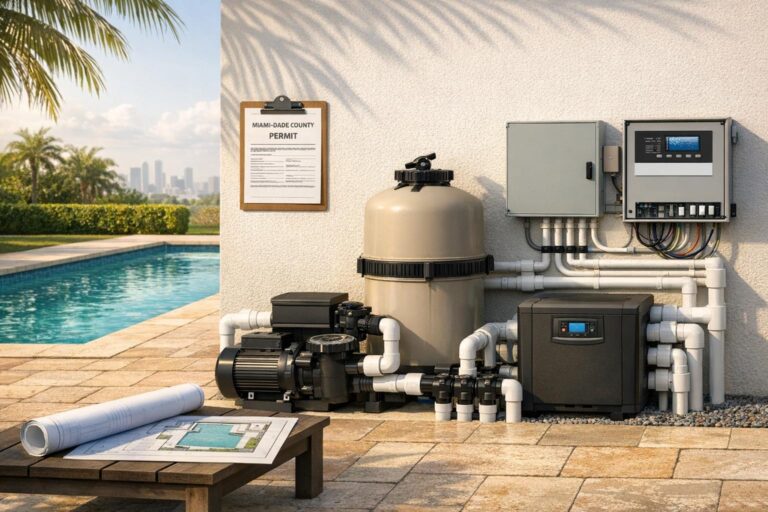

Pool automation can save you up to 75% on energy costs, but common mistakes often erase these benefits. Improper pump programming, unscheduled automated features, neglected sensors, and inefficient plumbing or filters are the main culprits. Fixing these issues ensures lower energy bills and better system performance.
Here’s what you need to know:
- Variable-speed pumps: Running at unnecessarily high speeds or for too long wastes energy. Use the lowest effective speed and shorter cycles to save money.
- Automation scheduling: Running lights, heaters, and water features without a plan adds unnecessary costs. Align schedules with pool usage and off-peak electricity rates.
- Sensor maintenance: Dirty or miscalibrated sensors lead to faulty readings, causing heaters or pumps to overwork. Regular cleaning and calibration prevent this.
- Plumbing and filters: Clogged filters and poor plumbing design force pumps to work harder. Clean filters regularly and upgrade to larger pipes or filters if needed.
Professional inspections and regular maintenance are key to keeping your system efficient. Addressing these issues can significantly cut energy use while extending the life of your pool equipment.
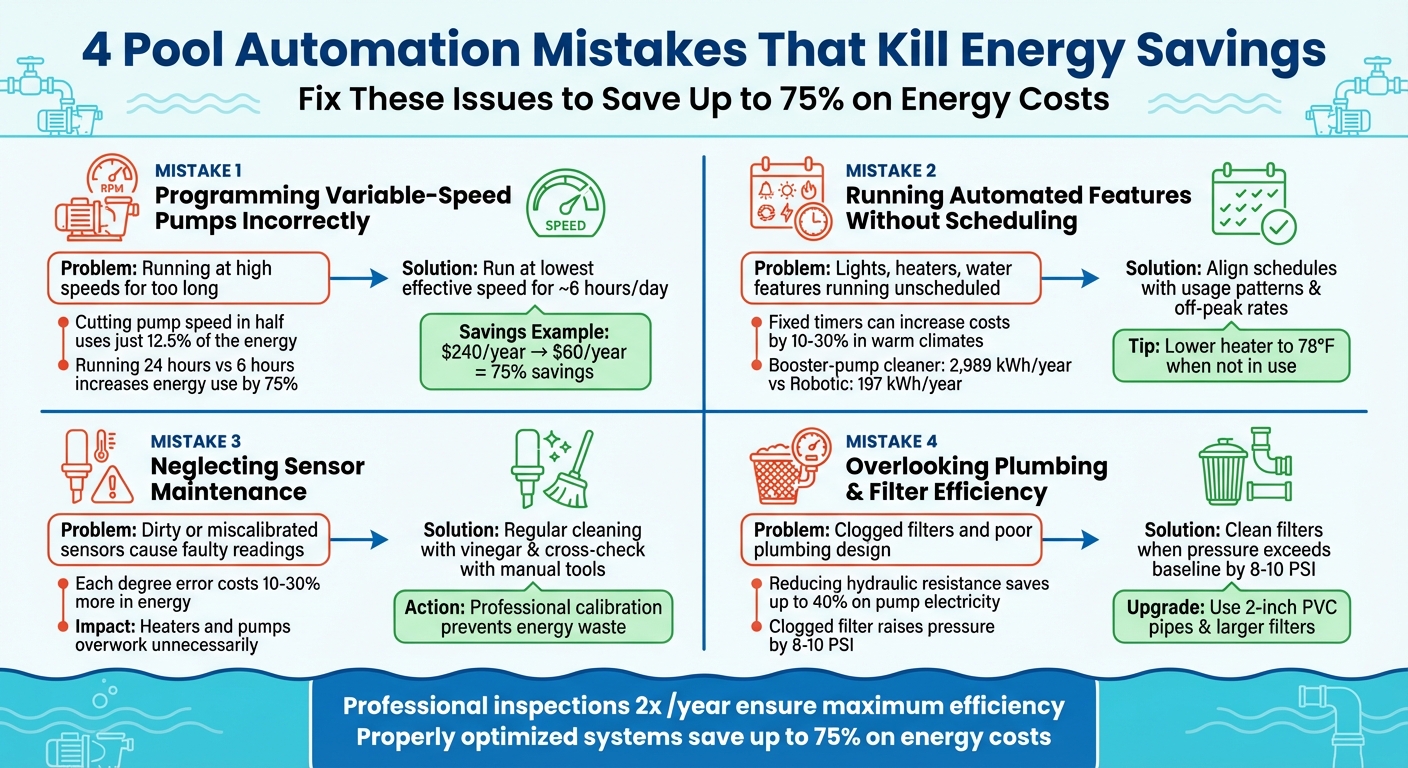
4 Pool Automation Mistakes That Waste Energy and How to Fix Them
Save Over $1000 by Optimizing Variable Speed Pumps: SUPER SCHEDULE @ 8:30 MARK! Slash All Costs!
Mistake 1: Programming Variable-Speed Pumps Incorrectly
single vs. variable-speed pool pumps can be a game changer for reducing energy costs – when they’re programmed the right way. But many homeowners unknowingly run their pumps at unnecessarily high speeds for too long, which defeats the purpose of having a variable-speed system. Let’s break down how incorrect settings waste energy and how to program your pump efficiently.
How Incorrect Pump Settings Waste Energy
Here’s the thing: cutting a pump’s speed in half uses just 12.5% of the energy it would at full speed[4]. This is thanks to the Affinity Law, which highlights the cubic relationship between pump speed and energy use. Running your pump at full throttle when a lower flow rate is enough for basic filtration is like leaving all the lights on in your house during the day – it’s wasteful.
Default heavy-duty settings can drain energy during everyday circulation. For example, running the pump for 24 hours instead of 6 can increase energy use by 75%[4]. On top of that, high speeds create extra hydraulic resistance, which strains your filters and plumbing. Over time, this can lead to leaks or even premature equipment breakdowns.
Tips to Optimize Your Pump’s Energy Use
To save energy, program your pump to operate at the lowest speed that still maintains effective filtration. Typically, this means running it for about 6 hours a day. Homeowners who made this adjustment – reducing runtime by 60% and lowering pump speeds – cut their yearly energy costs from $240 to just $60, a savings of 75%[1]. Start with a 6-hour schedule, and if the water stays clear, try reducing it in 30-minute increments.
Use specific speeds for specific tasks. High speeds should be reserved for things like cleaning, heating, or running water features. For routine filtration, stick to the lowest speed that gets the job done. If you’re on a time-of-use electricity plan, such as Florida Power & Light’s, schedule high-speed tasks during off-peak hours (like overnight or early morning) to take advantage of cheaper rates[7].
Another tip? Break up your pump’s runtime into shorter cycles throughout the day. Instead of running it for one long stretch, try three 2-hour cycles spread across morning, afternoon, and evening. This keeps skimmers active and prevents debris from settling. Also, make sure intake grates and baskets are clean to ensure smooth and efficient water flow[1].
Mistake 2: Running Automated Features Without Proper Scheduling
Pool automation can make life easier – when used wisely. But many pool owners let automation run unchecked, turning on lights, heaters, and water features without a plan. The result? Higher energy bills and wasted resources. Smart scheduling is key to getting the most out of your pool’s automated features.
The Hidden Costs of Overusing Automation
Leaving automated LED lights on all night, even when the pool isn’t in use, can rack up unnecessary energy costs. Similarly, fixed timers for fountains, waterfalls, and heaters – especially when set to higher-than-needed temperatures – can increase energy expenses by 10% to 30% in warm climates like Miami’s[2].
Unused spa jets add to the problem by mixing air with water, which forces heaters to work overtime[4]. And automatic cleaners that run excessively can be a major energy drain. For instance, a booster-pump cleaner might use as much as 2,989 kWh per year, compared to just 197 kWh for a robotic model[4].
Smart Scheduling for Your Pool’s Automation
To cut down on energy waste, align your pool’s automation with your actual usage patterns. If you only swim in the evenings or on weekends, adjust the heater to a lower temperature – around 78°F – when the pool isn’t in use. According to the U.S. Department of Energy[2], lowering the temperature during downtime is more cost-effective than reheating later.
If your electricity provider, such as Florida Power & Light, offers Time-of-Use plans, take advantage of off-peak rates by scheduling your pump and heater to operate overnight or early in the morning. For those with solar panels, sync your pump’s high-speed cycles with peak solar production hours, typically between 10:00 AM and 2:00 PM, to make the most of your solar energy[7].
Don’t forget to adjust your automation settings with the seasons. For example, during Miami’s hot summer months, turn off the heater entirely and set specific on/off times for lights and water features to avoid unnecessary energy use.
Mistake 3: Neglecting Sensor Maintenance and Calibration
While programming your pump and scheduling operations correctly is important, keeping your sensors in good shape is just as critical for saving energy. Pool automation systems rely on sensors – like temperature, flow, and chemical sensors – to ensure everything runs smoothly. When these sensors get dirty or lose calibration, they start giving inaccurate readings, which can lead to wasted energy. Faulty data from just one sensor can result in significant energy inefficiencies.
How Sensor Issues Can Drive Up Energy Costs
Take temperature sensors, for example. If your sensor incorrectly reports the water temperature as 78°F when it’s actually 80°F, your heater will keep running unnecessarily. According to the U.S. Department of Energy, "The energy consumption for each degree rise in temperature will cost 10%–30% more in energy costs, depending on your location" [2]. In a warm place like Miami, this small error could add up to hundreds of dollars over a single pool season.
Chemical sensors can also cause problems. When salt chlorine generators or chemical dosing pumps receive inaccurate data, they tend to over-correct. This results in longer cycles than needed, wasting electricity in the process [8]. Similarly, flow sensors clogged with debris might misinterpret the situation as a restriction in the system. In response, the pump compensates by running at higher speeds, burning more energy – all because of a dirty sensor probe.
These issues often go unnoticed because, on the surface, everything looks fine. Meanwhile, your equipment is silently working overtime.
How to Keep Sensors Accurate
The good news? Regular maintenance can prevent these issues. Start by cross-checking your automation system’s readings with manual tools. For example, compare your temperature sensor’s data with a standard pool thermometer. Similarly, use chemical test strips or a liquid test kit to verify the readings from your automation app. Even small discrepancies mean it’s time to recalibrate.
Cleaning your sensors is another crucial step. Calcium scaling and organic buildup can create a barrier on sensor probes, slowing their response time. This delay can cause your heater or chemical systems to run longer than they should. To clean your sensors, use a soft cloth and white vinegar, following the manufacturer’s instructions.
Modern automation systems often include real-time alerts that notify you about water quality changes or equipment issues. Pay attention to these smartphone alerts – they’re often the first sign of sensor drift [8].
For more advanced calibration or troubleshooting, consider hiring a professional. Expert services can ensure your sensors are properly calibrated and communicating effectively with your automation system. Alligator Pools offers maintenance packages that include sensor calibration, probe cleaning, and diagnostics to keep your automation system running efficiently. Regular professional inspections can catch sensor problems early, preventing energy waste and keeping your utility bills in check.
sbb-itb-a36f8f1
Mistake 4: Overlooking Plumbing and Filter Efficiency
While programming and sensor maintenance are essential for energy savings, the role of plumbing and filters can’t be ignored. Even the most finely tuned systems can waste energy if the plumbing is poorly designed or the filters are dirty. Inefficient plumbing setups and clogged filters create hydraulic resistance, forcing the pump to work harder than necessary. This extra effort can cancel out any energy savings your automation system might provide.
How Plumbing and Filters Impact Energy Use
The design of your plumbing system plays a major role in energy efficiency. Narrow pipes, long runs, and sharp 90-degree bends all increase hydraulic resistance, also known as Total Dynamic Head (TDH). According to the U.S. Department of Energy:
By decreasing the pool circulation system’s hydraulic resistance, you can reduce the pump’s electricity use by up to 40% [1].
Similarly, the condition of your filters significantly affects system performance. A clogged filter can raise pressure by 8–10 PSI above its clean baseline, forcing the pump to use more energy to maintain water flow [1][9]. Even with energy-efficient settings, such as reducing pump speed by 30%, poor plumbing or dirty filters can undo these savings by requiring higher speeds to compensate [10].
To combat these issues, regular maintenance and smart upgrades are key.
Improving Plumbing and Filters for Better Efficiency
Start by keeping an eye on your filter’s pressure gauge. If the pressure exceeds the clean baseline by 8–10 PSI (typically 5–15 PSI), it’s time to clean or backwash the filter [9][11]. If the gauge needle doesn’t return to zero when the pump is off, replace it immediately – accurate readings are essential for maintaining efficiency.
To minimize friction in the plumbing system, replace 90-degree elbows with 45-degree fittings or flexible piping [1]. For a more comprehensive upgrade, consider upsizing your pipes to 2-inch PVC and installing a larger filter. A filter rated at least 50% higher than your pool’s design flow rate can trap more debris before needing cleaning, reducing resistance and allowing the pump to run at lower, more efficient speeds [1][6].
Weekly maintenance is also crucial. Empty skimmer and pump strainer baskets regularly – especially during heavy use periods – to prevent blockages that can overwork the pump [1][10]. ENERGY STAR highlights the broader benefits of maintaining clean and properly sized components:
The slower circulation rates also put less strain on the filters, plumbing, and other parts of the system, reducing the chance of leaks, repairs, or premature plumbing component replacement [4].
How to Get the Most Energy Savings from Pool Automation
Fixing common mistakes is just the start. To truly maximize energy savings with your pool automation system, you need smart programming, consistent maintenance, and expert oversight. The difference between a system that saves you money and one that drains your wallet often boils down to proper setup and ongoing care.
Professional Inspections and Equipment Servicing
Beyond addressing programming or maintenance errors, regular professional inspections are key to keeping energy use in check. Even a well-designed system needs consistent upkeep to stay efficient. Experts recommend scheduling inspections twice a year – once in the spring and again in the fall – to identify and fix potential issues early on[3]. These inspections go beyond surface-level cleaning, focusing on tasks like sensor calibration and ensuring your variable-speed pump operates at the correct flow rates for each function.
When you install a variable-speed pump, it’s crucial to calibrate it right away. A trained technician can confirm that your pump is running at the lowest effective speed, cutting down on unnecessary energy use[5]. They’ll also check for phantom energy draws and verify that your system complies with Florida Building Code requirements[3][5].
Routine servicing doesn’t just enhance efficiency – it also prevents minor problems from escalating into costly repairs. Professional care ensures that every component of your system operates at its best.
Alligator Pools‘ Energy-Saving Services

Alligator Pools provides the expertise needed to make your pool automation system as energy-efficient as possible. Our licensed technicians specialize in optimizing systems for Miami-Dade County homeowners, offering services like precise pump programming, sensor calibration, and full system maintenance. We’ll configure your variable-speed pump to run at the ideal speeds for different tasks, create schedules tailored to your pool usage and utility rates, and ensure all components work seamlessly together.
Our approach includes verifying flow rates, adjusting equipment size if necessary, and programming multiple shorter filtration cycles throughout the day instead of one long session. This method not only saves energy but also improves system performance. Plus, we stand by our work with a 3-year workmanship guarantee, giving you peace of mind that your system will remain efficient and reliable for years to come.
As Miami-Dade continues to experience rising temperatures – the average number of days above 90°F has jumped from 84 to 133 annually since 1970 – an efficient pool system is more than just a way to save money. It’s an essential tool for managing the increasing strain on your electric bill[3].
Conclusion
Pool automation can significantly reduce energy bills – but only if it’s programmed and maintained properly. In places like Miami-Dade County, where pools run year-round and require constant upkeep, even small errors can lead to higher utility costs instead of savings.
The good news? These problems are entirely fixable. By optimizing pump schedules, carefully calibrating sensors, maintaining plumbing and filters, and setting up systems wisely, you can ensure your pool operates efficiently.
Regular expert inspections can also make a big difference. A skilled technician can adjust flow rates, confirm sensor accuracy, and fine-tune your system for peak performance. In fact, with properly optimized pump settings, homeowners can save up to 75% on energy costs[1].
At Alligator Pools, we specialize in helping Miami-Dade homeowners maximize the benefits of their pool automation systems. Our licensed technicians have deep experience with the unique challenges of year-round pool use in South Florida. We’ll ensure your system is programmed correctly, operates efficiently, and is fully maintained – all backed by our 3-year workmanship guarantee.
Don’t let avoidable mistakes drive up your energy costs. Reach out to Alligator Pools for a professional inspection and start saving today.
FAQs
What’s the best way to set up my variable-speed pool pump to save energy?
To get the most out of your variable-speed pump and save energy, aim to run it at the lowest speed that still ensures proper water circulation. For most pools, this sweet spot is usually between 1,200 and 1,800 RPM, which requires far less energy compared to higher speeds. Reserve higher speeds (around 2,200–2,800 RPM) for specific tasks like cleaning, heating, or running water features, and try to limit these to just 2–4 hours a day.
For an effective schedule, focus on low-speed operation for the majority of the time. For instance, you could run the pump overnight or during off-peak hours at a low speed, use a mid-speed setting for water turnover, and save high-speed operation for short, essential tasks. Adjust the schedule as needed throughout the year, especially if you’re using features like heaters or waterfalls more frequently. By keeping the pump running at the lowest effective speed most of the time, you can maintain crystal-clear water while cutting energy costs – potentially saving $150 to $300 annually.
How can I schedule my pool’s automated features to save on energy costs?
To keep energy costs down, it’s all about smart scheduling for your pool’s automated features. Run the pump only when it’s needed – about 6 to 8 hours a day is usually enough. Avoid running it continuously, and if you can, schedule it during off-peak electricity hours, like early mornings or late evenings, when rates are typically lower.
For a bigger impact on savings, switch to a variable-speed pump. Set it to low speed for everyday filtration and save the higher speeds for tasks like cleaning or operating water features. When it comes to heating, aim to keep the pool temperature around 78°F. Each degree above that can really drive up heating costs. To further cut down on energy use, think about getting an automated pool cover. It helps minimize heat loss and evaporation when the pool isn’t being used.
By tweaking these settings and reviewing them seasonally to align with Miami-Dade’s climate, you can fine-tune your pool automation system and keep those energy bills manageable.
How often should I maintain my pool’s sensors and filters to keep it running efficiently?
To keep your pool’s automation system running smoothly and energy-efficiently, sticking to a regular maintenance routine is essential. Here’s a straightforward guide to help you stay on track:
- Daily: Look for error codes on sensors, skim debris off the water surface, and check that the water level is where it should be. Fix any issues right away to prevent energy waste.
- Weekly: Empty the skimmer and pump baskets, inspect the impeller for blockages, and test the water’s chemical balance. Make sure sensors, like those for temperature and flow rate, are functioning correctly.
- Monthly: Clean or backwash the pool filter and check it for any leaks or clogs. A clean filter ensures sensors can do their job without interference.
- Seasonally: Before summer or hurricane season, secure sensor wiring, adjust automation timers to match your needs, and use waterproof covers to protect the sensors.
- Annually: Schedule a professional inspection to calibrate sensors, check wiring, and evaluate the overall performance of your system.
By following this schedule, you’ll keep your pool automation system in excellent shape, save energy, and enjoy a stress-free swimming season.